




Coaster trains operate on a 42-mile route between the Oceanside Transit Center and the Santa Fe depot in downtown San Diego, serving 8 stations. The tracks, once part of Santa Fe’s Surf Line, have long hosted intercity passenger trains between San Diego and Los Angeles. Today, Amtrak runs Pacific Surfliners on the route, linking San […]
Tag: Encyclopedia
Metrolink
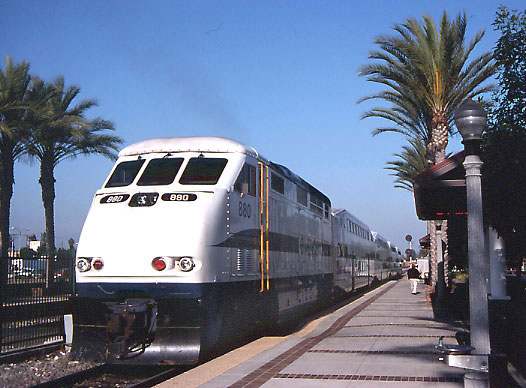
Metrolink F59PHI 880 pauses with Orange County Line train 688 at the Fullerton, Calif., station at 5:39 p.m., on August 7, 1998. The Los Angeles commuter rail system has grown dramatically since its 1992 startup. George Fletcher Metrolink, the working name of the Southern California Regional Rail Authority, operates commuter service in the Los Angeles […]
Steam locomotive profile: 2-8-4 Berkshire
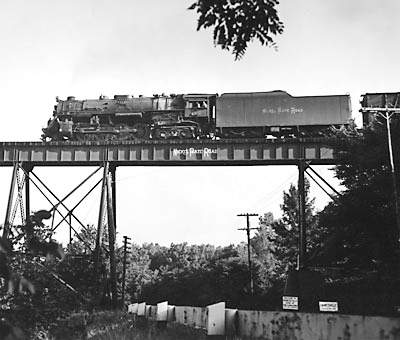
One of Nickel Plate’s handsome Berkshires leads a westward freight across the Grand River bridge in Painesville, Ohio. No. 802 was originally built for the Wheeling & Lake Erie in 1937, then went to work for the Nickel Plate Road in 1949 when the NKP leased the W&LE. John A. Rehor During the 1920s, America’s […]
Steam locomotive profile: 2-10-0 Decapod
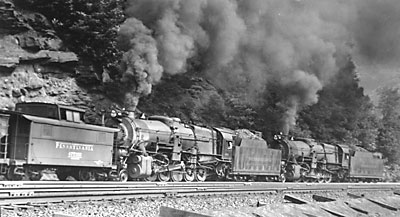
Two Pennsylvania Railroad Decapods shove a heavy freight around Horseshoe Curve in the Allegheny Mountains. H. W. Pontin, Railroad Photographic Club The first 2-10-0s were built for the Lehigh Valley in 1867. They were not, however, a success. Their long rigid wheelbase was too much for the track, and the two locomotives were later rebuilt […]
Steam locomotive profile: 2-10-2 Santa Fe
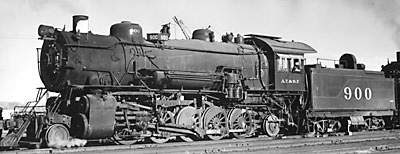
Santa Fe No. 900 was part of the railroad’s first class of 2-10-2s, delivered by Baldwin between 1903 and 1904. Photographed at Raton, N.M., on May 3, 1950. C. C. Trinbham Differences of decades: The design of the final class of 2-10-2s built for the Santa Fe could be traced to the 2-8-2, rather than […]
Steam locomotive profile: 2-10-4 Texas
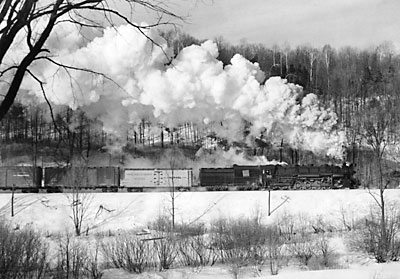
Central Vermont 2-10-4 No. 703 puts on quite a show rolling through Sudbury, Vt., with a northward freight in 1955. Paul A. Reynolds In 1925, just four months after demonstrating its new 2-8-4 on the Boston & Albany, Lima received an order from the Texas & Pacific for the first 2-10-4s. The ten engines ordered […]
Steam locomotive profile: 4-4-0 American
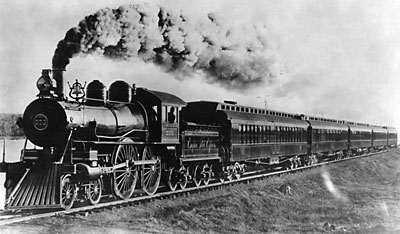
New York Central 4-4-0 No. 999 earned a place in history when it reached a speed of 112.5 mph while pulling the four-car Empire State Express between Batavia and Buffalo, N.Y., on May 10, 1893. This publicity shot, made after her world-famous run, clearly shows the locomotive’s uncommonly large 86-inch driving wheels. New York Central […]
Steam locomotive profile: 4-6-0 Ten-Wheeler
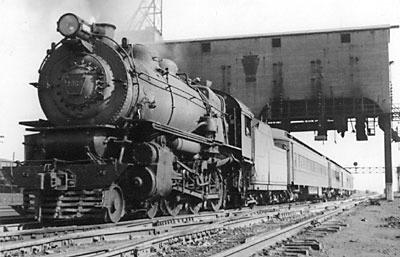
The Pennsylvania Railroad built 90 G5s class 4-6-0s between 1923 and 1925. Ten-Wheeler No. 1963 was photographed pulling away from the coaling dock at Fort Wayne, Ind., with a westbound passenger train in October 1947. J. R. Crosby The first Ten-Wheelers appeared in the late 1840s. They grew out of the need for a locomotive […]
Steam locomotive profile: 4-4-2 Atlantic
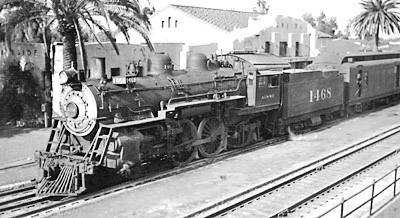
Santa Fe owned the largest fleet of Atlantics, and kept a handful in service until 1953. No. 1468, a 1909 Baldwin, was pinch-hitting for an ailing gas-electric car when it pulled up to the depot at Riverside, Calif., with a westbound train on January 14, 1941. Jack Whitmeyer In the 1890s there was a general […]
Steam locomotive profile: 4-6-2 Pacific
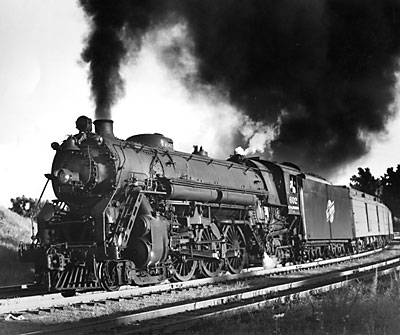
C&NW subsidiary Chicago, St. Paul, Minneapolis & Omaha owned the world’s heaviest and most powerful Pacifics. No. 602 – one of the road’s three giant 4-6-2s, built by Alco in 1930 – blasts through St. Paul, Minn., with train 514 on July 5, 1953. W. H. N. Rossiter The 4-6-2, or Pacific type, grew out […]
Steam locomotive profile: 4-6-4 Hudson
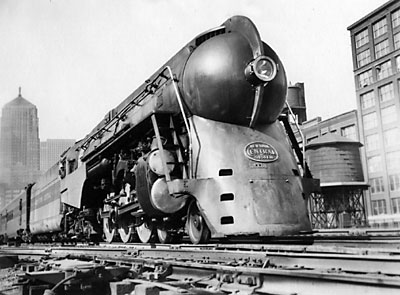
Henry Dreyfus created the timeless design worn by the streamlined 4-6-4s that pulled the Twentieth Century Limited. New York Central rostered North America’s largest fleet of Hudsons. In this photo, one of the speedsters prepares to depart LaSalle St. Station in Chicago. W.C. Merle, II In the early 1920s, as passenger train lengths grew and […]
Steam locomotive profile: 4-8-2 Mountain
BY Neil Carlson The development of the 4-8-2 grew out of the need for a locomotive with greater power than the Pacific to handle heavy passenger trains in mountainous terrain. The first 4-8-2 in North America was built at Alco’s Richmond plant and delivered to the Chesapeake & Ohio in 1911. Chessie wanted an engine […]
