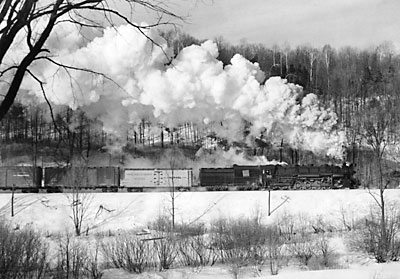
Central Vermont 2-10-4 No. 703 puts on quite a show rolling through Sudbury, Vt., with a northward freight in 1955. Paul A. Reynolds In 1925, just four months after demonstrating its new 2-8-4 on the Boston & Albany, Lima received an order from the Texas & Pacific for the first 2-10-4s. The ten engines ordered […]
Read More…
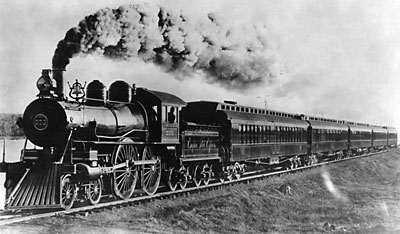
New York Central 4-4-0 No. 999 earned a place in history when it reached a speed of 112.5 mph while pulling the four-car Empire State Express between Batavia and Buffalo, N.Y., on May 10, 1893. This publicity shot, made after her world-famous run, clearly shows the locomotive’s uncommonly large 86-inch driving wheels. New York Central […]
Read More…
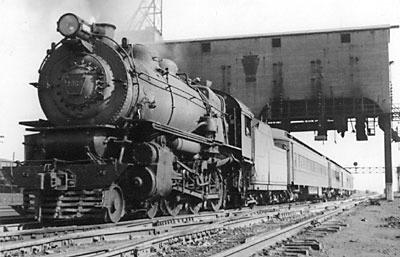
The Pennsylvania Railroad built 90 G5s class 4-6-0s between 1923 and 1925. Ten-Wheeler No. 1963 was photographed pulling away from the coaling dock at Fort Wayne, Ind., with a westbound passenger train in October 1947. J. R. Crosby The first Ten-Wheelers appeared in the late 1840s. They grew out of the need for a locomotive […]
Read More…
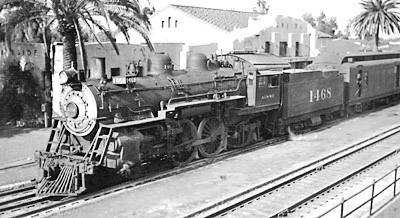
Santa Fe owned the largest fleet of Atlantics, and kept a handful in service until 1953. No. 1468, a 1909 Baldwin, was pinch-hitting for an ailing gas-electric car when it pulled up to the depot at Riverside, Calif., with a westbound train on January 14, 1941. Jack Whitmeyer In the 1890s there was a general […]
Read More…
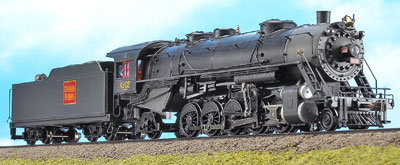
Bachmann’s HO USRA light 2-10-2 This powerful HO 2-10-2 may be called a “light” 2-10-2, but it’s still a big steam locomotive by most model railroad standards. For its size, this new Bachmann locomotive is surprisingly flexible and capable of negotiating 18″-radius curves. A factory installed automatic dual-mode decoder allows it to operate on either […]
Read More…
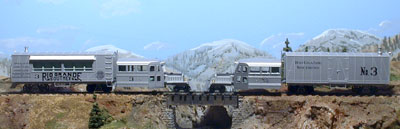
Precision Craft’s On3 and On2 1/2 narrow gauge Galloping Goose Ready-to-waddle narrow gauge plastic models of homemade motor cars are available with dual-mode Digital Command Control (DCC) sound decoders that will also operate on DC. These converted vehicles are offered in both freight and tourist versions, and in either On3 (scale 36″ gauge) or On2½ […]
Read More…
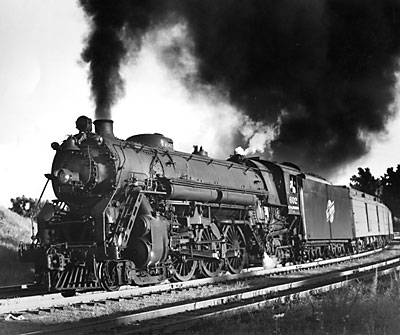
C&NW subsidiary Chicago, St. Paul, Minneapolis & Omaha owned the world’s heaviest and most powerful Pacifics. No. 602 – one of the road’s three giant 4-6-2s, built by Alco in 1930 – blasts through St. Paul, Minn., with train 514 on July 5, 1953. W. H. N. Rossiter The 4-6-2, or Pacific type, grew out […]
Read More…
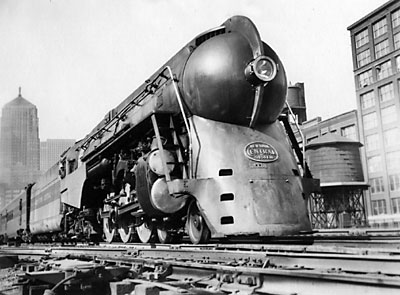
Henry Dreyfus created the timeless design worn by the streamlined 4-6-4s that pulled the Twentieth Century Limited. New York Central rostered North America’s largest fleet of Hudsons. In this photo, one of the speedsters prepares to depart LaSalle St. Station in Chicago. W.C. Merle, II In the early 1920s, as passenger train lengths grew and […]
Read More…
BY Neil Carlson The development of the 4-8-2 grew out of the need for a locomotive with greater power than the Pacific to handle heavy passenger trains in mountainous terrain. The first 4-8-2 in North America was built at Alco’s Richmond plant and delivered to the Chesapeake & Ohio in 1911. Chessie wanted an engine […]
Read More…
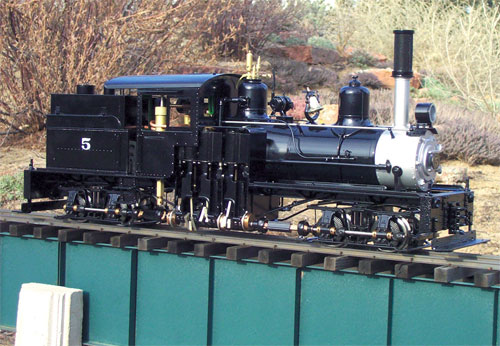
Marc Horovitz Gauge 1, 1:20.3 scale, live-steam ShayAccucraft Trains31112 San Clemente St.Hayward CA 94544Price: $1,799Web site: www.accucraft.com All-metal model based on a Michigan-California Lumber Company Shay; three cylinders; butane-fired boiler; hinged cab roof; displacement lubricator; boiler fittings include safety valve, pressure gauge, water glass, check valve, filler plug; blow-off pressure, 50 psi; hand pump in […]
Read More…
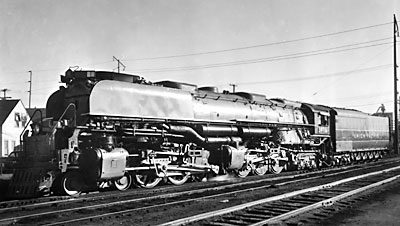
Better than most railroads, perhaps, the Union Pacific understood fast freight service. With an expansive network of lines spread across the western states, the railroad had to maintain fast schedules in order to remain competitive. Mindful of this, UP purchased the first heavy fast freight locomotives: unique three-cylinder 4-12-2s, built by Alco from 1926 to […]
Read More…
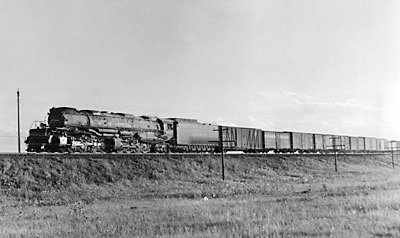
The proving ground for Union Pacific’s locomotives was a 75-mile portion of its busy main line between Ogden, Utah, and Evanston, Wyo. Eastward trains faced a climb through the Wasatch Mountains on grades of 1 percent or better. It was an expensive line to operate, particularly given UP’s practice of running big trains that typically […]
Read More…