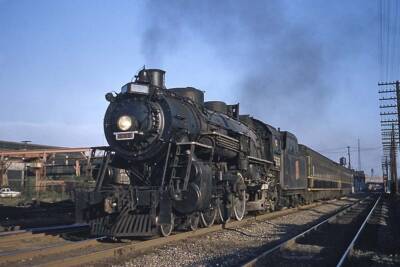

Burlington Route 4-8-4 No. 5621 on a westbound freight clatters across the Illinois Central diamonds at Mendota, Ill., as it slows for a coal and water stop in September 1954. Philip R. Hastings photo […]
CB&Q Northern at Mendota
Action may be required on your Trains.com account in order to continue accessing content. Click here to learn more.
Burlington Route 4-8-4 No. 5621 on a westbound freight clatters across the Illinois Central diamonds at Mendota, Ill., as it slows for a coal and water stop in September 1954. Philip R. Hastings photo […]
LAKE BUENA VISTA, Fla. — Two of Disney World’s steam locomotives have reached the century mark. No. 3, Roger E. Broggie, and No. 1, Walter E. Disney, both 4-6-0s, were both built by Baldwin Locomotive Works in 1925. Both have been part of the Disney World roster in Florida since the park opened in 1971. […]
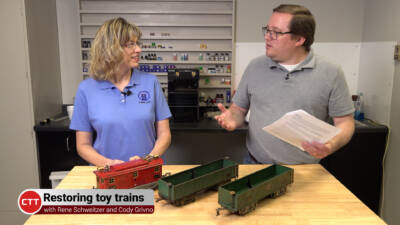
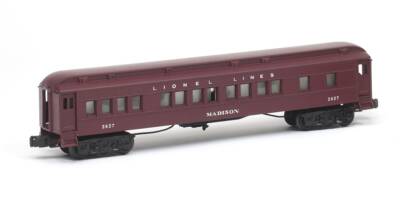
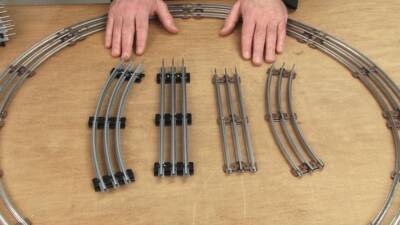
What do I collect? I collect original prewar trains in Standard and Wide Gauge, i.e. 2 1/8”. Lionel created the gauge in 1906, and called their trains the “Standard of the World.” Soon, Standard gauge caught on as a label, possibly to differentiate from other gauges at the time. When the Ives Toy Co. modified […]
Pennsylvania Railroad P5a electric 4737 brings a freight into Philadelphia from the west after a heavy snowfall in early 1958. The motor is passing the station at Overbrook, easternmost of the suburban stops on the Main Line to Paoli. Aaron G. Fryer photo […]
During the latter half of the 1920s the single expansion articulated locomotive had evolved into a very capable machine. It could lug a heavy train over mountain grades, and in flat terrain it could run at the same speed as a 2-8-2. But railroad locomotive superintendents grappled with an unanswered question. Could a simple articulated […]
It isn’t much of a stretch to proclaim the 2-8-4 Berkshire-type steam locomotive as the “poster child” of the Super Power era of steam locomotives. “Berkshire,” “Kanawha,” “Big Emma” — regardless of what they were called, the wheel configuration helped advance steam technology through size, speed, and power. The development of the Berkshire all started […]
The Frisco’s 4200-series Mikados of 1930 were among the most powerful 2-8-2s on any railroad. They were rated at 68,500 lbs. tractive effort — 78,100 lbs. with booster — and could wheel fast freights at 50 mph. Frank E. Ardrey photo […]
In 1940, the Chesapeake & Ohio needed new locomotives to meet a burgeoning demand for transportation. Its biggest engines were a fleet of single expansion 2-8-8-2s, purchased in the mid-1920s to haul coal on its line across the Alleghenies, where tunnel clearances prevented the use of anything larger. In the 1930s, C&O embarked on rebuilding […]
DURANGO, Colo. — Rio Grande Southern 4-6-0 No. 20 recently traveled from its home at the Colorado Railroad Museum in Golden to the Durango & Silverton Narrow Gauge Railroad. The trip, aboard a semitruck, took the locomotive over Colorado’s 10,222-foot-high Lizard Head Pass, where it once operated. No. 20 last crossed this pass in the […]
Editor’s note: The January 2026 issue of Trains Magazine includes author Greg Richardson’s article on the development of positive train control, “The road to PTC,” viewed primarily through the lens of his time in Union Pacific’s PTC program. Space limitations precluded inclusion of his look at development of PTC for Big Boy No. 4014; we […]
SILVIS, Ill. — More than 70 years ago, the Chicago, Rock Island & Pacific worked from a 45-stall roundhouse located on its 90-acre facility in western Illinois. That building has long since been demolished. Now, Railroading Heritage of Midwest America has broken ground to install a 135-foot turntable and build a six-stall roundhouse on the […]
In September 1955, workers at the Pennsylvania Railroad’s Renovo (Pa.) engine terminal prepare L1s 2-8-2 No. 8426 for service as a stationary steam supply at the road’s giant Sunnyside Yard in New York City. The Mike has been converted to oil-firing for this duty, most likely its last assignment. Philip R. Hastings photo […]