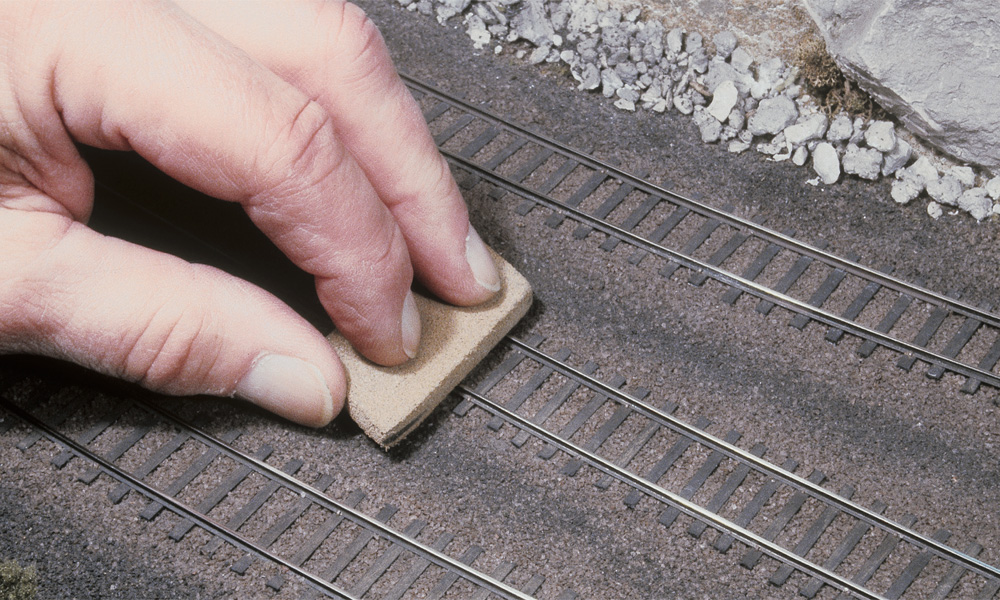
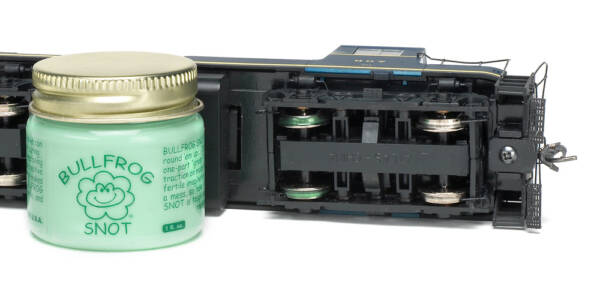
Q: I have a tight HO scale helix with a grade of 3%. My smaller steam engines have a hard time pulling more than two or three cars up the grade. I know the standard answers: increase engine weight, add a second engine, apply Bullfrog Snot to the drivers, make sure car trucks roll smoothly. But I’m curious. Has anyone ever tried to imitate the prototype method of applying sand? I’m considering gluing very fine metal shavings to the rails or roughing up the rails with a file or sandpaper. Has anyone ever tried that, and if so, what problems did they run into? — Randy Bartelt, Madison, Tenn.
A: Hi, Randy. I haven’t heard of anyone trying that idea, but I’m still confident in advising you not to do it. The reason is power — not pulling power, but electricity. Roughing up the surface of your railheads might improve your model locomotives’ traction, but it would do so at the expense of electrical contact. Model railroad wheels already contact only a very small patch of the railhead, thanks to their small radius. The smoother the wheel and railhead are, the more of that area can conduct electricity. But a rough rail surface would by definition contact the wheel less reliably. The difference might not be a big one, but the smaller your pickup wheels, the more significant the difference would be.
But even worse would be a problem that would just increase over time: rail gunk. The microscopic pits and scratches you’d be putting in your railheads would become natural places for non-conductive grime to build up. One theory of where this mysterious stuff comes from is carbon from electrical sparking between the wheels and the rails. If this theory is true, rough railheads would also lead to a lot more arcing, and again, more gunk. You’d have to clean your track more often to get rid of it. And as you do so, what effect will that repetitive scrubbing have on your railheads? Yup — it will smooth them out, negating any traction advantage you would get.
The only way this trick might be a good idea is if your locomotives run on batteries with radio control, so electrical contact with the rails wouldn’t matter. Since you run HO scale, I doubt that’s the case. I suggest you stick with your standard answers. I reviewed Bullfrog Snot in our May 2009 issue, and I can recommend it. Just make sure you only apply it to one or two of your driver wheels per locomotive, not the railhead.
Send us your questions
Have a question about modeling, operation, or prototype railroads? Send it to us at AskTrains@Trains.com. Be sure to put “Ask MR” in the subject.
Share this article