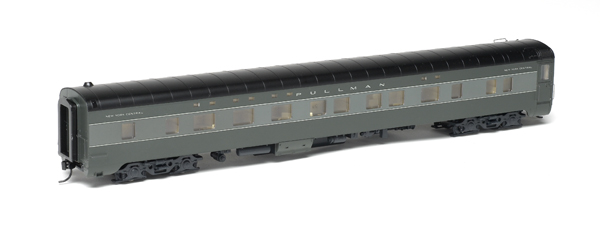
 Walthers’ HO scale 1948 20th Century Limited
Prototype. Pullman actually built these plan 4069B 4-4-2 (4 bedroom, 4 compartment, 2 drawing room) cars for the 1938 edition of the Century, at which time they carried names in the Imperial series and had light gray sides, dark gray window bands, and full skirting. The NYC had the 10-year-old cars refurbished (including removing the skirts) and repainted with dark gray sides and a light gray window band for the 1948 Century. At that time they received new names in the Bridge series. The cars did carry full-width diaphragms for the 1938 train and at the introduction of the 1948 train, but those did not survive for long.
Modelers who want to depict the Century precisely will want different numbers of each sleeping car depending on the year modeled.
The model. Though Walthers has offered a smooth-side 4-4-2 in HO scale for several years, this is an all-new car with subtly different window placement and substantial differences in the underframe. It also has model 43-R triple-bolster roller-bearing trucks, which are correct for this car. The cars that were new for the 1948 Century used 41-C-11 trucks.
The 43-R trucks look good, though detail-oriented modelers will want to drill through the large holes on either side of the springs. The car doesn’t roll especially well because of the metal-on-metal contact between the sideframes and the axles. You’ll also want to lubricate the axle ends with low-viscosity plastic-compatible oil, as outlined in the instructions. The trucks do pick up electricity, but the car isn’t lighted; a separate lighting kit (Walthers no. 1049) is available for $11.98. To remove the roof to install lighting, twist the car gently until some of the clips snap out of the slots in the skeleton frame.
The construction of this car will be familiar to modelers with other Walthers passenger cars – a styrene plastic skeleton frame with snap-on styrene sides, ends, underframe, and roof. The interior is also molded styrene, and the underframe comes with all the key details added. Adding car name decals and installing and painting handrails are left up to the purchaser. One switch from earlier cars is that the Century cars have all-metal Proto Max knuckle couplers in the traditional size, not scale size. The flush-mounted windows don’t have painted frames. The car matches the dimensions on a Pullman floor plan closely.
The paint on our sample was smooth and the (gray) striping/lettering has white edging, which is correct for the period. One of the end-of-car road names was slightly out of alignment. The dark gray paint has a different tint than that on earlier Walthers NYC gray cars. Walthers discovered a set of the original Dupont paint chips and matched that paint for these cars.
With this 4-4-2, Walthers has added another important streamlined car to its line. The Atlantic Coast Line, Canadian National, Illinois Central, and Pennsylvania RR had Imperial cars. And just like on the prototype, I’m sure they’ll find a home on many HO scale lines.
Price: $64.98
Manufacturer
Wm. K. Walthers Inc.
P.O. Box 3039
Milwaukee, WI 53201
www.walthers.com
Road names: New York Central, undecorated
Features:
36″ metal wheelsets with RP-25 contour, correctly gauged
Detailed underframe
Flush-mounted windows
Metal knuckle couplers with coil springs in swinging boxes, at correct height
Modeler-installed car name decals and handrails
Weight: 7 ounces (Correct per NMRA RP-20.1)