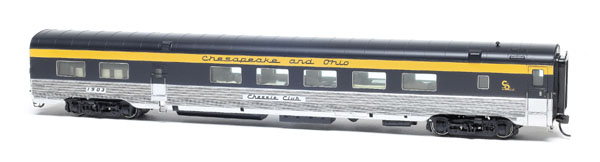
After the C&O began receiving its huge new postwar passenger car fleet in 1950, the Pere Marquette service was expanded with more pairs of trains to Chicago. Thus one pair of trains linked Detroit and Grand Rapids on fast 3-hour schedules, while several longer consists ran between Grand Rapids and Chicago on 5-hour schedules.
A variety of C&O’s new Pullman-Standard cars were assigned to these trains, so the Walthers models represent the second consists that operated on the Pere Marquettes between 1954 and 1963.
The model is made from all-new tooling that closely matches the dimensions shown on a C&O data sheet in the Pere Marquette Passenger Car Pictorial book by Arthur B. Million, published by the Pere Marquette Historical Society Inc.
Our sample is an excellent replica of car no. 1903, named Chessie Club. It’s superbly finished and ready-to-run. The model is made up of more than 80 molded styrene parts and formed wire details. All of the assembly work is first rate.
The excellent instruction sheet includes an exploded-view illustration that shows how all of the parts fit together. The car’s floor, sides, and ends all snap into the frame, and then the details are applied. More than 17 underbody parts represent the air conditioning, air brake, battery, electrical, and water systems.
A pair of steel weights is sandwiched between the interior and the main floor so truck electrical pickups and contacts can power the optional interior lighting.
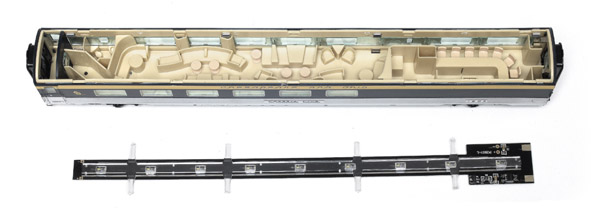
Sprung diaphragms are provided at both ends, and the car has Proto-Max magnetic couplers mounted at the proper height in swinging coupler boxes.
The car rides on a pair of General Steel Castings type 41-N-11 4-wheel trucks. These trucks have tubular axles with National Model Railroad Association RP-25-contour metal wheels. All of the wheels collect current for interior lighting (if used).
The carbody has a plated metal finish that simulates the stainless steel on the prototype’s fluted lower sides and window frames. When this plating is combined with the smoothly-applied C&O Enchantment Blue and Federal Yellow paint, the effect is strikingly realistic.
Our sample came neatly lettered in the post-1950s C&O standard script scheme. The yellow C&O heralds are properly applied on both sides in the blue window band next to the vestibule. All of the windows have stainless steel frames and lightly-tinted glazing.
Overall, Walthers has done a superb job of capturing the look and appearance of the colorful prototype Chessie Club as it operated in the last decade before Amtrak.
Manufacturer:
Wm. K. Walthers Inc.
P.O. Box 3039
Milwaukee, WI 53201
www.walthers.com
Road name: Chesapeake & Ohio
Era: 1954 to 1963
Features:
- 8-wheel electrical pickup
- Factory-installed grab irons
- Interior details
- Optional light-emitting diode (LED) DC/DCC lighting
- Proto-Max metal couplers
- Tinted windows
- Turned metal 36″ wheels (mounted in gauge)
- 24″ minimum radius
- Weight: 7 ounces (matches NMRA recommended practice RP-20.1)