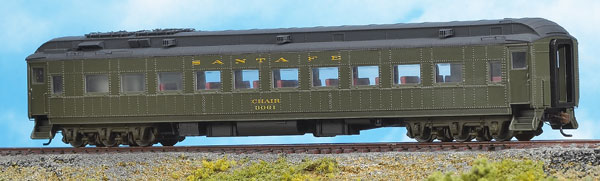
Among the last heavyweights. The model represents the last group of heavyweight chair cars built for the AT&SF, the 3060-3069 series delivered by Pullman in 1930. In Santa Fe terminology, a chair car originally had individual paired seating instead of the bench seats used in coaches. By the late 1930s, chair cars, including these heavy¬weights, had pairs of individual reclining seats.
All the 3060-series cars were equipped with steam-ejector air conditioning during the mid to late 1930s, and remained in passenger service into the 1960s. They served on non-streamlined trains such as the California Limited, the Grand Canyon, the Ranger, and the Scout, among many others. (The last two cars in the series were converted to chair-diners 1519 and 1520 in 1949.) Most of these cars were used in work service when retired from passenger assignments.
An accurate model. The Walthers HO model is scaled to within inches of the prototype in all major dimensions and captures the weighty, solid appearance of these cars. It’s 77 scale feet long over the vestibules, 14′-3″ tall over the roof, and 10′-3″ wide over the carbody. In addition to the 3060 series, this car could also represent one of the 3050-3059 series of 1929 with some rearrangement of underbody and interior details. The model’s distinctively Santa Fe features include the wide windows, lack of belt rails, and exposed I-beam side sills. As a replica of an air-conditioned car, it also has the large roof hatches that characterized the AT&SF’s steam-ejector A/C installations.
The model’s interior, featuring a large women’s lounge, matches the floor plan for this car series in the book Coach, Smoker & Chair Car Genealogy, by John McCall, published by the Santa Fe Railway Historical & Modeling Society (atsfrr.net). The underbody includes all the major components, includ¬ing a small valve cabinet for the air conditioning system, although it lacks piping and brake rigging.
The six-wheel trucks are top-equalized types following AT&SF specifications that Walthers tooled especially for these cars. They aren’t the same as the Pullman type 242 top-equalized trucks used under some of Walthers’ Pullman sleeping cars. They have scale 36″-diameter wheels with RP-25 contours. The gauge of two of the wheelsets was too narrow according to the National Model Railroad Association standards gauge, but I was able to twist them into confor¬mance by finger pressure. Then I put a tiny drop of cyanoacrylate adhesive on each wheel-axle joint – at the backs of the wheels – to make sure the wheelsets stay in gauge.
As fine as these trucks are, they’re also the sites of this model’s only major detail omission. All of the Santa Fe’s heavyweight passenger cars were equipped with truck-mounted generators hung inboard from one of the truck frames; air-conditioned heavyweights had two generators, one on each truck. The Walthers trucks lack these genera¬tor mountings, and the model has only one generator attached to the floor next to the center sills.
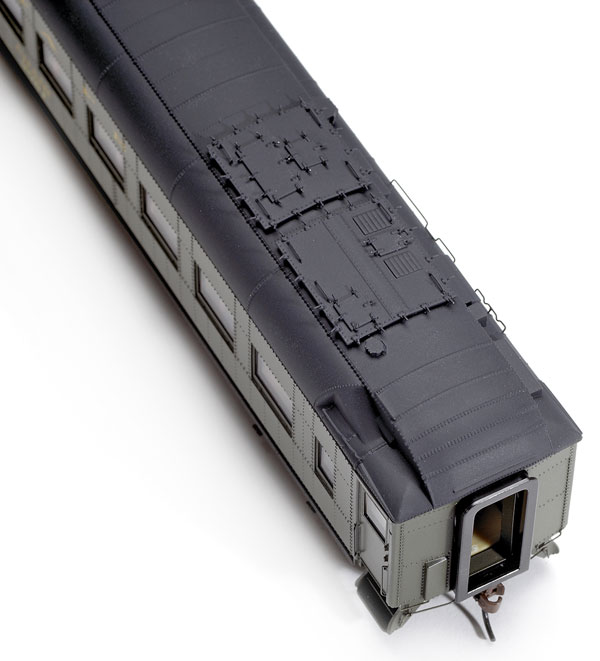
There were so many bare-metal parts to be touched up that I simply airbrushed the entire roof with Polly Scale Steam Power Black after I had the detail parts in place. For the end grabs and uncoupling levers, a Polly Scale mixture of four parts GN Empire Green and one part Reefer Yellow is a good match for the olive green body color.
Weighing 6.5 ounces, the chair car is almost exactly in accordance with NMRA Recommended Practice 20.1. It has magnetic knuckle couplers installed in swing arms pivoted back near the body bolsters. The couplers ride slightly low compared to the Kadee height gauge, but there’s no good way to adjust their height with this mounting. Shimming above the truck bolsters to raise the couplers isn’t a good idea since the car’s height is correct as it comes.
The one-piece diaphragms have integral springs and are close to scale size. But they touch the next car’s diaphragm only when the slack is pushed out of the couplings, so they don’t form a closed corridor between cars.
Walthers’ recommendation for a 24″ minimum radius is sound. When I tried running the car around a 22″-radius curve, the wheels rubbed on the underframe.
The car shown on page 98 is painted coach green and black, as were most of these cars during their time in passenger service. As on other recent Walthers passenger cars, the car numbers are supplied as decals, so any car in the series can be modeled. The yellow lettering is appropriate for any time from the early 1950s onward. Before that, AT&SF passenger cars had gold lettering.
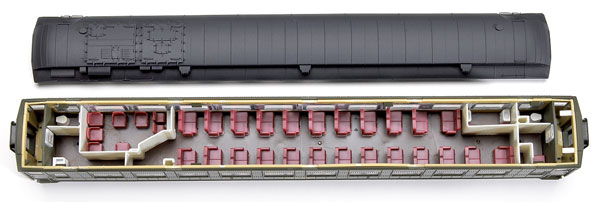
Flexibility for the future. Since this model follows the Walthers pattern of using appliqué sides on a core body, it should be possible for the manufacturer to offer several other varieties of Santa Fe heavyweights that shared this car’s common dimensions. A fine model in its own right, the 3060-series chair car would be even more notable as the start of a series of distinctive AT&SF passenger cars.
Price: $44.98
Manufacturer
Wm. K. Walthers, Inc.
P. O. Box 3039
Milwaukee, WI 53201
www.walthers.com
Description: Plastic and metal ready-to-run Atchison, Topeka & Santa Fe passenger car
Paint schemes: green with black roof, green with silver roof, two-tone gray with black roof, and undecorated
Features: Santa Fe six-wheel top-equalized trucks
Interior detail in realistic colors
McHenry scale-size magnetic knuckle couplers
Removable roof with hatches and air-conditioning duct