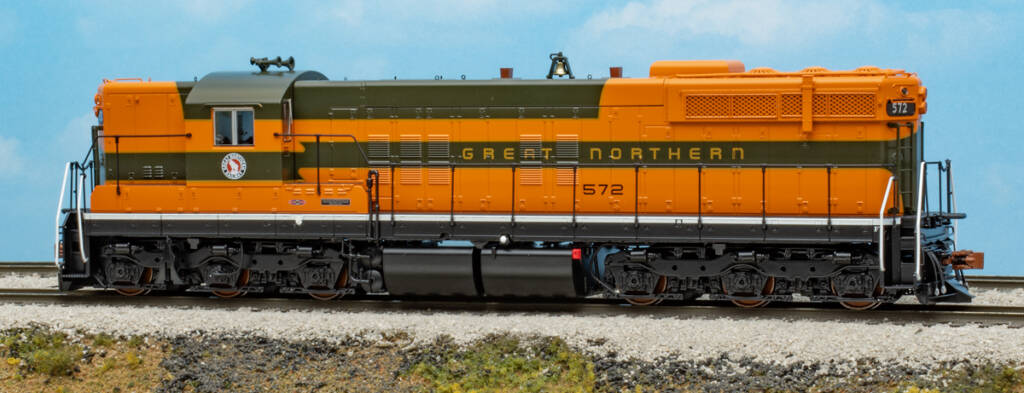
An Electro-Motive Division SD7 is one of the latest additions to the ScaleTrains Rivet Counter line. The HO scale model, based on a prototype from the early 1950s, features injection-molded plastic and die-cast metal construction; factory-applied, prototype-specific details; and metal semi-scale Type E couplers painted a rusty color.
Prototype history
Electro-Motive Division produced the SD7 from February 1952 until November 1953. During that time, 188 units were produced, all for railroads in the United States. The six-axle diesel, rated at 1,500 hp, was equipped with a 16-cylinder, 567B diesel engine.
The sample we received is decorated as Great Northern 572, part of the railroad’s 550 through 572 series. The SD7 was built by EMD in April 1953 under order number 5182 and delivered in the Empire Builder scheme. It later wore GN’s simplified Omaha Orange and Pullman Green and Big Sky Blue paint schemes. The schemes were introduced in 1962 and 1967, respectively.
Following the March 1970 merger that created Burlington Northern, the locomotive became BN 6022. The SD7 was retired by the railroad in July 1983.
Model features
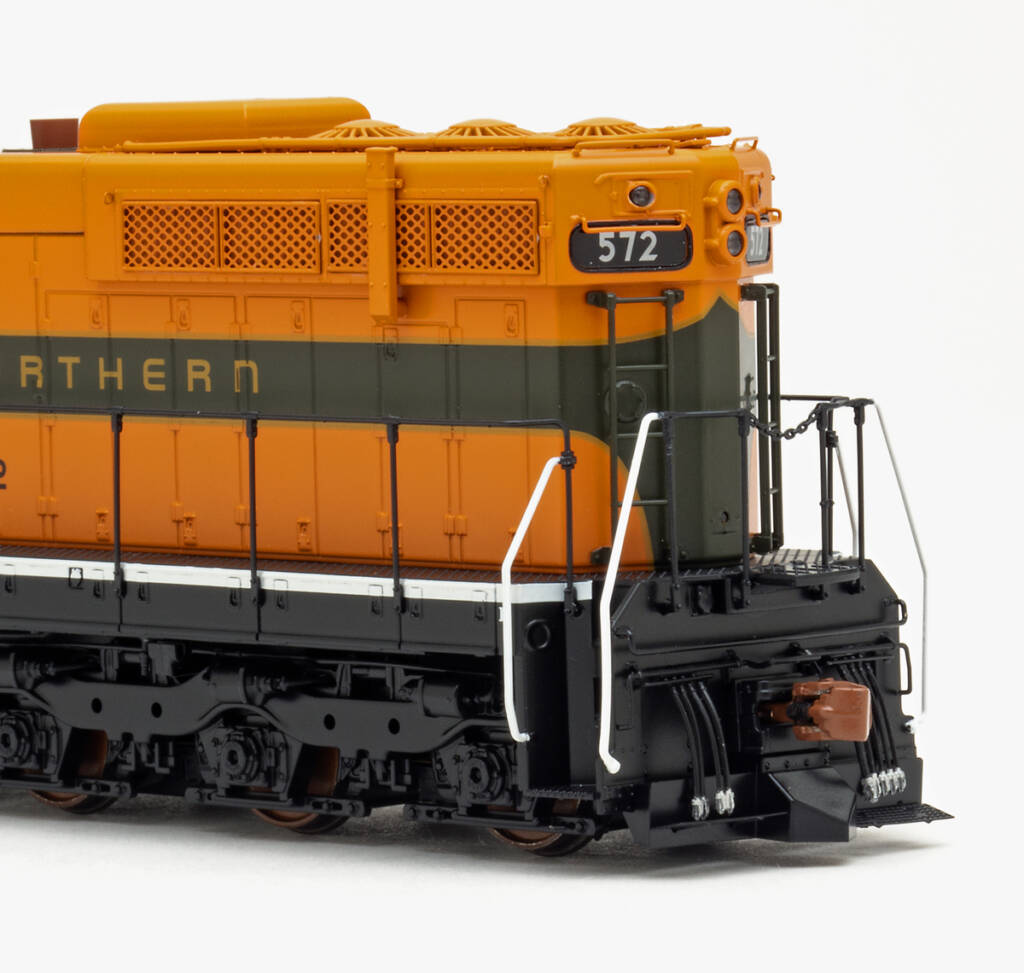
As part of the Rivet Counter line, it shouldn’t be a surprise that the SD7 is a detail-rich model. The pilots feature see-through, etched-metal footboards; formed wire footboard handrails; and plastic m.u. and train line hoses.
The handrails and stanchions are plastic, with the vertical railings painted white. Plastic ladders and factory-installed and painted wire grab irons can be found on the end of the short and long hoods.
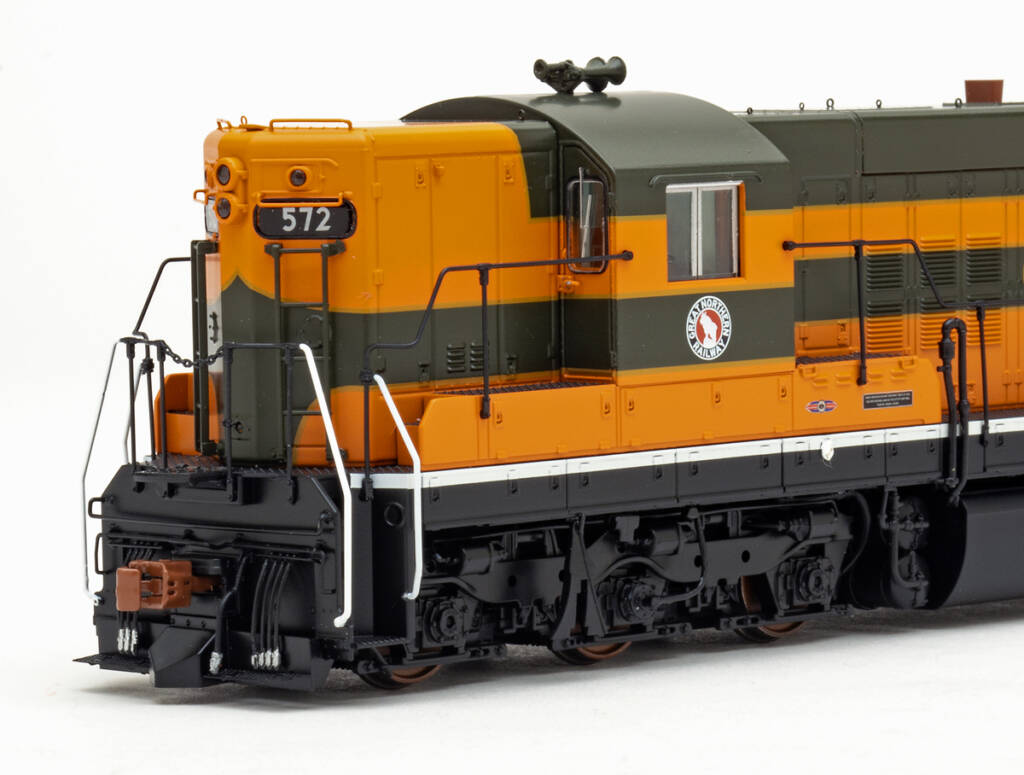
A cast brass Leslie S-3-L air horn is attached to the top of the cab. I couldn’t find a prototype image of the 572 in its as-delivered scheme. Photos of the unit in the simplified and Big Sky Blue schemes show a pair of single-chime air horns on the winterization hatch.
Long hood details include tapered exhaust stacks, a bracket-mounted bell between the stacks, a winterization hatch with a see-through screen, photo-etched metal lift rings, and piping near the radiator fans. An exhaust stack for the standby heater is located over the radiator intake screens.
A closer look
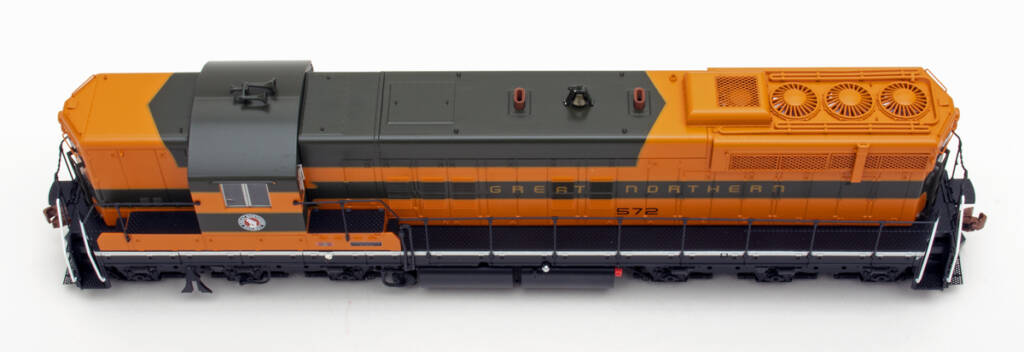
Our review model is decorated in the Empire Builder scheme. The paint is smooth and evenly applied, and graphic placement follows prototype images. The stripes separating the orange and green and the road name have more of a Dulux Gold appearance, but should be yellow. The EMD builder’s plates and equipment trust plates (the latter with legible lettering!) are correctly placed. The Scale Trains model matches drawings published in an EMD SD7 operating manual from March 1952.
I took the model over to our test track, which features an NCE Power Cab. At step 1, the six-axle unit ran at less than 1 scale mph. The model achieved a top speed of 65 smph at step 28. The maximum speed on the prototype ranged from 65 to 89 mph depending on the gear ratio.
For real-world testing, I used the SD7 to switch cars on our Winston-Salem Southbound layout. The GN unit had no problem navigating the mix of handlaid and commercial track and turnouts (the latter as sharp as a No. 4). It made it over the 30-degree crossing trouble free.
In addition to the SD7, ScaleTrains also offers an EMD SD9 decorated for Conrail and Norfolk Southern. Whether powering a freight, switching a yard, or working cars at an industry, the six-axle diesel would be a good fit for any HO layout set between the 1950s and today.
Click here to watch a video of the ScaleTrains HO EMD SD7 in action on our Winston-Salem Southbound Tar Branch layout.
Facts & features
Price: Direct-current model with 21-pin connector, $214.99; with ESU LokSound V5 sound decoder, $324.99
Manufacturer
ScaleTrains
4901 Old Tasso Road NE
Cleveland, TN 37312
scaletrains.com
Era: April 1953 to early 1960s (as decorated)
Road names: Great Northern; Chicago, Burlington & Quincy; Southern Pacific; and Union Pacific. Six road numbers per scheme.
Features
- Body-mounted die-cast metal semi-scale Type E couplers, at correct height
- Metal wheel stubs on plastic drive axle gears, in gauge
- Minimum radius, 18″; recommended radius, 22”
- Weight: 1 pound, 1.7 ounces