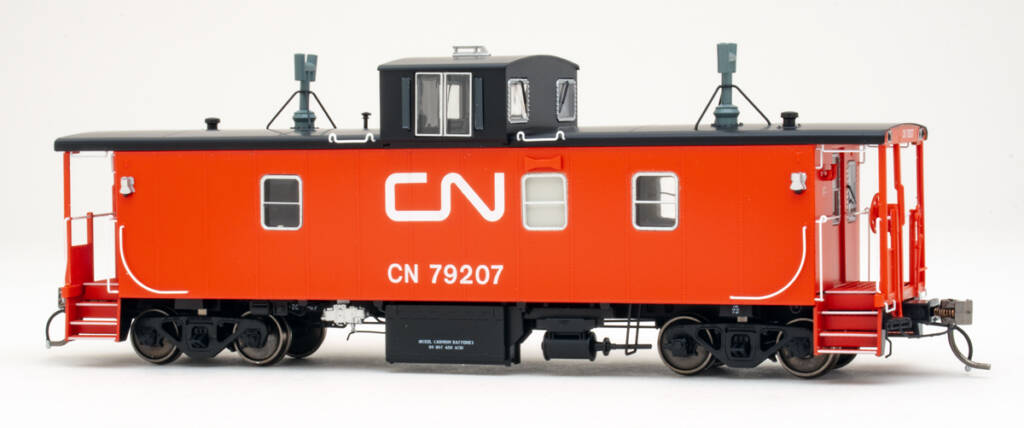
Though cabooses have all but disappeared from today’s railroads, they’re still front and center for hobby manufacturers. Rapido Trains recently released its latest premium-level model, the HO scale Canadian National Hawker Siddeley van. The model features a detailed interior and underbody, numerous operating lighting features, and metal semi-scale couplers.
Prototype history
Hawker Siddeley produced 150 steel vans, numbered 79200 through 79349, for the CN in 1967. The cabooses were built at the manufacturer’s plants in Trenton, Nova Scotia, and Fort William, Ontario, Canada.
The vans, designed to replace the railroad’s aging roster of wood cabooses, featured many amenities modern for the time. The axle-driven generator provided power for the hot plate, interior lighting, marker lights, refrigerator, and two-way radios, among other items. Two oil stoves, one appointed for cooking, kept the vans warm on cold Canadian nights.
Canadian National’s fleet of Hawker Siddeley vans stayed in service into the 1990s. The full-size CN 79207 was spared the scrapper’s torch and is on display in Minto, New Brunswick, Canada.
Model features
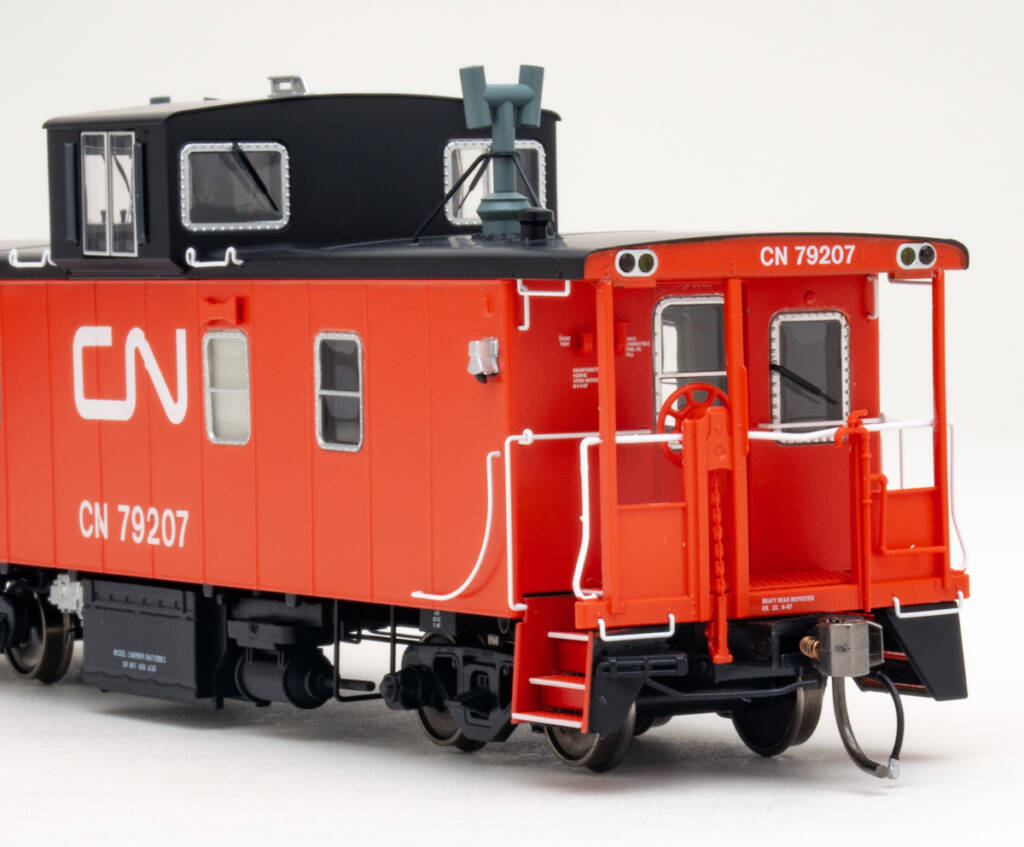
Rapido’s CN Hawker Siddeley van features injection-molded plastic construction, complemented with formed-wire grab irons; a detailed, multi-color interior; and see-through, etched-metal steps and end platforms. Rooftop details include two smokejacks, assorted vents, and a Sinclair antenna on the cupola. The end cupola windows have windshield wipers; wind deflectors frame the windows on the side.
I was unable to remove the shell to see all of the interior details, but they are visible through the side and end windows. I carefully removed the cupola to see the seats and railings. Wires for the light are attached to the inside of the cupola, so lift it off gently.
A Rapido Lighter magnetic wand is included to control the various lighting features, which work in direct current and Digital Command Control. A sheet included with the van shows where to wave the wand to control the cupola light, end marker lights, cabin and step lights, and track inspection lights [The as-delivered model doesn’t have inspection lights. — Ed.]
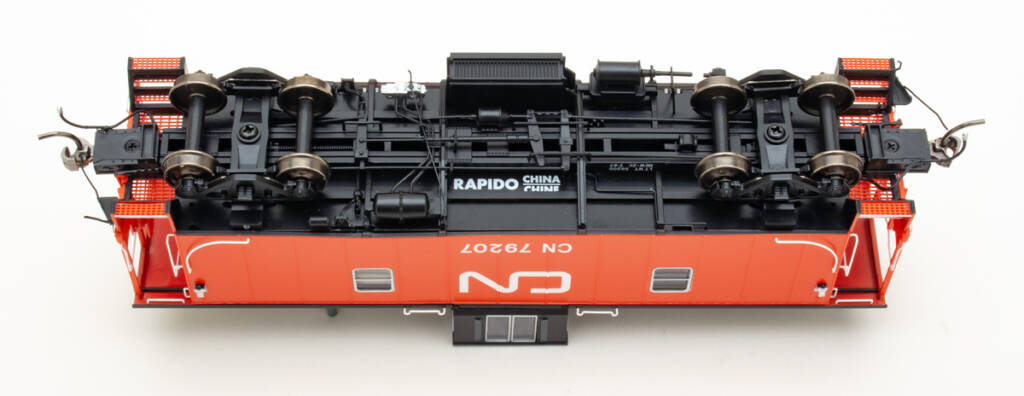
In typical Rapido style, the underbody has many details. The battery box, control valve (painted silver), and axle-driven generator can be seen in the image above. The van’s cushioned underframe, along with the brake system appliances and various pipes, rods, and levers, are also depicted.
A closer look
The sample we received is decorated in the as-delivered paint scheme. The paint is smooth and evenly applied, and the white graphics are opaque.
A prototype photo of CN 79207 from September 1967 is included in Canadian National Color Guide to Freight and Passenger Equipment, Volume 2 by John Riddell (Morning Sun Books, 2001). At the time of the image, there were no grab irons flanking the cupola and the step edges weren’t painted white.
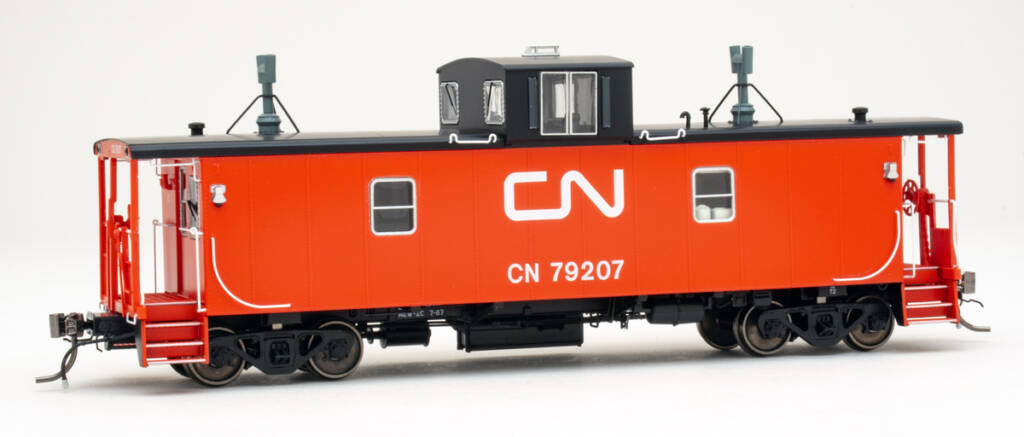
The 1970 Car and Locomotive Cyclopedia of American Practice (Simmons-Boardman Publishing Corp.) contained drawings of the CN Hawker Siddeley van. The model matches or is within scale inches of published data.
To put the caboose through its paces, I placed it in a train on our Winston-Salem Southbound Tar Branch. The compact switching layout has commercial and handlaid track and turnouts (the latter as sharp as a No. 4) and a 30-degree crossing. The Rapido model had no issues when being pushed and pulled on the 2 x 8-foot model railroad.
If you model the CN in HO scale from 1967 through the 1990s, you’ll definitely want to check out Rapido’s CN Hawker Siddeley van. With details inside and out, prototype-specific lighting features, and metal wheels and couplers straight from the box, what more could you ask for?
Facts & features
Price: $129.95
Manufacturer
Rapido Trains
382 High St.
Buffalo, NY 14204
rapidotrains.com
Era: 1967 to 1990s
Road names: Canadian National (as-delivered with red/orange steps, late with black steps, and international) and Devco Ry. One to eight road numbers per scheme; also available undecorated.
Features
- Body-mounted semi-scale couplers, at correct height
- Metal wheel stubs on plastic axles, in gauge
- Weight: 4.2 ounces, .4 ounce too heavy per National Model Railroad Association Recommended Practice 20.1