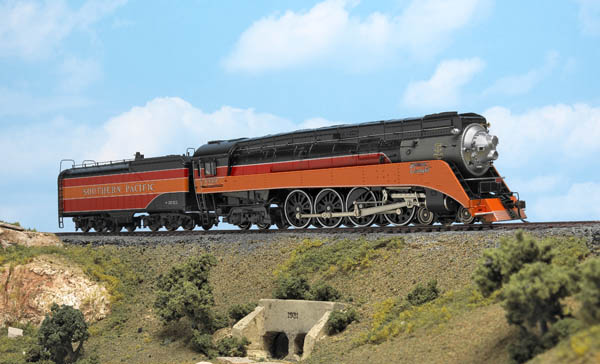
The GS-4. Built by the Lima Locomotive Works in 1941, 30 class GS-4 4-8-4 steam locomotives hauled the Southern Pacific’s streamlined Daylight and other passenger trains. The most prominent Daylight trains were No. 98 from San Francisco to Los Angeles and No. 99 in the opposite direction.
The GS-4 fleet led trains 98 and 99 until diesels finally took over in 1957. Southern Pacific no. 4449 is the only surviving GS-4.
All the dimensions of the MTH GS-4 match prototype drawings in the April 1972 Model Railroader.
Model construction and paint. The MTH GS-4 is built primarily from die-cast metal. Molded-in details, including boiler bands and rivet seams, match prototype photos.
Handrails and piping are separately applied. The enclosed cab has a positionable roof vent and apron. A plated air horn is on the fireman’s side of the smokebox.
Our sample is painted in SP’s post-June 22, 1946 livery, when the railroad omitted “Lines” from its equipment and used 15″ lettering across locomotive tenders.
The model’s pinstripes and lettering are SP Lettering Gray. All the lettering and Daylight herald are edged in black like the prototype. The pinstripes don’t have black edging.
The model includes builder’s, equipment trust, and superheater patent plates that are readable under magnification. The train indicator boards display the number “99.”
Drivetrain and electronics. A flywheel-equipped motor is housed inside the boiler and powers the third drivers. The siderods transfer power to the other drivers. The fourth drivers have traction tires.
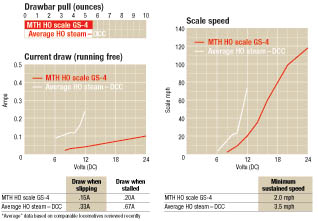
The MTH GS-4 should haul a Daylight consist without difficulty. The model pulls the equivalent of 25 average HO passenger cars on straight and level track.
Metal contacts inside the drawbar make a wireless connection between the electronics in the tender and the engine.
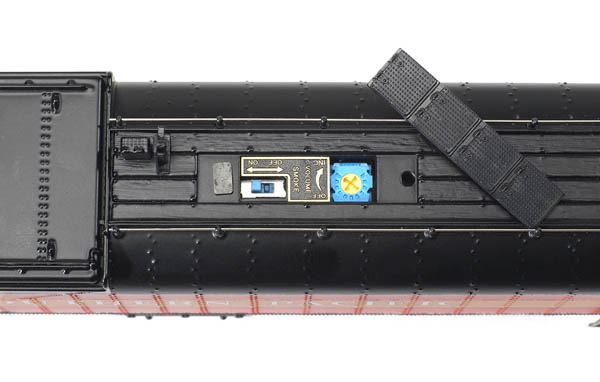
The smoke on/off switch and sound volume control are located under the tender water hatches.
I tested the model on DC using a Model Rectifier Corp. Tech 4 power pack. Lights, sound, and smoke came on at 6.5 volts. I advanced the throttle to 8 volts and the GS-4 crept at 2 scale mph. The model reached 60 scale mph at 15 volts.
The MTH GS-4 is designed for up to 24 volts, which is higher than the 12 volt maximum specified by National Model Railroad Association S-9 for DC power packs. Voltages above 12VDC have the potential to damage lightbulbs and motors in other equipment.
I tested the GS-4 above 12 volts using an LGB power pack. The model reached a top speed of 118 scale mph at 24 volts, which is close to the prototype’s 110 mph maximum speed.
In DCC I ran the GS-4 with an MRC Prodigy Advance that delivers 16.4 volts. The model operates best using 128 speed steps. The GS-4 started moving at 2 scale mph in speed step 1 and accelerated to its top speed of 118 scale mph.
The model has 28 DCC functions, including turning the signal light on or off (function 5) and blowing a grade-crossing signal with the GS-4’s air horn (function 12). Function 4 triggers an arrival/departure sequence, including train announcements, conductor calls, and passengers at the platform.
The model has only 10 programmable configuration variables, limiting the ability to fine-tune the GS-4’s performance in DCC.
Controlled by the Commander’s thumbwheel, the GS-4 accelerated in 1 scale mph increments. Buttons trigger numerous sound effects, including a train crash sequence.
In DCS, the GS-4 also has a realistic whistle that you can “quill” as if you were pulling on a whistle cord. You can vary the whistle’s pitch and duration with the Commander’s thumbwheel.
In DC, DCC, or DCS, the sound effects and synchronized smoke are top-notch. This die-cast steamer is an excellent model of the GS-4.
Price: $449.95
Manufacturer
MTH Electric Trains
7020 Columbia Gateway Drive
Columbia, MD 21046-1532
www.mth-railking.com
Description: Die-cast metal sound-equipped locomotive
Road names: Southern Pacific (Daylight post-1946) no. 4449; American Freedom Train no. 4449; Burlington Northern Santa Fe no. 4449; SP (Daylight pre-1946) nos. 4453, 4449; SP (black post-1946) no. 4437
Automatically switched between DC, Digital Command Control (DCC), or MTH Digital Control System (DCS) modes
Constant-voltage headlight
Drawbar pull: 5.6 ounces
Electrical pickup on six drivers and all 12 tender wheels
Engine and tender weight: 2 pounds 3 ounces
Engineer and fireman figures
Front and rear scale-size magnetic couplers mounted at the correct height
Five-pole skew- wound motor with flywheel
Illuminated classification lights, train indicator boards, and cab interior
Minimum radius: 22″
MTH Proto-Sound 3.0 operates in DC, DCC, or DCS modes
NMRA RP-25 contour metal wheels in gauge
Operating fan-driven smoke unit
Operating signal light
Sprung drivers
User-installed drivers without traction tires