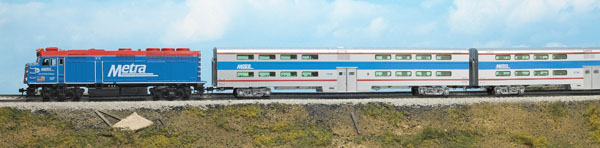
Metra mainstays. Based on the GP40 freight locomotive, the 3,000 hp F40PH and its variants have led long-haul Amtrak trains since the late 1970s. The locomotives are also used by many commuter railroads.
Metra no. 137 was one of 22 F40PHs delivered to Metra’s predecessor, the Regional Transit Authority (RTA), between 1979 and 1980. The F40PHs continued to serve the Chicago area after Metra was formed in 1984. Around 2001, Metra upgraded the F40PH fleet, including no. 137, with new equipment such as cab air conditioners. Currently there are more than 100 F40PHs on the Metra roster.
Many F40PHs went through another rebuilding program starting in 2008. Metra no. 137 returned from its last rebuilding in 2011 with a new type of cab air conditioner, rounded cab door windows, and other modifications.
Pullman-Standard bi-level cars have also had a long service life. Originally built in the late 1960s for the Chicago & North Western, the cars served through the 1970s on the CRTA. Some of these cars continue to carry passengers throughout the Metra system.
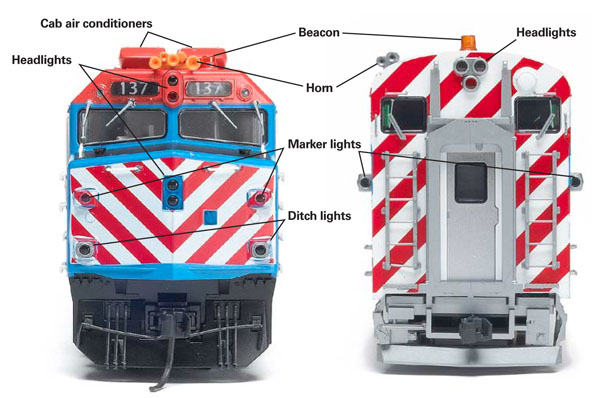
The model’s paint scheme matches prototype photos. There’s sharp separation between the colors, including the red and white safety stripes on the nose.
The locomotive features several sprues of modeler-installed, press-fit detail parts. I found sprue nippers, a sharp hobby knife, and round-nose tweezers with grooved jaws essential to completing this project. Installing all the parts took me a couple of hours.
Most of the parts, such as the handrails, are acetal plastic and molded in the appropriate color. However, to match the roof color, the rooftop engine room vent is painted plastic. Unfortunately, cutting this part from the sprue left two spots of gray, unpainted plastic. Luckily these areas are barely visible from a
normal viewing distance.
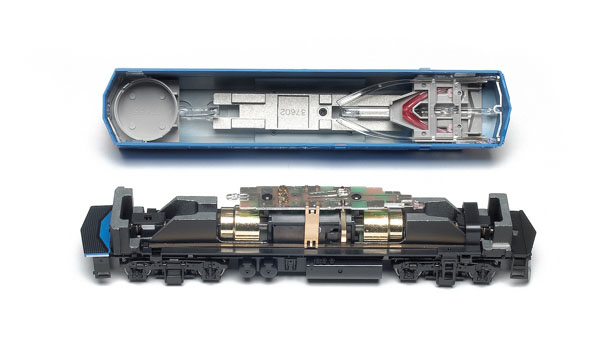
Locomotive mechanism. After removing the coupler boxes, I lifted off the locomotive body shell. There’s a die-cast metal weight attached under the hood and a plastic enclosure under the rear
radiator fan for a 28mm speaker.
The dual-flywheel-equipped motor is in the center of the die-cast metal frame. The printed-circuit board atop the motor includes an eight-pin socket for converting the locomotive to Digital Command Control (DCC). A board-replacement DCC sound decoder is also available from Digitrax (part no. SDH164K1C).
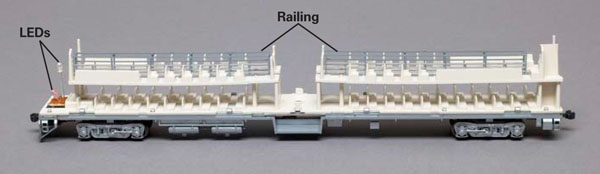
With all those windows, many modelers will want to add some figures. Thankfully the cars have press-fit body shells that are easy to remove. The interiors are molded in tan plastic and the seating arrangements match prototype diagrams. The upper level features a separate silver-painted handrail.
The Metra paint job is spot on. The lettering, including the IRTA logo near the center door, is crisply printed.
The cars include modeler-installed acetal plastic grab irons and other parts.
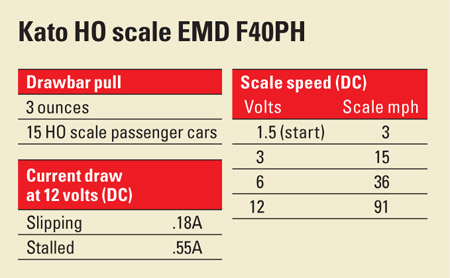
Both the locomotive and cars ran smoothly through turnouts and around 18″-radius curves. When coupled, there is 3/16″ between the car diaphragms.
The modeler can replace the factory-installed Kato couplers with the included Kinematic couplers. These couplers reduce the space between diaphragms by half on straight track, but have a wide range of motion that allows the cars to negotiate tight curves. With either standard or Kinematic couplers, the cars look more realistic on broader curves.
Lighting. Both the locomotive and cab coach have operating headlights and red marker lights. These lights automatically turn on or off according to the direction of travel. The locomotive also features
illuminated number boxes that are always on, as well as ditch lights that are on only when the F40PH runs forward.
Interior lighting kits for the coaches are available separately (part no. 7501). Modeler-installed track power pickups designed specifically for the bi-levels are included with the cars.
The HO F40PH and bi-level cars were accurate models when they first came out, and Kato has done an outstanding job modifying them to match the Metra prototypes.
Manufacturer
Kato USA Inc.
100 Remington Rd.
Schaumburg, IL 60173
www.katousa.com
Road names: Chicago METRA, Amtrak (phase III), Chicago RTA, Rock Island (cars only)
Era: 2001 to 2011 (Chicago Metra locomotive, as detailed), 1984 to present day (Chicago Metra cars)
Locomotive features
- All wheel drive and electrical pickup
- Blackened scale 42″ metal wheels in gauge
- Eight-pin Digital Command Control socket
- Five-pole skew-wound motor with dual brass flywheels
- Kato magnetic knuckle couplers with modeler-installed trip pins at correct height
- Light-emitting diodes (LEDs) illuminate number boxes, directional headlights, and
- ditch lights
- Weight: 15 ounces
Car features
- Blackened metal wheels, in gauge
- Cab-coach has directional LED headlight and marker lights
- Kato knuckle couplers with modeler-installed trip pins at correct height
- Optional modeler-installed Kato Kinematic knuckle couplers
- Weight: 6.25 ounces (coach), 6.5 ounces (cab-coach).
- The cab-coach is 0.3 ounce too light and the coach is 0.5 ounce too light per National Model Railroad Association RP-20.1.