Prototype. General Motors Electro-Motive Division built 421 E8A and 39 E8B diesels for North American railroads from 1949 to 1953. The E8 featured two new 567B engines that produced 2,250 hp, making it more powerful than its 2,000-hp predecessor, the EMD E7.
Electro-Motive built the last E unit, the E9, from 1954 to 1963. The 2,400-hp E9 was virtually identical in appearance to the E8.
The E8 locomotives hauled passenger trains on United States main lines into the mid-1970s. Several E8s continued in commuter service until the 1990s.
The dimensions of the BLI model match drawings in the Model Railroader Cyclopedia, Vol. 2: Diesel Locomotives (Kalmbach Publishing Co., out of print).
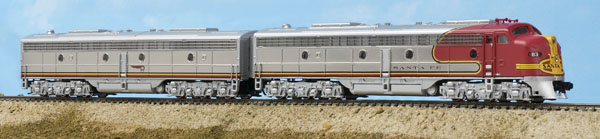
Appearance. Our review sample came decorated for the Atchison, Topeka & Santa Fe Ry. The prototype for the model, as with the 13 other E8s on the Santa Fe, were rebuilt by EMD in 1952 and 1953 from the railroad’s E1 diesels. Classed E8M (“M” stood for modified) by the Santa Fe, these rebuilt units looked identical to a new production E8, but they had some internal differences and were rated at 2,000 hp.
Lettering and striping placement of the model’s red-and-silver warbonnet livery match prototype photos. On the prototype the sides of the body were unpainted stainless steel, while other silver parts, such as the truck sideframes and roof, were silver-painted metal. Broadway Limited accurately modeled this on the N scale E8 by using a brighter shade of silver for the sides of the body and a duller shade of silver for the roof, trucks, pilot, fuel tank, and rear.
Unlike the prototype, the molded-in class lights on the model are painted over with the same shade of red used on the body shell. Other molded details on the plastic body shell match prototype photos. Separately applied parts include etched-metal side grills and sprung end diaphragms.
The cab of the A unit features some interior detail, but painted crew figures aren’t included.
Mechanism. To remove the body shell of the A unit I first removed the front coupler. Then I used two toothpicks to carefully spread the body shell to disengage four locking pins. Then I could lift the shell off the die-cast metal frame.
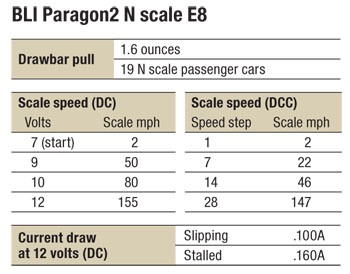
A can motor and two brass flywheels are enclosed in the lower half of the frame. Gearboxes above the trucks transfer power to all six axles. The rear wheels of the rear truck have traction tires, helping the engine achieve an impressive 1.6 ounce drawbar pull.
The DCC decoder is mounted on top of the rear half of the frame. A single downward-facing speaker in a plastic enclosure is mounted on top of the front half of the frame. Two light-emitting diodes (LEDs), one for the headlight and another for the Mars light, are attached to a separate printed-circuit board mounted to the front of the cab interior assembly.
The engine sounded like recordings of 567 diesels that I’ve heard. I liked the default horn sound, but if you disagree, there are two other horn sounds available.
The model includes the “macro” feature found in HO Paragon2-equipped models. You can record an operating sequence, including various sound effects, and then watch as the model runs through the sequence automatically.
I easily programmed the Paragon2 decoder using an MRC Prodigy Advance DCC system. Advance consisting a set of A-B-A diesels was very easy, and the procedure is clearly outlined in the instruction manual.
The model performed smoothly in our DCC speed tests. After programming CV5 (maximum voltage) to a value of 80, the model achieved a more prototypical 110 scale mph top speed.
DC performance. I tested the BLI E8 in DC using an MRC Tech 4 power pack. Out of the box, the headlight came on at 6 volts (V), but as I advanced the throttle the sounds didn’t function and the model wouldn’t move.
To fix this so I could run the engine required a BLI DCMaster Analog Programmer ($39.99, sold separately), which allows you to program CVs on a DC layout. I programmed the analog motor control minimum voltage (CV252) to a value of 60. I also programmed the analog sound start (CV 131) to 50.
The lights and sounds on the model then started at 6V. At 7V the E8 started moving at 2 scale mph. After I programmed the analog motor control maximum voltage (CV251) to a value of 80 the model had a prototypical 110 scale mph top speed.
The DCMaster allows you to trigger the whistle, bell and other sound functions. You can run the E8 without the DCMaster and still hear engine and brake sounds.
Although the model requires a DCMaster to program it in DC mode, the BLI E8 ran well and sounded great. In DCC mode the model is easy to program and operate. This streamlined diesel features realistic sounds and would look great hauling an N scale lightweight passenger train.
Price: A or B unit, $199.99; Illinois Central A unit with dummy B unit, $249.99; DC no sound, $99.99; Dummy B unit, $74.99
Manufacturer
Broadway Limited Imports, LLC
9A East Tower Circle
Ormond Beach, FL 32174
www.broadway-limited.com
Road names: E8A or E8B: Atchison, Topeka & Santa Fe; Union Pacific. E8A only: Canadian Pacific; Chesapeake & Ohio; Chicago, Burlington & Quincy; Louisville & Nashville; New York Central;
Pennsylvania; Southern; Southern Pacific (E9A). E8A only or E8A and dummy
E8B set: Illinois Central. Undecorated E8A and E8B units available with horizontal or vertical grills and with or without Mars lights.
Era: 1949 to 1990s
Features
All-wheel drive
Dual-mode Paragon2 DCC sound decoder operates on DC and DCC layouts
Electrical pickup on 10 wheels
Five-pole skew wound can motor with dual brass flywheels
Minimum radius: 93/4″
RP-25 contour metal wheels in gauge
Two Micro-Trains magnetic knuckle couplers at correct height
Weight: 4 ounces per unit