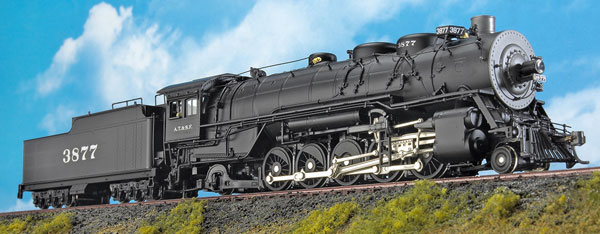
The Baldwin Locomotive Works built engines 3800 through 3828 to the Santa Fe’s specifications in 1919 and went on to construct all 140 engines of this class by 1927. Super-sized 2-10-4s replaced 2-10-2s on some Santa Fe lines after 1938, but 3800s continued working the mountain passes of Cajon, Raton, and Tehachapi until replaced by diesel-electrics. Mostly retired by 1953, the last engines of the 3800 class were scrapped in 1956.
Though the 3800s were built to standard dimensions, their appearance evolved over the eight years of their construction and changed further while they were in service. Various details, including the square cab, two sandboxes, and Elesco feedwater heater system with the type CF two-stage water pump, mark Broadway’s model as a representative of the group built in 1924, engines 3876 through 3890. Its detailing is appropriate from that time to roughly the mid-1930s, when all the 3800s received a foam-collapsing system that’s not included on the
model.
Broadway is also offering this engine as the one-of-a kind 2-10-4 no. 3829, built as part of the 1919 order but with an experimental four-wheel trailing truck not applied to any other 3800s.
Detailing on the HO 3800 includes separately applied wire handrails and uncoupling levers as well as separately applied piping and appliances. There is some molded-on piping, but it mostly doesn’t detract from the overall effect. Under the cab, however, piping and brake equipment are molded onto solid backgrounds on either side where the real engine had open space.
These engines were built with prominent canvas cab awnings extending over the arched tops of the cab windows, and the tiny molded awnings hiding under the cab handrails don’t do them justice. The oil separator for the feedwater heater system is missing – it should be under the pilot deck and behind the pilot beam on the left side.
The model comes with two die-cast metal ladders to be installed on the valve gear hangers but no instructions on how to do so. The ladders fit at the front end of the hanger on each side, with the notch or step on the ladder forward and the locating tab inside the hanger. I used cyanoacrylate adhesive to secure them, but epoxy might be a better bet since these parts are in such vulnerable positions.
There should also be a long step below the crosshead guides on each side. Omitted on the model, the steps should extend from the rear cylinder head covers to vertical supports hanging from the crosshead guide yoke behind the ladders.
The side rods are stamped metal. The engines’ original slab rods were about 4 inches thick, but the model’s rods scale only half that and don’t have the substantial heavy look of the real thing.
The locomotive and tender are finished in matte black with appropriate aluminum (silver) lettering. The smokebox front and smokestack are a graphite color the Santa Fe called “Tarpon Gray.” The driving and pilot wheels are painted black but have shiny metal axle ends, which should also be black. The shiny tender wheels are mostly hidden but should be black as well.
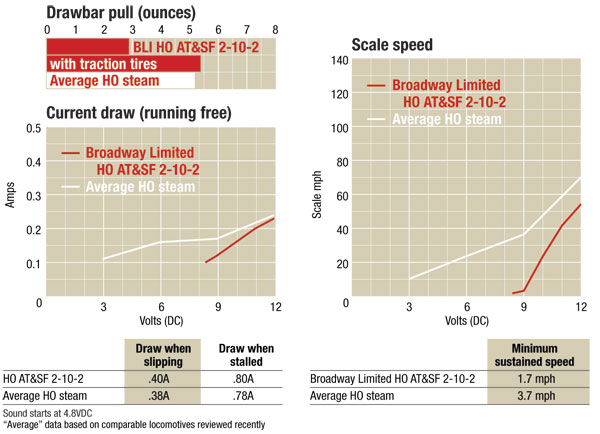
The engine runs smoothly and quietly, with little mechanical noise to compete with the sound system. Its speed range is excellent, as the real 3800s were limited by timetable to a maximum speed of 55 mph and were usually held to top speeds of 40 to 45 mph in service.
With its traction tires in place, this 2-10-2’s drawbar pull is equivalent to 80 free-rolling freight cars on straight level track. Even without the traction tires, using the optional driver set included, the engine handles about 40 cars.
The recommended minimum radius of 22″ is as tight a curve as the engine can manage. It runs more reliably on larger radii.
The sound effects are typical of QSI, but with a new “drifting” feature which quiets but doesn’t completely eliminate the exhaust chuff when the throttle setting is reduced. The drifting effect was more noticeable in DC operation than with DCC, but the operator’s manual says this effect will be more pronounced with higher values set in configuration variables CV3 and CV4. The chuff rate isn’t exactly four per driver revolution, but in DCC operation this can be adjusted using CV56.
Santa Fe power. Overall, the Broadway Limited 3800-class 2-10-2 gives a good impression of its prototype, whether posed rods-down for a roster shot or hard at work on layout grades. – Andy Sperandeo, executive editor
Price: $349.99
Manufacturer
Broadway Limited Imports LLC
4 Signal Ave., Ste. C
Ormond Beach, FL 32174
Phone: 386-673-8080
www.broadway-limited.com
Description
Ready-to-run plastic and
metal 2-10-2 Santa Fe-type
steam locomotive
Road numbers
(All Atchison, Topeka & Santa Fe): 3829 (2-10-4), 3855, 3876, 3877, and painted but unlettered
Automatic dual-mode (DC and
DCC) sound and control system
Cab interior with backhead detail
and crew
Can motor with flywheel geared
to third driving axle
Constant headlight
Coupled wheelbase: 89′-6″,
requires 14″ turntable
Drawbar pull: 2.88 ounces,
5.44 ounces with traction tire
Engine and tender weight: 27.5
ounces (engine alone weighs
21.5 ounces)
Kadee Magne-Matic couplers
(tender coupler .020″ too high)
Minimum radius: 22″
RP-25 contour wheels
(mounted in gauge)