

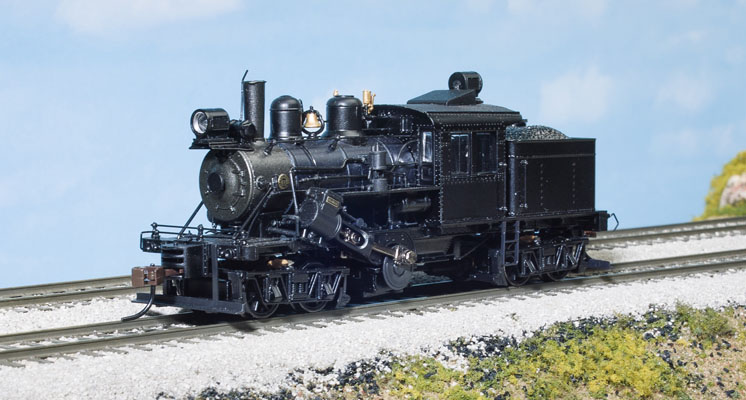
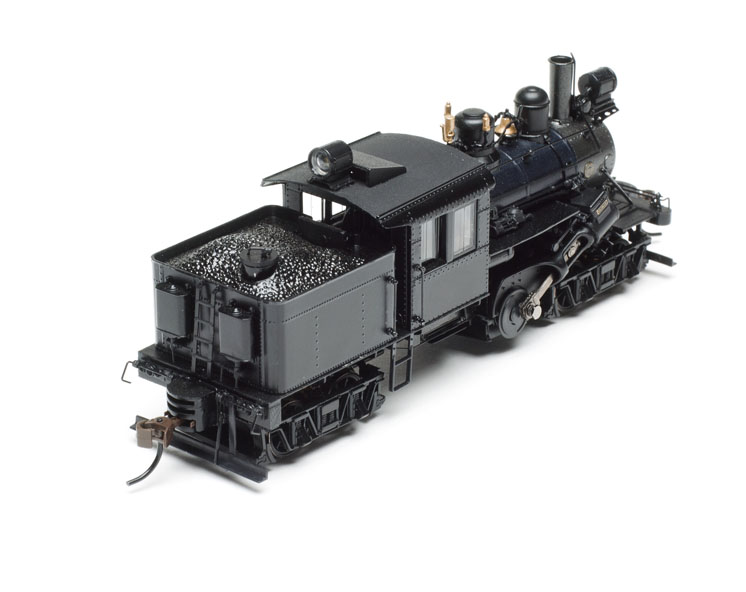
Die-cast metal construction and a prototypical mechanism highlighted the Bachmann HO scale two-truck Climax back when I reviewed it in the February 2006 Model Railroader. The geared logger is back and now includes a factory-installed Digital Command Control (DCC) decoder. It also supports a plug-in module (sold separately) that provides the sound and performance of a SoundTraxx Tsunami decoder.
Prototype. Between 1888 and 1928, the Climax Manufacturing Co., eventually renamed Climax Locomotive Works, built more than 1,000 geared locomotives for logging, mining, and industrial customers. Most were either two-truck (class B) or three truck (class C) locomotives built to customer specifications.
The prototype for the Bachmann model is a standard gauge 55-ton class B Climax built in 1910 for Moore-Keppel Lumber Co. This two-truck Climax currently hauls tourists for the Durbin & Greenbrier Valley RR.
The model. Made almost entirely of die-cast metal, the Bachmann Climax features well-defined boiler bands, rivet seams, and other molded detail. Separate parts include handrails, piping, throttle linkage, and single-phase air compressor.
The fully round boiler, spoked wheels, and blackened metal side rods add to the models’ realism. The cab interior features a molded boiler backhead.
Most of our unlettered review sample is painted in satin black finish. The matte finish on the cab roof simulates an area where soot would accumulate on the prototype. The smokebox and stack are painted to represent a graphite finish.
I appreciated that Bachmann included round builder’s plates on the smokebox as well as rectangular climax nameplates on the steam chests.
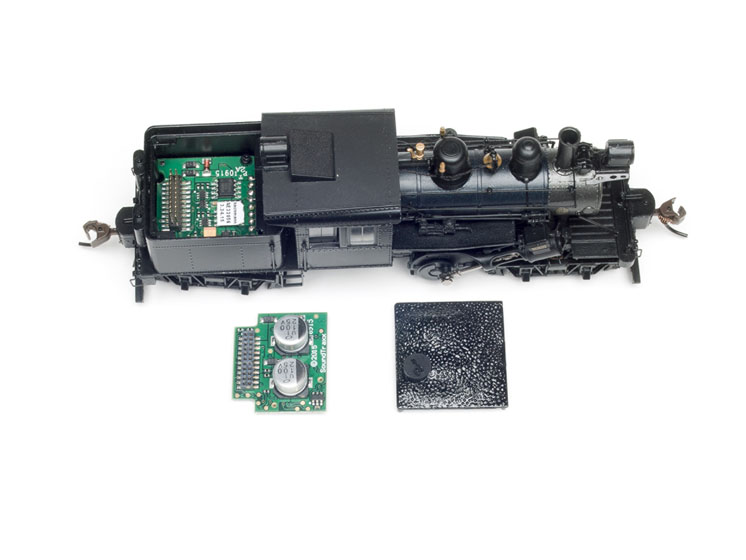
Mechanism. The can motor and flywheel are enclosed by the boiler. The mechanism operates like its prototype, as a center gearbox transfers power via front and rear drive shafts to both truck-mounted gearboxes. One major improvement over the previous release is that all the gears are now metal.
A downward-facing round speaker enclosure is mounted to the frame under the coal/water bunker. Removing the die-cast metal coal load reveals the Bachmann DCC decoder. The board has a 21-pin socket for the sound module. The Climax can operate on direct-current (DC) as well as DCC layouts.
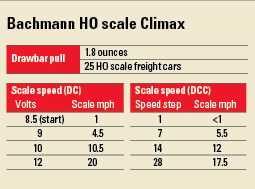
Performance. All-wheel drive makes the Climax a powerful puller for a locomotive of its relatively small size. In addition to having a drawbar pull equivalent to 25 free-rolling HO freight cars on straight and level track, the locomotive hauled an 8-car train up a 3 percent grade without slipping or stalling.
During DCC and DC speed tests, the locomotive crept along steadily at 1 scale mph or less. The charts from the speed and drawbar tests are shown on the right.
The model’s speed and pulling performance were the same after I installed the sound module. The big difference is that once the sound module was installed I had access to more configuration variables (CVs) to fine-tune performance, including setting up speed tables.
DCC sound. I placed the sound-equipped Climax on the rails of our DCC-equipped layout and heard steam hisses and the thumping of an air pump. At random intervals I heard the sound of a fireman scooping coal into the firebox. Once the locomotive got underway, the exhaust chuffs were synchronized with the mechanism.
With its sound module installed, the locomotive has the same features as a SoundTraxx Tsunami-equipped Bachmann Spectrum-series steam locomotive, including the arrangement of the functions. These user-triggered effects include the headlight, bell, long and short whistle, blowdown, and coupler. The default whistle is a 3-chime type that sounds reminiscent of the prototype. A single-chime and peanut type are also available. Function 6 triggers the sound of a water stop.
The squealing brake sound activates when the throttle is decreased. The sensitivity of this feature can be adjusted or completely turned off using CV198, which is what I did. I prefer to have the brake independent of the throttle, so I mapped function 7 to the brake effect and used CV61 to set up that button to actually function as a brake. Note that the default function setup on the Bachmann decoder is different than an aftermarket Tsunami board. This meant that for the Climax I had to set CV34 to 0 to access the brake effect.
One of my favorite features is the Dynamic Digital Exhaust. With this feature, the exhaust sound varies in volume and timbre according to both the load placed on the motor and the throttle setting. Several CVs are available to adjust this effect. Depending on these settings, the exhaust gets louder when the locomotive pulls a heavy train, starts out, or heads upgrade. The exhaust gets softer and the rod clanks get louder when the engine runs light or heads downgrade.
When drifting down a long, steep grade I also like to mute the exhaust sound altogether. A locomotive shouldn’t be working steam going downhill. This effect is easy to accomplished on-the-fly by muting the exhaust volume.
Another favorite feature is independent volume control for all sound effects. The decoder’s features are described in an online user’s manual that’s available as a free download from both the Bachmann and SoundTraxx websites.
DC sound. When run on a DC layout, the locomotive’s sounds are limited to automatic effects. The exhaust chuffs are in time with the mechanism. I heard squealing brakes when I rapidly decreased the throttle. The random air pump and fireman effects were also present. Those with access to a DCC system or DC sound controller, such as the Model Rectifier Corp. Tech 6, can program and trigger other effects, including the whistle and bell.
The addition of DCC and sound make this detailed geared logger better than ever.
Price: $399 (DCC, no sound),
$129 (sound module)
Manufacturer
Bachmann Industries Inc.
1400 E. Erie Ave.
Philadelphia, PA 19124
www.bachmanntrains.com
Era: 1910 to 1960 (or present as excursion locomotive)
Road names: Painted and unlettered, Demonstrator no. 3, Moore-Keppel, and W.M. Ritter
Features
▪▪All-wheel electrical pickup
▪▪Chemically blackened RP-25 contour metal wheels in gauge
▪▪Die-cast metal construction
▪▪Directional light-emitting diode headlight and backup light
▪▪E-Z Mate Mark II knuckle couplers, at correct height
▪▪Flywheel-equipped can motor
▪▪Minimum radius: 15″
▪▪User-installed snowplow
▪▪Weight: 8 ounces