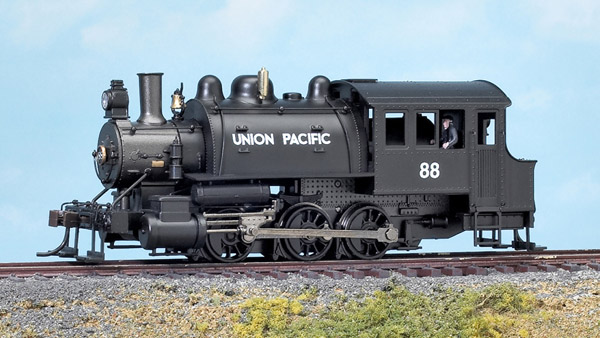
The prototype. Saddle-tank steam switchers didn’t require a tender, so they could handle the tight curves and light rail of industrial track. These locomotives carried a relatively small amount of coal or fuel oil, usually behind the cab, and carried water in a tank that surrounded the boiler.
Saddle-tank steam switchers were used in mining, lumber, and other industrial operations through the steam and steam-to-diesel transition eras. Many of these lightweight locomotives also served as “shop goats” at railroad locomotive and car shops. The wheel classification for this type of locomotive has a “T” at the end to designate it as a “tank” engine.
The prototype for the Bachmann model is an 0-6-0T built by Alco in 1910 for a mining operation in eastern Ohio. The HO scale locomotive matches prototype drawings in the Model Railroader Cyclopedia Vol.1: Steam Locomotives (Kalmbach Publishing Co.).
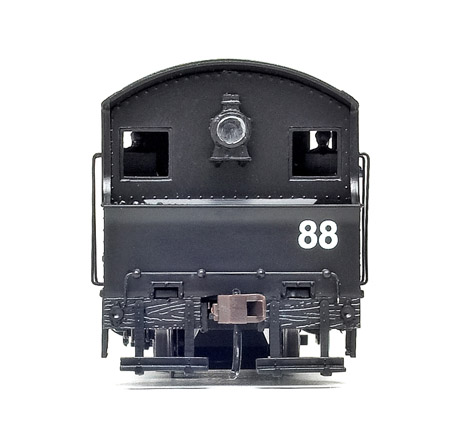
All the lettering on the locomotive is straight and opaque. Two copper-colored rectangles representing builder’s plates are printed on the sides of the graphite-colored smoke box. The black paint on the boiler, coal bunker, and cab has a smooth satin finish.
The body shell is made of plastic. Separately applied detail parts include the piping and sand lines. The bell, whistle, handrails, and stanchions are metal.
Molded details are well defined, including the rivet seams on the cab roof and the wood grain on the pilot beam. The cab interior includes a molded backhead and painted crew figures. None of the windows have glazing.
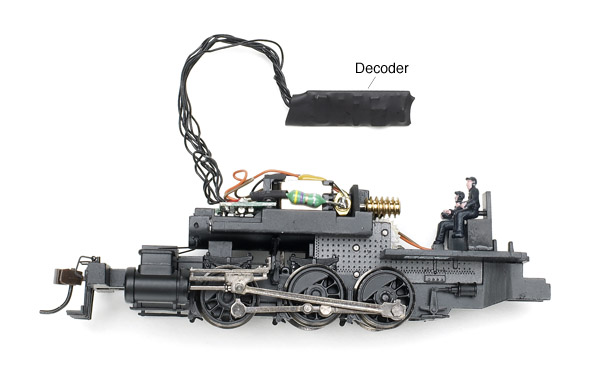
The frame, including the cylinders, is die-cast metal. The motor is mounted on top of the frame and connected via a worm gear to a gear box that turns the rear axle. The metal side rods transfer power to the other two axles. The running gear is chemically blackened for a more realistic appearance.
The printed circuit board is above the motor. The Bachmann DCC decoder measures 5/16″ x 1″ and has seven wires that are soldered to the PC board.
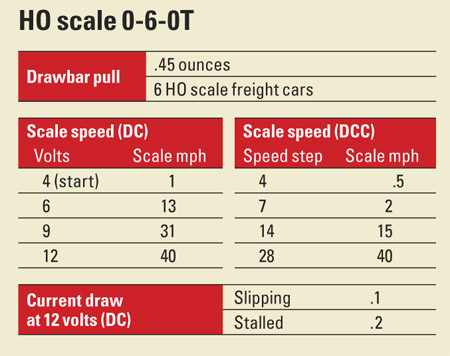
I also ran the engine with an NCE Corp. Powercab DCC system. The Bachmann decoder supports 28 or 128 speed steps. However, even after setting the starting voltage (CV2) to its maximum value of 32, the model didn’t move until speed step 4 when running in either 28 or 128 speed steps.
Function 0 turns the headlight on and off, and function 1 dims the headlight. When the engine is in reverse the backup light shines.
In both DC and DCC the switcher accelerated to 40 scale mph, which is fast for an industrial switcher.
According to a test with a digital force meter, the switcher has a drawbar pull equivalent of six HO freight cars on straight and level track. On our layout the 0-6-0T pulled a cut of eight cars, but it struggled up a grade and when pushing the eight cars through curves.
This tank engine is a well-detailed model, but be mindful of its light pulling capacity.
Price: $125
Manufacturer
Bachmann Trains, Inc.
1400 E. Erie
Philadephia, PA 19124
www.bachmanntrains.com
Road names: Union Pacific; Atchison, Topeka & Santa Fe; Colorado Mining Co.; Midwest Quarry & Mining Co.; Weyerhaeuser. Painted and unlettered version available.
Era: 1910 to 1950s
Features: