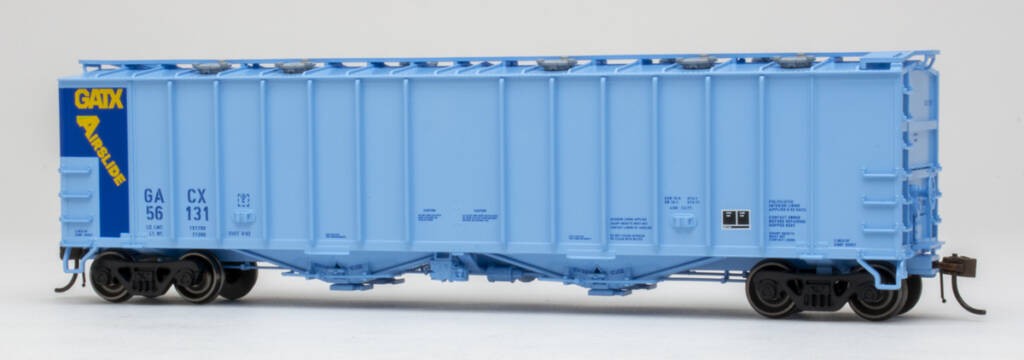
A newly-tooled model has joined the Bachmann HO scale freight car lineup. The General American 4,180-cubic-foot capacity Airslide covered hopper, offered in four paint schemes, features injection-molded plastic construction, 36″ metal wheelsets, and body-mounted E-Z Mate Mark II plastic couplers.
Prototype history
General American produced the 4180 Airslide from 1963 to 1980. The cars were designed to transport dry, granular, and powdered products. Some examples include clay, flour, starch, and sugar.
During the course of the 4180’s lengthy production run, changes were made to the car, referred to by railfans as “phases.” Details on the Bachmann model align with the phase TZL cars built between 1966 and 1969. Spotting features include a low brake wheel and four grab irons on each side corner.
The sample we received is decorated at GATX Capital 56131, part of the GACX 56112 through 56132 series. The prototype car was built by General American in November 1981. The full-size covered hopper, though similar in appearance to the 4180, was built to the larger 4566 Airslide specifications. These cars were produced between 1978 and 1985. Some full-size 4180s were also painted in the GATX two-tone blue scheme. Other road names offered by Bachmann are correctly numbered to match 4180 Airslide covered hoppers.
Model features
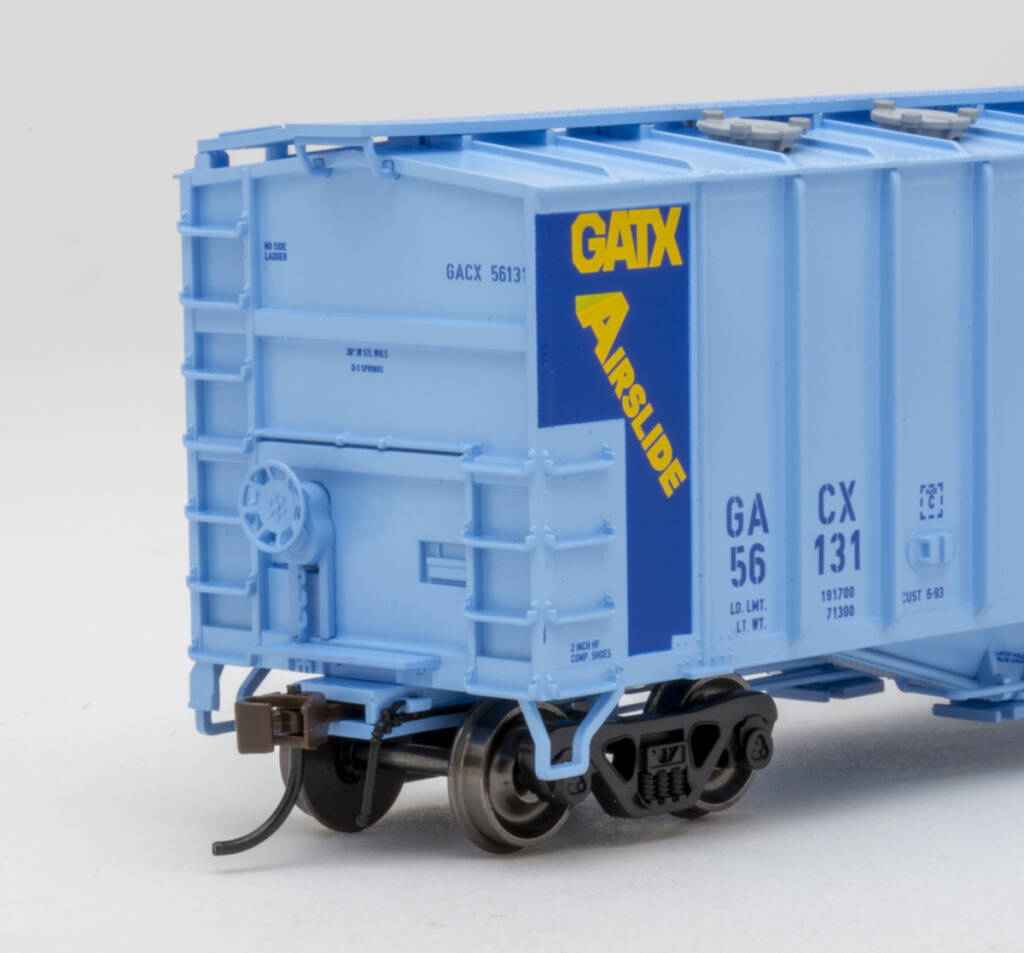
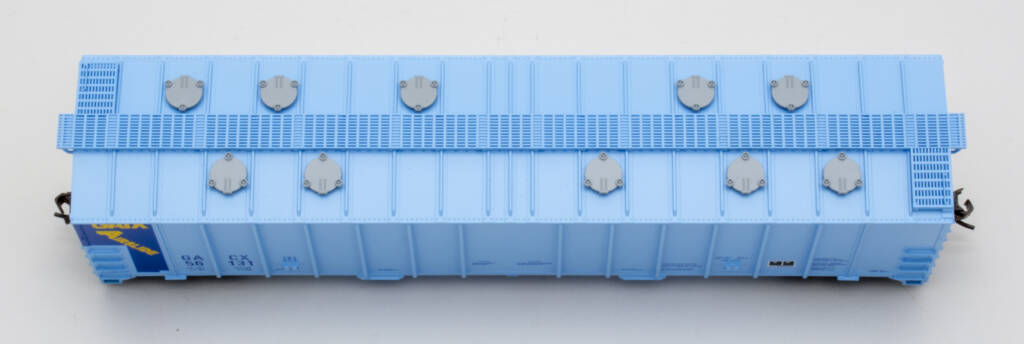
The ready-to-run model has a one-piece body. The roof features a factory-applied, see-through plastic running board casting with molded grab irons on the laterals and 10 hatch covers.
The grab irons, shaker brackets on the sides, and the stirrup steps are all molded. The hand brake, brake wheel, and crossover platforms are factory-applied details.
A pair of vertical stiffeners that run from the top of the sill to the bottom of the first horizontal post on the car ends were omitted.
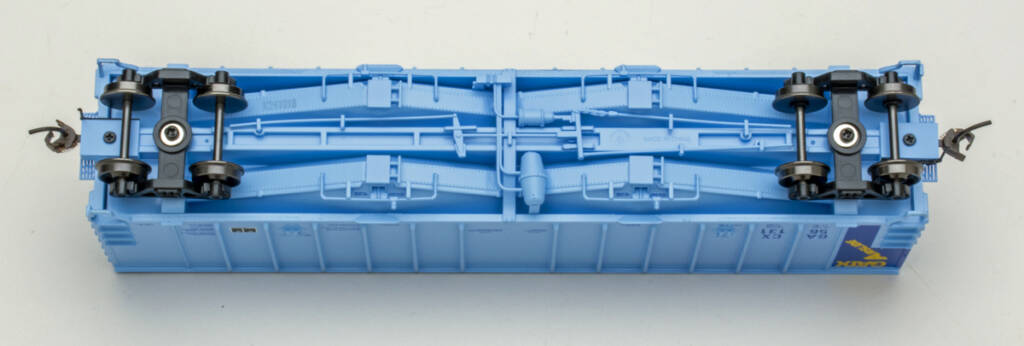
The underbody is a separate plastic casting. Four tabs, two per side, lock into slots on the inside of the body shell. A steel weight is attached to the top of the underbody with a pair of screws.
Though the inner and outer trough plates are molded, most of the remaining underbody details are freestanding. The outlet piping fits into molded brackets. The gravity outlets are factory applied, as is the lateral underframe support brace.
The brake system, which is easy to see on the Airslide covered hopper, is nicely rendered. Molded plastic auxiliary and emergency reservoir pipes run from the air reservoir to the control valve. Similarly, a molded brake cylinder pipe connects its namesake with the control valve. Related rods, support brackets, and levers are also represented.
The draft-gear boxes are molded as part of the underbody. Screw-mounted plastic covers hold the couplers in place. A plastic air hose with angle cock and glad hand detail is attached to the side of the box on both ends.
A closer look
Our review sample is neatly painted in GATX Capital’s two-tone blue scheme. Graphic placement matches prototype images of GACX 56131 that I found online. The load limit and light weight are accurate for the road number.
Prototype drawings of the GATX 4180 Airslide were published in the 1966 Car and Locomotive Cyclopedia of American Practice (Simmons-Boardman Publishing Corp.) The truck centers are correct. The model measures a scale 50′-2″ over the end sills, compared to the prototype’s 49′-9″. The length over the running boards is a scale 6″ too long.
I took the Airslide over to our Winston-Salem Southbound Tar Branch to test it in a train while dropping off and picking up freight cars at industries. The covered hopper had no troubles while being pushed and pulled.
Bachmann offers the General American 4,180-cubic-foot capacity Airslide covered hopper in a colorful assortment of paint schemes covering the mid-1960s through the 2000s. If your HO scale layout has rail-served customers that ship or receive dry, granular, or powdered products, this is a model worth checking out.
Facts & features
Price: $65
Manufacturer
Bachmann Trains
1400 East Erie Ave.
Philadelphia, PA 19124
bachmanntrains.com
Era: 1966 to 2000s (varies based on paint scheme)
Road names: GATX Capital, Burlington Northern, CSX, and Union Pacific. Two road numbers per paint scheme.
Features
- 36″ blackened metal wheels, in gauge
- Body-mounted E-Z Mate Mark II couplers, at correct height
- Weight: 3.8 ounces, .7 ounce too light per National Model Railroad Association Recommended Practice 20.1