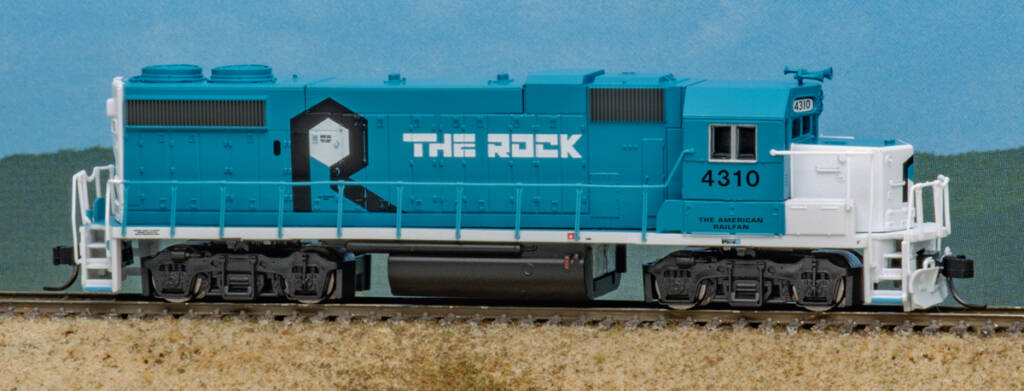
An Electro-Motive Division GP38-2 has been added to the Master Line from Atlas Model Railroad Co. The N scale model, based on a Phase II prototype, uses former Walthers (and before that Life-Like) tooling that Atlas acquired back in 2018.
Prototype history
Electro-Motive Division produced the GP38-2 from January 1972 until July 1986. More than 2,200 units were built during the production run. The 2,000-hp road switcher was fitted with a 16 cylinder, 645E3 diesel engine; an AR10 alternator; and D77B traction motors.
Our review sample is decorated as Rock Island No. 4310, from the railroad’s 4300 through 4314 series delivered in August and September 1976. The railroad had two other groups of GP38-2 locomotives, 4315 through 4355 (delivered between September and November 1976) and 4368 through 4379 (delivered in November 1978).
When the Rock Island shut down on March 31, 1980, units 4300 through 4325 were sent back to Equilease. The engines later became part of the Missouri Pacific fleet, numbered 2238 through 2263.
Model features
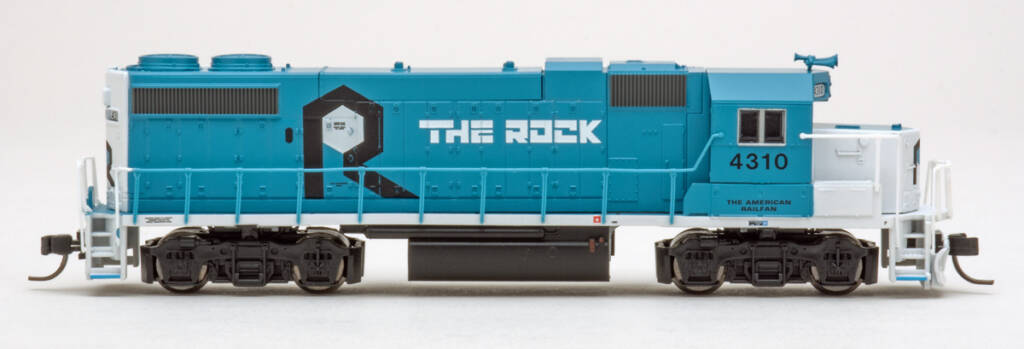
The Atlas GP38-2 features a multi-piece plastic body consisting of the cab, long and short hood, and sill unit. There are four holes by the lead radiator fan for a winterization hatch (not included with the Rock Island model). The water-level sight glass window is printed on the engineer’s side of the long hood.
The Geep has a mix of molded and separate, factory-applied details. The class lights, eyebolts, grab irons, m.u. hoses, and uncoupling levers are among the molded parts. Freestanding details include the air horn, bell, electrical cabinet air filter box, radiator fans, and snow plow. The handrails are molded in flexible engineering plastic.
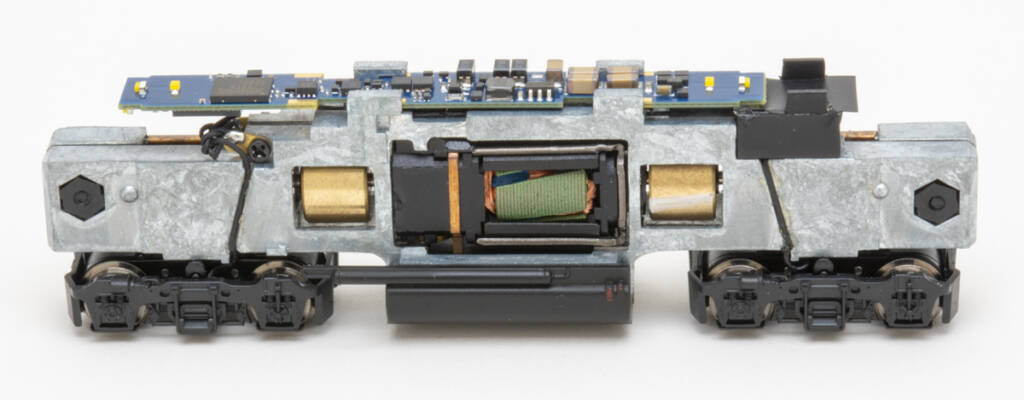
The GP38-2 has a split, die-cast metal frame that encloses the motor and flywheels. Wires run between the wheel wipers and metal tabs attached to the frame with screws. The ESU LokSound V5 decoder is mounted on top of the frame. The speaker, also in DC models, is located in the fuel tank.
Measuring up
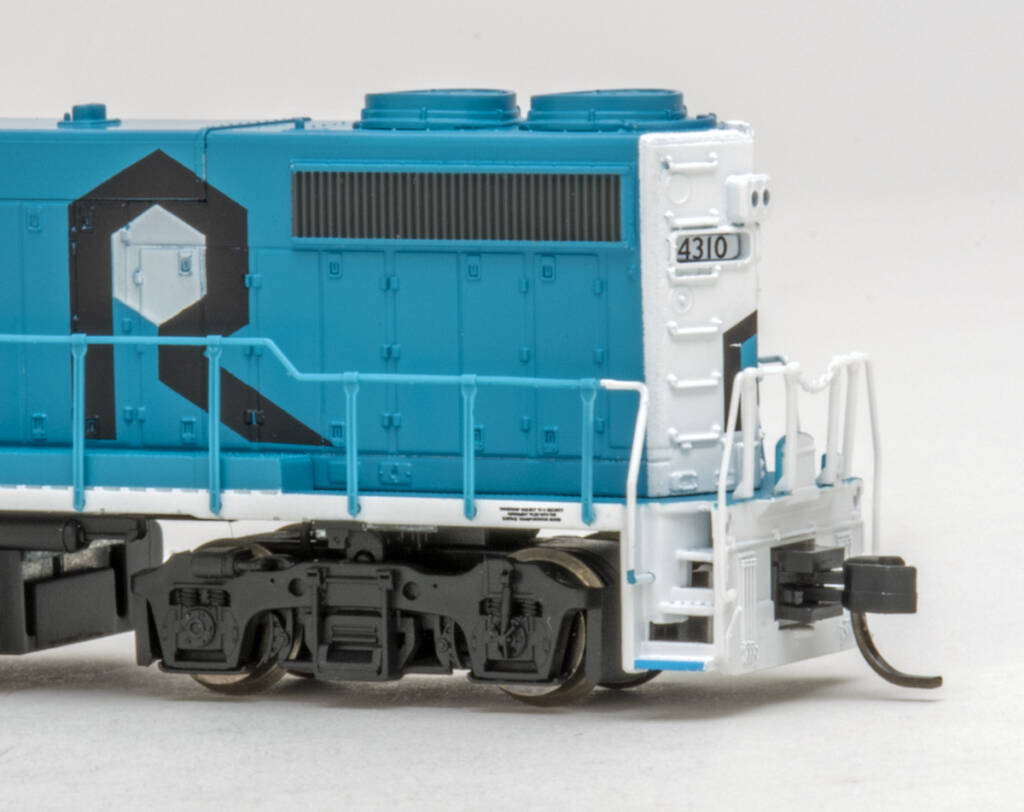
The sample we received is neatly painted in Rock Island’s blue-and-white scheme, dubbed by railfans as “Bankruptcy Blue.” The placement of the graphics follows prototype photos.
There are some detail discrepancies between the model and prototype. The Atlas model has an angled paper air filter box; the prototype’s was square. The front anticlimber on the model follows the lines of a style used on early 1980s production GP38-2s. The prototype unit had a Nathan P5 air horn, not a three-chime horn.
The model’s dimensions match prototype drawings published in the Model Railroader Cyclopedia: Vol. 2, Diesel Locomotives (Kalmbach Publishing Co., out of print). I tested the hood unit at the workbench with an NCE Power Cab. At step 1, the model moved at 1 scale mph. The locomotive achieved a top speed of 78 scale mph. The full-size road switchers had a maximum speed between 71 and 83 mph depending on the gear ratio.
To see how the Atlas model performed in an operating layout environment, I took the unit over to our Milwaukee, Racine & Troy State Line Route. The GP38-2 pulled nine hoppers to the quarry and effortlessly led a 13-car freight train on the main. The locomotive had no issues navigating the model railroad’s generous 18″ radius curves and No. 6 turnouts.
The Atlas N scale Phase II GP38-2 joins the Phase I model that was added to the manufacturer’s Master Line back in 2006. This one-two punch of four-axle road switchers is a great asset for those modeling the early 1970s to the present day in 1:160 proportion.
Facts & features
Price: Direct-current model with factory-installed speaker, $134.95; with ESU LokSound V5 sound decoder, $234.95. Subtract $10 for undecorated models.
Manufacturer
Atlas Model Railroad Co.
378 Florence Ave.
Hillside, NJ 07205
shop.atlasrr.com
Era: January 1972 to present (varies based on paint scheme)
Road names: Rock Island; Alaska RR; Canadian Pacific; Chicago, South Shore & South Bend; Conrail; GATX Locomotive Group; Norfolk Southern; and Southern Pacific. Two to three road numbers per paint scheme; also available undecorated.
Features
- Body-mounted Accumate couplers at correct height
- Metal wheel stubs on plastic drive axle gears, properly gauged
- Weight: 2.4 ounces
Share this article