

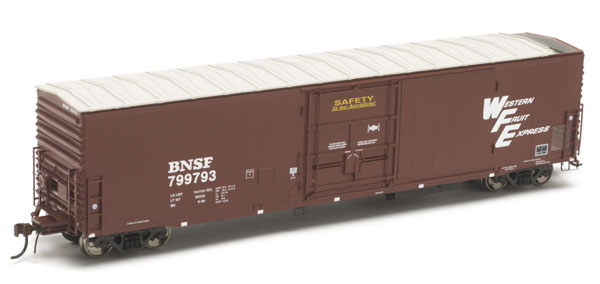
Our sample is decorated as BNSF Ry. no. 799793. The full-size car was part of an order built for the St. Louis-San Francisco at FGE’s Alexandria, Va., shops in 1971.
The model’s dimensions closely match drawings in the 1974 Simmons-Boardman Car and Locomotive Cyclopedia. The distance over the pulling faces was a scale foot too long, but this is typical due to the design of model couplers. Information on the compact disc Freight Cars Illustrated, Vol. 12 states that the reefer was upgraded with a Thermo King SD-711-SR tractor-trailer style refrigeration unit. It’s lettered as a Carrier unit on the model.
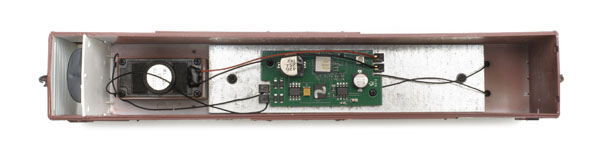
Out of the box, the sound was so loud it vibrated the plastic roof, creating a rattling sound. I lowered the volume to approximately 60 percent, which resolved this issue.
Then I placed the car, with its volume adjusted, at different locations in a 15-car (all with metal wheelsets) train pulled by a sound-equipped engine on our HO scale Milwaukee, Racine & Troy. Not surprisingly, the sound-equipped reefer was hard to hear right behind the locomotive. The sound unit had maximum impact when the car was placed mid-train and beyond. Visit our website, www.ModelRailroader.com, to see (and hear) the demonstration.
The refrigeration-unit sounds cycle on and off automatically. The sound cycle lasts just under two minutes.
On DC, the sound decoder started at 7.8V, a whisker above the minimum 7.7V necessary for operation. Per the instructions, the car shouldn’t be run on layouts with track voltage higher than 19V.
The Athearn Genesis 57-foot FGE mechanical reefer is a well-executed model on its own. The sound decoder
is icing on the cake.
Manufacturer
Athearn Trains
1600 Forbes Way, Ste. 120
Long Beach, CA 90810
www.athearn.com
Era: 1971 to present (as decorated)
Road names: BNSF Ry. with Western Fruit Express lettering (mineral red in six numbers). See website
for additional road names.
Features
- McHenry scale knuckle couplers, mounted at proper height
- Metal wheels mounted on plastic axles, correctly gauged
- Separately applied details
- Weight: 5.5 ounces (0.5 ounce too heavy based on NMRA recommended practice 20.1)
- Wire grab irons and stirrup steps