Most modelers can pinpoint the photos, people, events, books, or stories that inspired them to build their model railroads. For me, I can honestly say that my N scale Naugatuck Valley RR started with a lone boxcar – a Micro Trains 40-foot single-door boxcar decorated in New Haven black and orange.
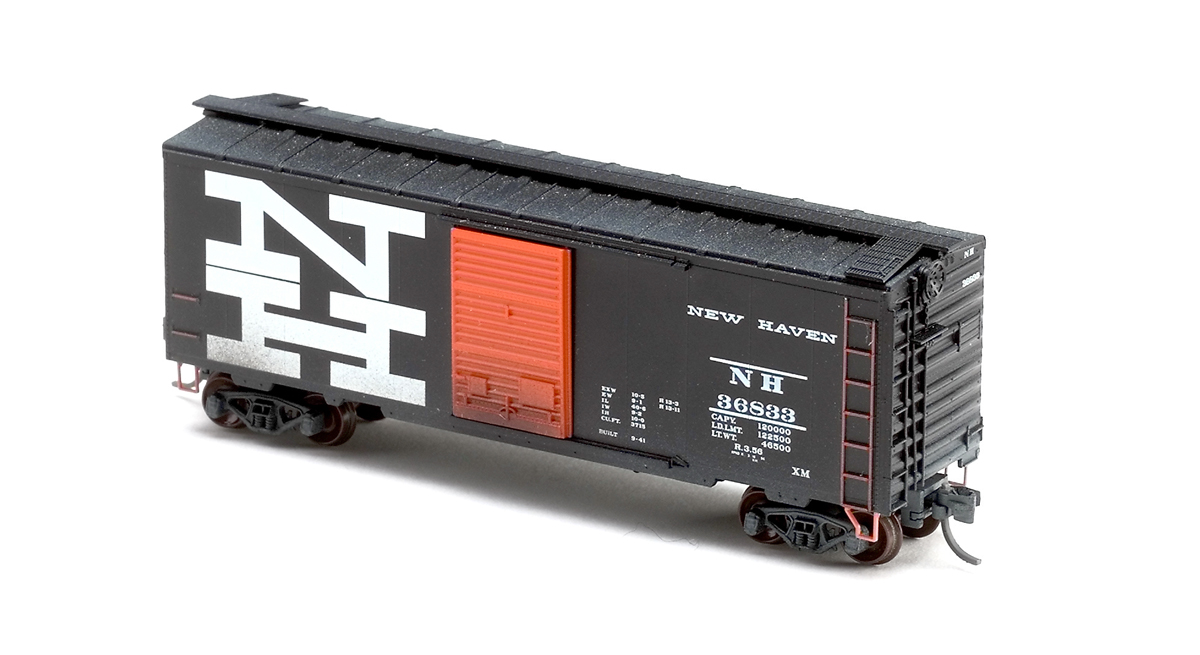
I got the car in December 2001, just a few weeks after I’d come to work for Model Railroader. The boxcar had been sent to the office as a product sample. After being photographed and written up for the magazine, the car went on display in my office. It’s hard to believe that my current layout owes its existence to that chance encounter with a boxcar (which, since I modeled in HO, was the wrong scale), but that’s how it happened… sort of.
No, that night I didn’t drive straight from work to the nearest Home Depot and start buying lumber; it took a bit longer for that to happen. But the boxcar provided the initial push for me to do some research and start scribbling plans. There was also a house to build, but I’m getting ahead of myself.
From Soo to New Haven
During my first four months at MR, I lived out of a hotel during the week and drove home to Illinois on weekends. This meant I had a lot of free time on my hands on weeknights, and I often read railroad books in the company library. I’m a big fan of the Soo Line, and it didn’t take much time for me to exhaust Kalmbach’s supply of Soo Line material. Remembering the New Haven Micro-Trains boxcar while looking for something else to read one night, I picked up a book on the New York, New Haven & Hartford RR.
The book was Diesel Locomotives of the New Haven Railroad, by H.F. Cavanaugh (N.J. International, Inc., 1980). It featured nice color photos and provided a look at the New Haven’s system, including simple maps and information on some of the typical train movements and consists during the late 1950s and 1960s. It was a great entry point into the railroad and got the layout design wheels rolling. I read a few more New Haven books, and then I started sketching some ideas for a New Haven plan.
I figured I could build a small N scale layout while the house was under construction. Digging back through my New Haven research, I chose a sketch I’d made for a door-sized layout based on the railroad’s Naugatuck Branch. The line had “model railroad” written all over it since it featured picturesque New England scenery, good switching, and some light passenger traffic.
After I’d started the Naugatuck, I thought that it might be a good idea to write an article about apartment model railroading and provide some tips on how to build the layout and still get your security deposit back when you move. The results of that project turned into the first year of the “Step by Step” column in the magazine.
The layout wasn’t quite finished when the house was done, so when we moved, I set it up in a corner of the basement and completed it later that same year. But then the layout just wouldn’t leave. Before I knew what was happening, I’d tripled it in size to include the line’s hub, Waterbury, Conn. I then worked out the operating scheme for the layout and drafted plans to expand the line all the way to its terminus at Winsted, Conn.
And so now I model the New Haven – in N scale – largely thanks to a boxcar and an inspiring prototype railroad.
Naugatuck Railroad history
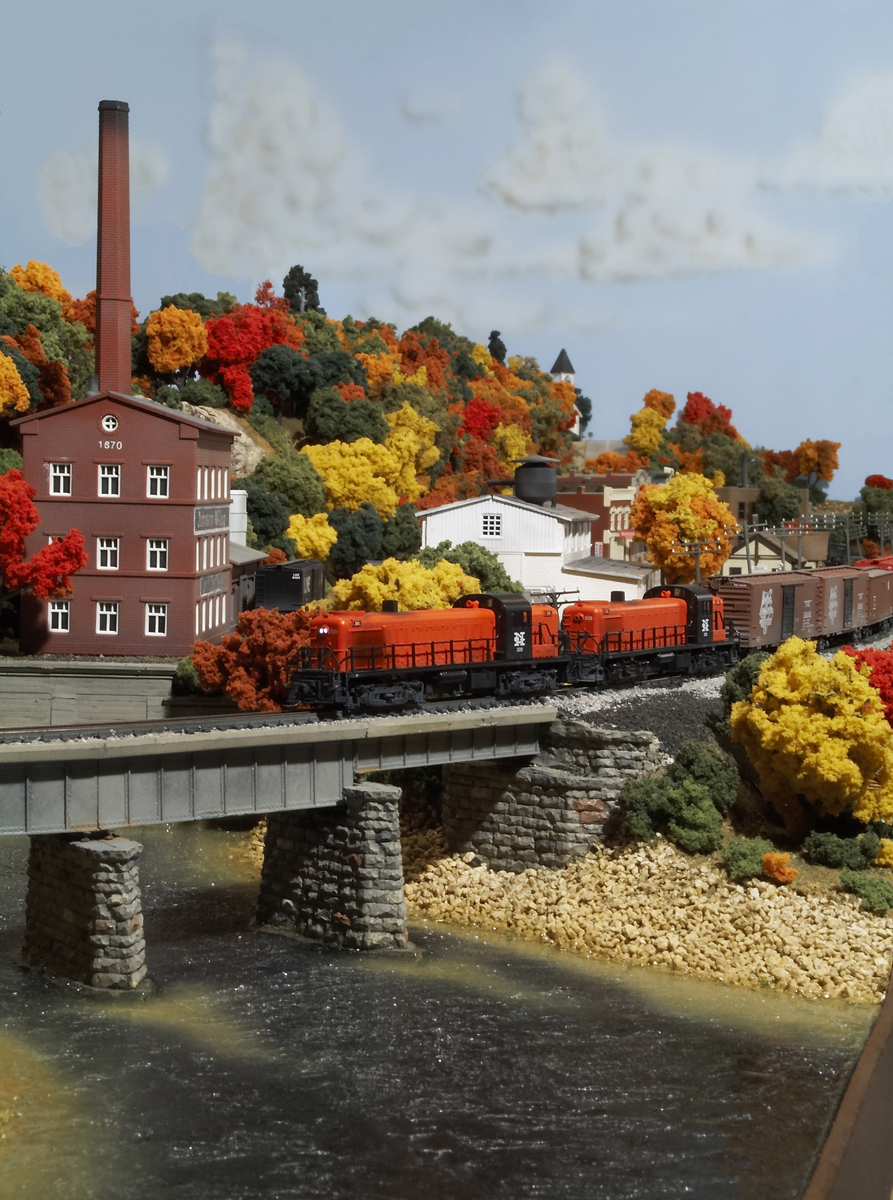
The real Naugatuck Branch got its start in 1849. Chartered as the Naugatuck RR (nicknamed the Naugy) in Waterbury, the main line ran from Winsted south to Devon, Conn., and was completed in little over a year. At Devon, the Naugatuck connected with the New York & New Haven RR and had an agreement with that line to run Naugatuck RR trains all the way to Bridgeport, Conn. There the Naugatuck used steamships to transfer passengers and freight to New York City until the NY&NH completed its line to New York a few years later.
Though the Naugatuck suffered some initial growing pains, largely because of periodic flooding of the Naugatuck River, the line prospered in the growing Connecticut industrial river valley. Additional improvements during these early years included opening a branch line to Watertown, Conn., west of Waterbury; making the main line and its bridges more flood-resistant; constructing railroad shops and docks at Bridgeport; and double-tracking the southern half of the railroad.
Despite the Naugy’s prosperity through the Civil War and beyond, increas–ing competitive pressure from the New York, New Haven & Hartford RR (formerly the NY&NH) resulted in financial woes for the line in the 1880s. The outcome was that the Naugy leased its property to the NH in 1887. This was meant to be a 99-year lease, but the line was eventually deeded over to the NH in the early 1900s. The New Haven ran the Naugatuck Branch until the railroad was absorbed into the Penn Central on January 1, 1969.
Operations in the 1950s
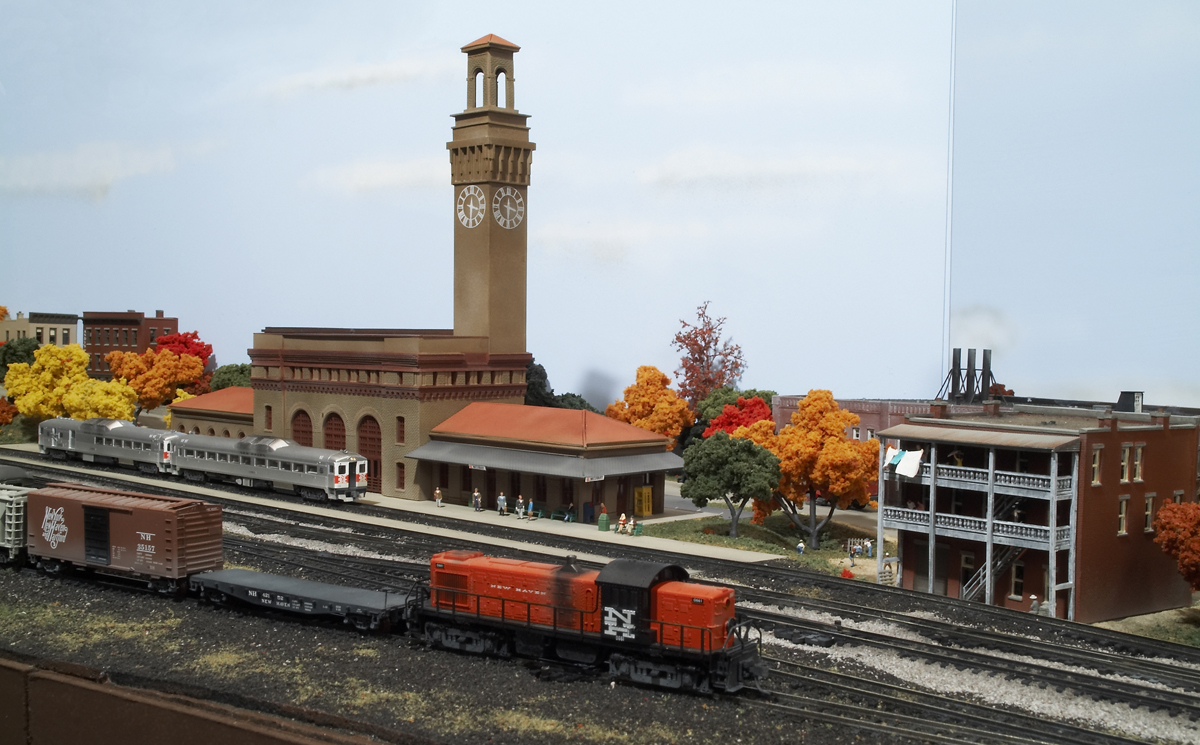
The New Haven’s Naugatuck line in the 1950s is a great fit for a mid-size operating model railroad. In the later ’50s the city of Waterbury saw two inbound and two outbound daily freight trains, an assortment of small way freights, and 10 daily commuter trains. Waterbury also had an impressive brick depot, a yard with local switching crews, an active freight house, and an operating interlocking tower (S.S. 202) at Bank Street Junction. The tower operator was also the dispatcher for the rest of the Naugatuck Branch.
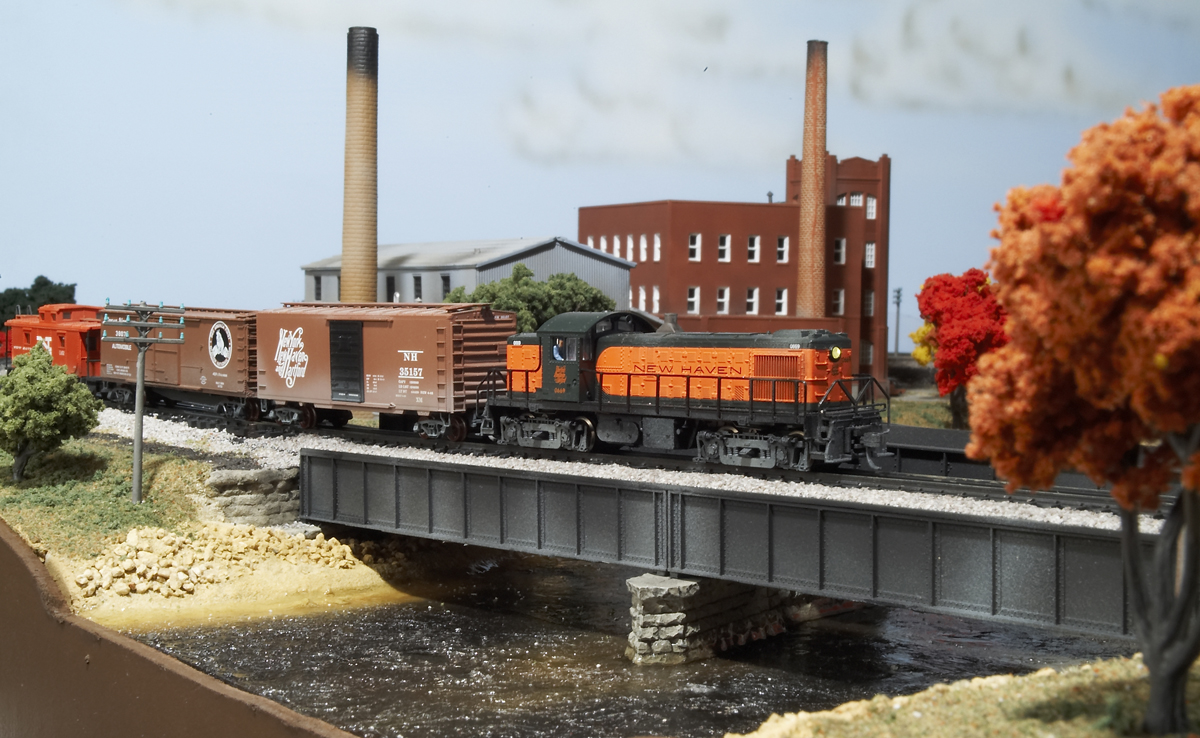
During this time, Waterbury received a daily freight from Cedar Hill Yard (New Haven, Conn.) and one from Maybrook Yard in New York. These trains would terminate in Waterbury’s yard where their cars were classified for the area’s way freights, Waterbury’s freight house, and local switching.
All the way freights were run as turns, originating in Waterbury and returning at the end of the work day. The north train (NX16) would switch industries from Waterbury to Winsted. Another train (NX15) would work the line south from Waterbury to Naugatuck. The third train (NX17) would switch the Highland Branch that ran between Waterbury and Hartford. Waterbury’s yard crew would switch the city’s local industries as well as those along the Watertown branch. When the way freights returned, the yard crew would make up the trains that returned cars south to Cedar Hill and Maybrook.
Late 1950s passenger traffic on the Naugatuck was mostly handled by Budd Rail Diesel Cars (RDCs). There were four daily commuter trains each way from Waterbury to Bridgeport. This was pretty much the same train, made up of two or three RDCs, and it ran back and forth all day (about an hour each way). At Bridgeport, passengers could board trains west to New York or east to New Haven and on to Boston.
There was also a daily commuter run from Waterbury east along the Highland Branch to Hartford. This train left Waterbury in the morning for Hartford and returned in the late afternoon. The RDCs were stored at Waterbury overnight, and there was typically a spare car on hand in case of extra traffic or a mechanical failure.
Operating the layout
The design for my version of the Naugatuck leans heavily towards operation. The layout centers on Waterbury and includes as many of the New Haven’s connecting lines and operating characteristics as possible. The Waterbury portion features key elements such as Bank Street Junction, the depot, the lower yard, and the freight house, though all had to be compressed to fit. Beyond that, the towns and industries on the rest of the railroad are freelanced; I chose good operating characteristics over attempting to re-create the prototype. The final combination still says “New Haven” but fits a model railroad format.
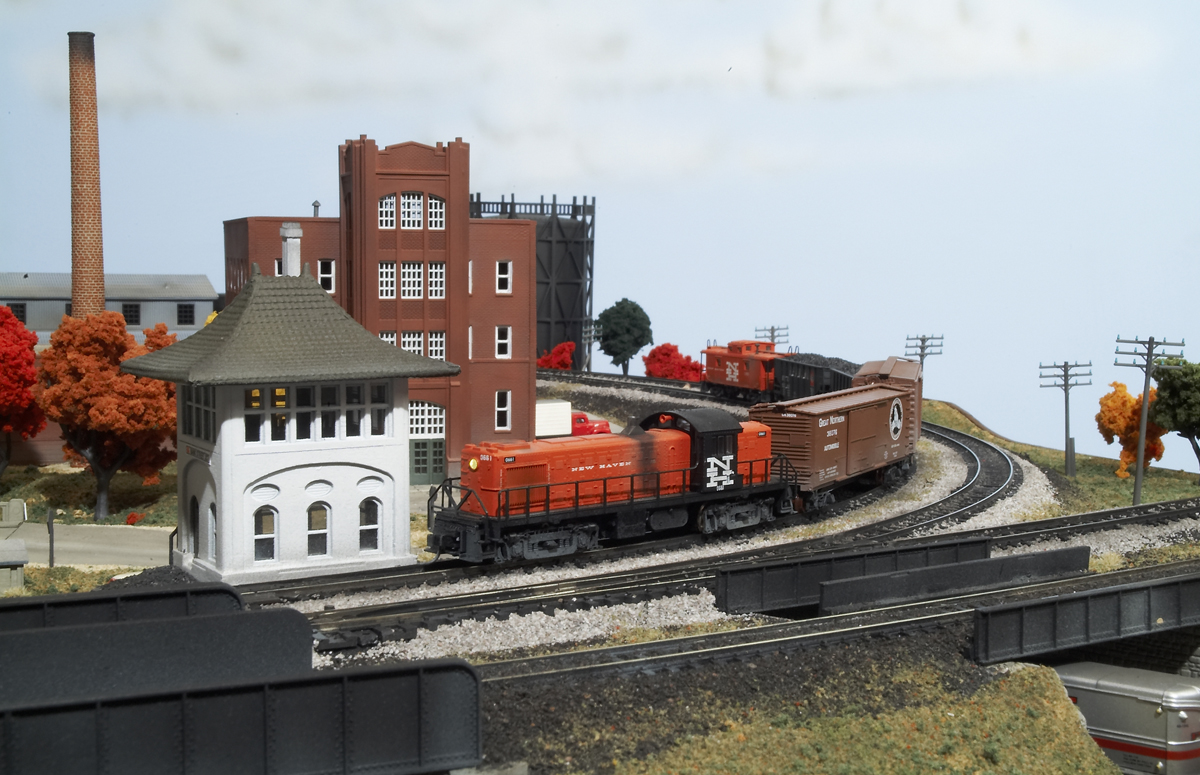
Though the layout takes up the space of a spare bedroom (roughly 10 x 10 feet), don’t be fooled by its small size. The industrial switching work, yard and freight house operations, and moderate schedule of commuter trains will keep a crew of five operators busy for an entire evening. Running trains at prototypical speeds also helps make the railroad seem bigger than it really is.
A typical operating session requires a yardmaster, three road engineers, and a dispatcher. The commuter RDCs are run by anyone available at the moment, including the dispatcher. Though I do have a fast clock, I currently use it to simply mark the passage of time. Instead, I’ve set up the railroad for sequence operation (running trains following a set order). I like the sequence method because I can run a session by myself over the course of several evenings, one job at a time – something that occurs much more frequently than getting a group together.
A typical session
The sequence for a typical operating day is shown on page 56. The first jobs called are the morning Waterbury yard crew and crews for the Cedar Hill and Maybrook trains. Once the two freight trains arrive in Waterbury, the yard crew sorts the cars for the three turns and for the local switch run. While that happens, the RDCs make their initial trips of the day to Bridgeport and Hartford. The Hartford RDC runs into staging and stays there until it returns in the afternoon. The Bridgeport train makes stops at all the stations on its way south.
The first way freight out of the yard is NX15. This train works the towns south of Waterbury. The tire plant and the A&P warehouse at Prospect Hill provide a bunch of switching work. Also, the busy RDC traffic between Waterbury and Bridgeport keeps the crew of NX15 on their toes since they need to keep the station tracks clear for the commuter trains, especially at Beacon where the station platform is located along the siding.
The Hartford way freight (NX17) is out of the yard next. This train runs into staging, swaps cars with a cut in storage, and then returns to Waterbury later in the session. The Hartford cars left in staging at the end of the session are rotated off the layout and replaced by different cars from the pool.
Once the Hartford train is set for its return trip, the same crew then takes NX16 north to Winsted. Currently, the north part of the line on the layout runs only as far as Hancock Bridge. This is a narrow little town along the back wall of the basement. I was originally going to make it just another staging yard, similar to the one used for Hartford, but I decided to included several small industry flats and a depot to make it more interesting. After the crew of NX16 finishes the switching work, like the Hartford run, they pick up another string of cars, this time from the Hancock Bridge siding, and ready their train to return to Waterbury later in the day.
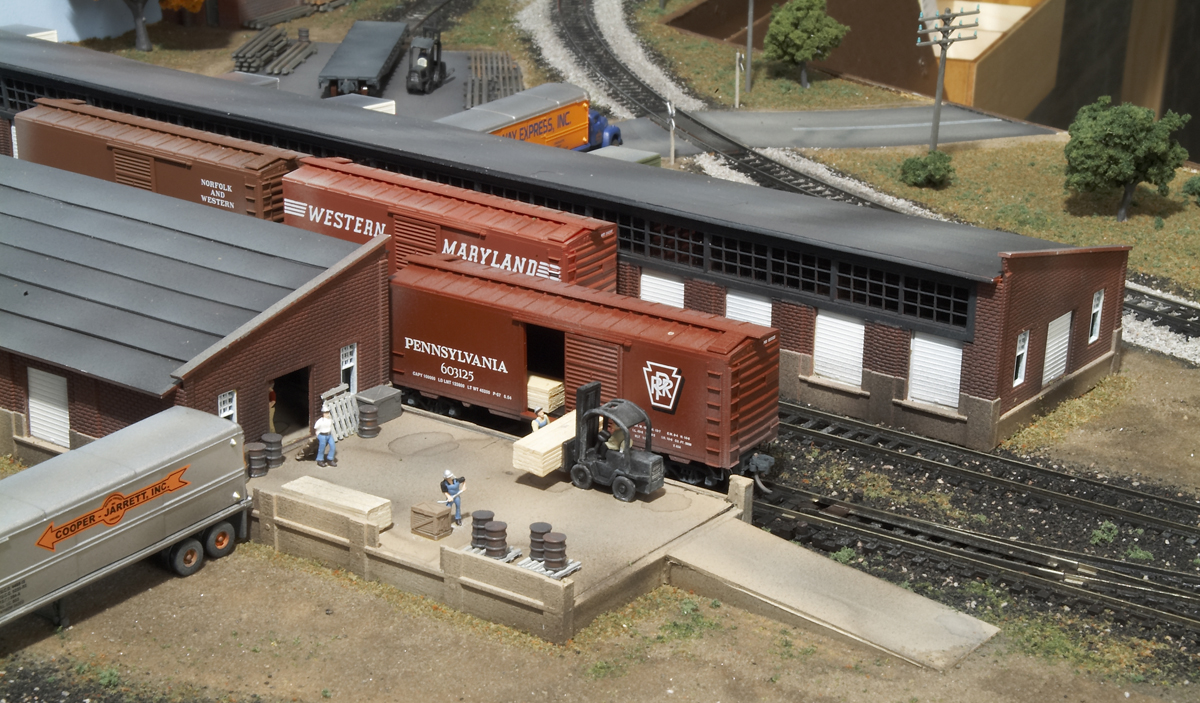
While the yard crew is busy getting the turns out of the yard, the River Job crew starts its day. The first task is to switch cars at the freight house. Waterbury had a very active four-track freight house. The prototype saw more cars through it on an average day than my staging area and yard tracks can supply for the entire model railroad during an operating session, so I cut the structure down to fit my layout. I built it to serve just two tracks, and the model is about half the prototype’s actual length. Near the freight house I also added a car clean-out track. This provides some extra switching work as cars are periodically dropped here to have their interiors cleaned before being used again.
After switching the freight house and cleaning track, the River Job crew next picks up cars for the industries nestled along the Naugatuck River on the south side of the city. Though there are just three of them, American Brass, Grivno Coal, and Quincy Smith Pin Co., switching these industries is somewhat of a puzzle. To get down to river level, the train must use a switchback, the tail of which is big enough for only a locomotive and four 40-foot cars. There is no runaround track here, and two of the three industries have facing-point switches, so all runaround moves must be made on the main line.
The key to success on the River Job is to pull all the outbound cars before doing anything else. With that done, bring in the inbound facing-point cars first, and things are fairly straightforward after that. I’ve watched several people try the River Job, and those that start by taking a string of cars down the switchback, always end up bringing them back out to the main again until they’ve cleared enough room to maneuver.
For a little more operation, I’ve included a Hartford/Maybrook train on the schedule. It was discontinued on the real railroad in 1954. I’ve also added a stop for it in Waterbury to drop off a few Hartford transfer cars before it heads south (and eventually back in to the staging yard).
By this point in the session, the afternoon yard crew is on duty, sorting cars from the arriving turns to put together the Cedar Hill and Maybrook trains. These outbound trains depart in the early evening hours. Also, the RDCs make their final runs and then tie up for the night at the depot.
With that, a session on the Naugatuck is finished. Preparing for the next session is fairly easy. I use car cards with four-cycle waybills, so I turn the waybills to the next step for all but in-transit cars and start again.
More to come
Hancock Bridge will be the jumping-off point for the next expansion of the layout. This phase will include a paper mill and two more towns.
When the addition is complete, it will make train NX16 a full-time job, just like NX15. Also, since I own an RDC-4 (Railway Post Office only), I’m going to use it to add a mail train that runs the entire line, all the way up to Winsted and back. It will be the only train that covers all of the modeled portions of the railroad.
I’ve also drawn up plans to add the Waterbury Gas Works to the front of the Bank Street Junction peninsula, and I’ve already started kitbashing the buildings for it. The gas works will provide a lot more work for the River Job.
These additions will give the layout six session-long operating jobs, including an extra engineer to run all the RDC traffic. It also means that I’ll probably need a few more New Haven boxcars.
Layout at a glance
Name: Naugatuck Valley RR
Scale: N (1:160)
Size: 9′-9″ x 10′-0″
Period: fall 1959
Prototype: New York, New Haven & Hartford RR
Locale: Naugatuck River Valley in Connecticut
Layout style: walkaround
Layout height: 42″
Benchwork: L girders supporting hollow-core doors
Roadbed: cork
Length of mainline run: Waterbury/south 41 feet, Waterbury/north 11 feet
Track: Peco code 55
Minimum turnout: no. 5
Minimum radius: 11″
Scenery: foam insulation board
Backdrop: painted styrene
Control: Atlas Digital Command Control

This article originally appeared in the April 2006 issue of Model Railroader. – Ed.