





Exploring former issues of Model Railroader magazine has always been something of a passion of mine. They are filled with a wealth of modeling tips and inspiring layouts that are still useful to today’s modelers. And through their product reviews and advertisements, old issues of MR provide a snapshot of where the hobby was technologically, as well as clues as to where it might head.
This series started as several years of Facebook posts, called “Lunchtime reading,” and later I expanded some of those musings for Trains.com articles, such as my essay on the history of coffee table layouts in MR.
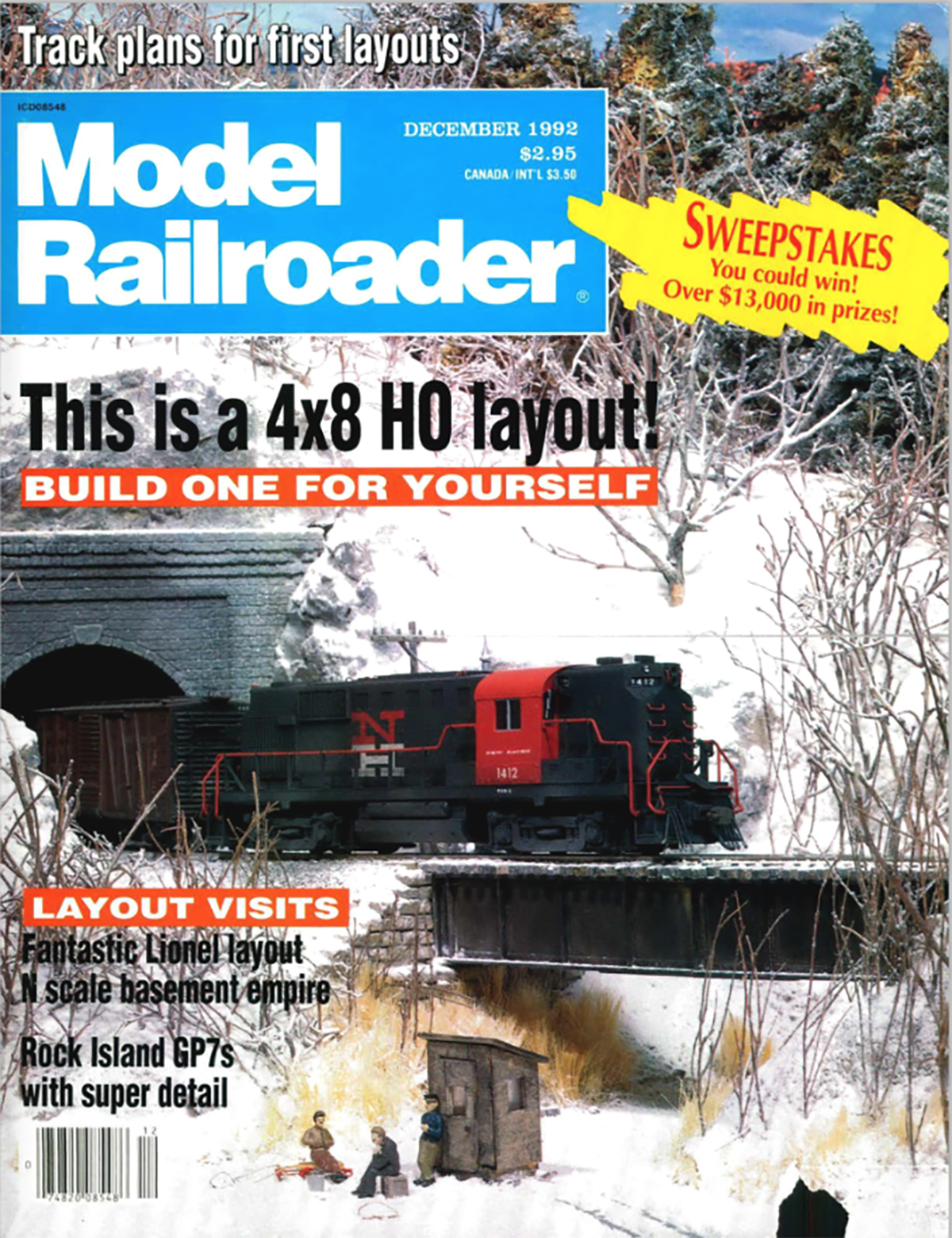
As many of you have responded positively to these articles, I decided to continue along those lines. This time, I selected one of my favorite issues from the 90s, December 1992, to be exact.
Although my dad had subscribed to MR in the 1960s and 70s, by the early 80s, model railroading had become more my thing than his, as he found RC model airplanes to be his new passion, so he let his subscription lapse. It wasn’t until 1989 that I could afford my own MR sub, and then maintained it up until I started working for the magazine in 2001, at which point I got them for free as a perk with the job.
The December ’92 issue stands out in my mind for several reasons, not the least of which includes its striking Lou Sassi cover, which we’ll discuss more in a bit. So please join me as I take you on a personal tour of some of the many things in the issue that I found fun, interesting, or both.
Atlas cartoon ad
Full-page display ad, inside cover
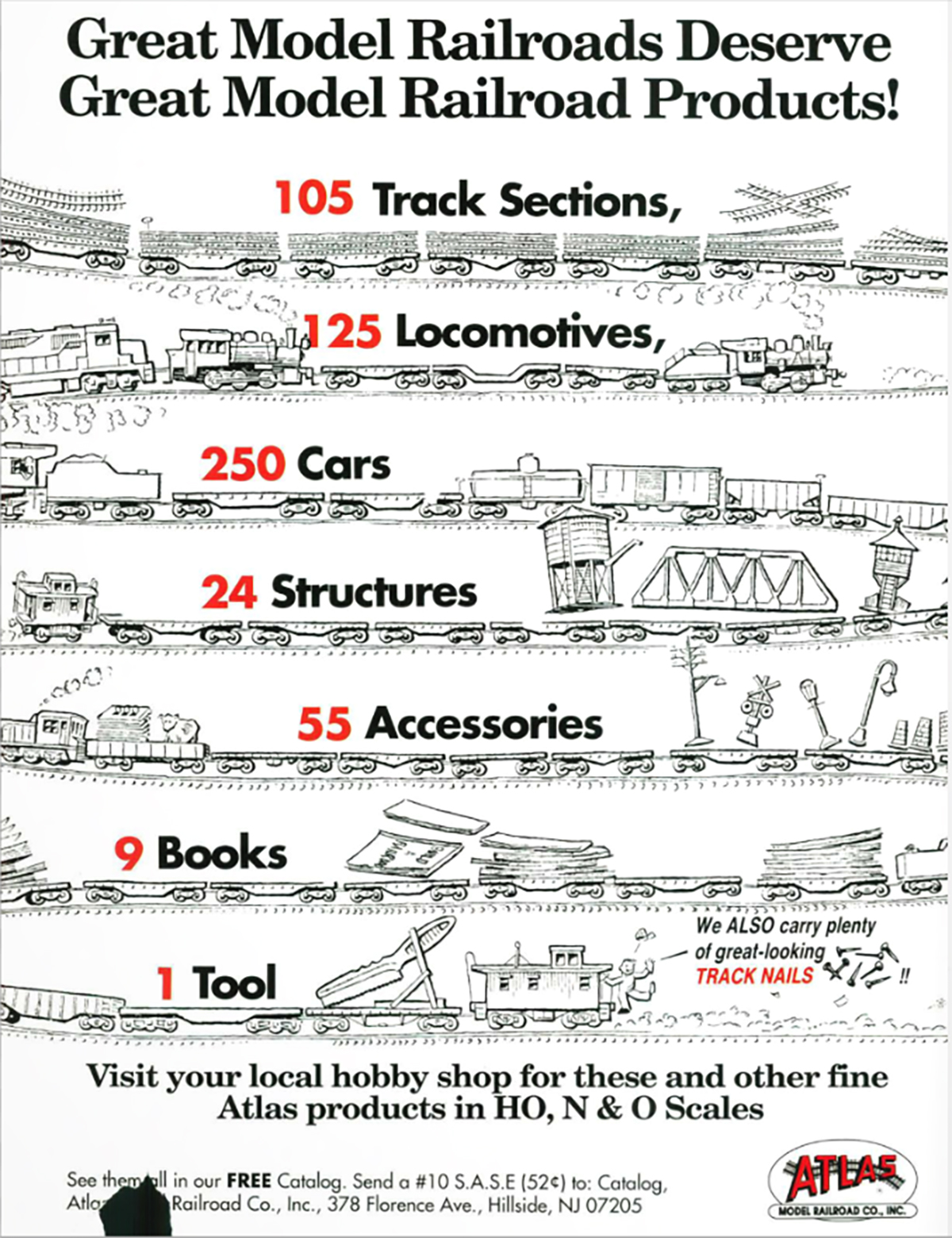
Atlas has been a regular tenant of the inside cover (called cover two in the publishing world) for many issues of MR. I always liked this ad for its whimsical approach, with its cartoon depiction of various Atlas products (I’d always wanted to be a cartoonist). I had the N scale version of the 0-4-0 switcher shown in line 2 decorated for the Baltimore & Ohio, and it ran on our small tabletop layout, which was also built with Atlas track. I just love the little guy hanging onto the caboose who calls out the track nails. I’m pretty sure that I’ve used Atlas track nails on almost every layout I’ve ever built, with the possible exception of my 1980s G scale railroad and the O gauge layout I built for my grandfather’s Lionel trains. (Besides being useful for laying track, if you cut off most of the shank, they also make great O scale doorknobs.)
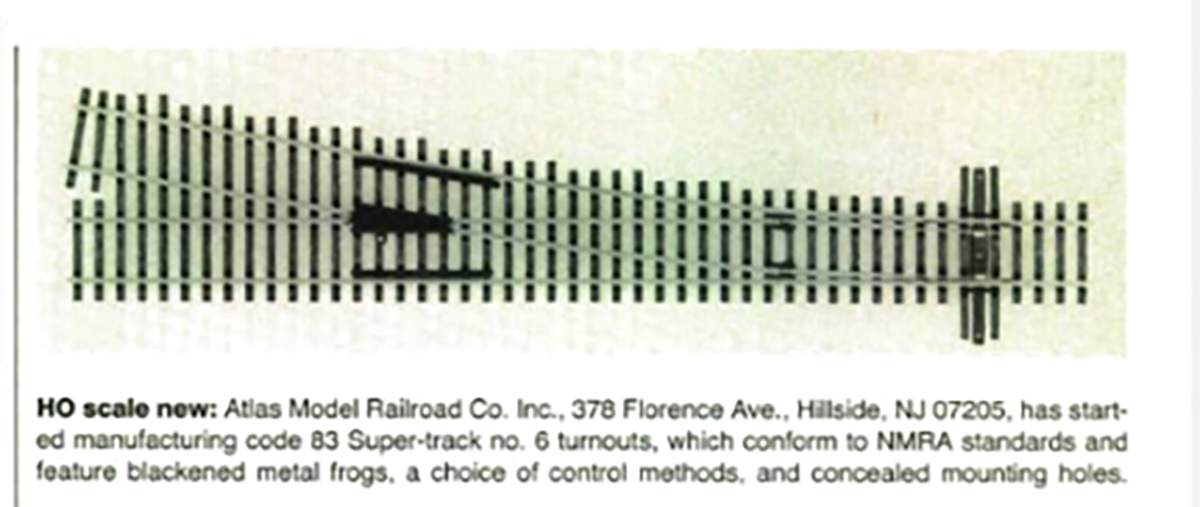
While on the subject of Atlas, MR Product News on page 8 of the issue announced the release of Atlas’s HO scale code 83 Super-track no. 6 turnouts. While other manufacturers, such as Shinohara, had been producing HO track with lighter-weight rail for years, Atlas was finally getting into that game. Today, code 83 is the norm, and many manufacturers, including Atlas, offer products for it. At the time, though, it was new, and it came out just before I started building my first HO scale Soo Line layout based upon the Milwaukee Road’s D&I Subdivision. I used Atlas code 83 track for the visible layout, but the staging yard still used Atlas code 100 turnouts and rail – it was much less expensive!
America’s Hobby Center
Full spread display ad, pages 10 and 11
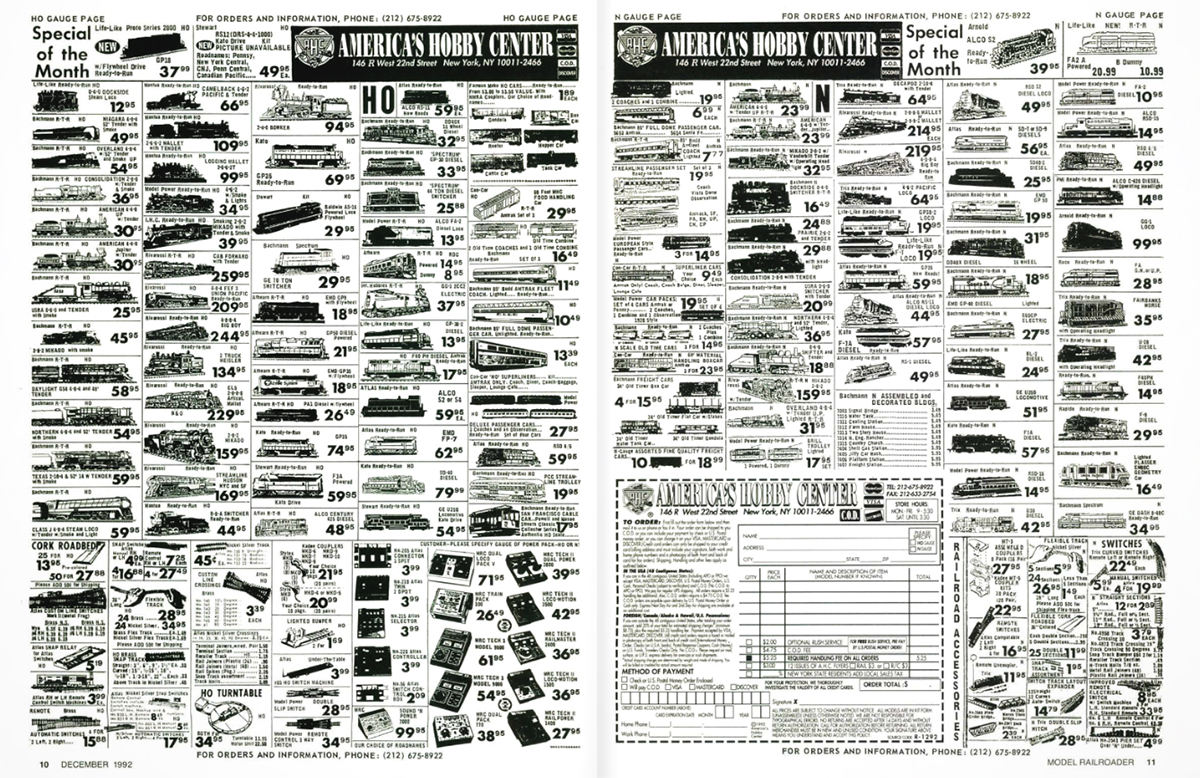
While the internet has made it much easier to find exactly what you want at the price you want to pay, it has also taken some of the fun out the hobby – mainly with the loss of mail-order ads such as this one from AHC, America’s Hobby Center. I used to love running my finger down the listings to see all of the model railroad products available, and would often find myself lingering over things that I really didn’t need for my layout but looked cool, nonetheless. Yes, you couldn’t really see much from the pen-and-ink illustrations or the very small photo clippings, but that was part of the fun – you needed to use your imagination to fill in the details.
These ads were labor intensive to produce, and in the 1990s, none of this was done on computers – these were all made using paste up boards that were then photographed and reduced to print size before being turned into a plate as a single image. When that work was taken over by computers, they were still time intensive to assemble, so often a seller would keep the same ad for more than one issue, even though they may have new products to list. You can also understand why these types of ads disappeared fairly quickly once the internet arrived. Even still, they are one of the wonders of their age, and they must have produced good results, as AHC, Standard Hobby Supply, Trainworld, and others like them were steady advertisers in MR for many years.
Micro-Trains Line boxcars
Display ad, page 12
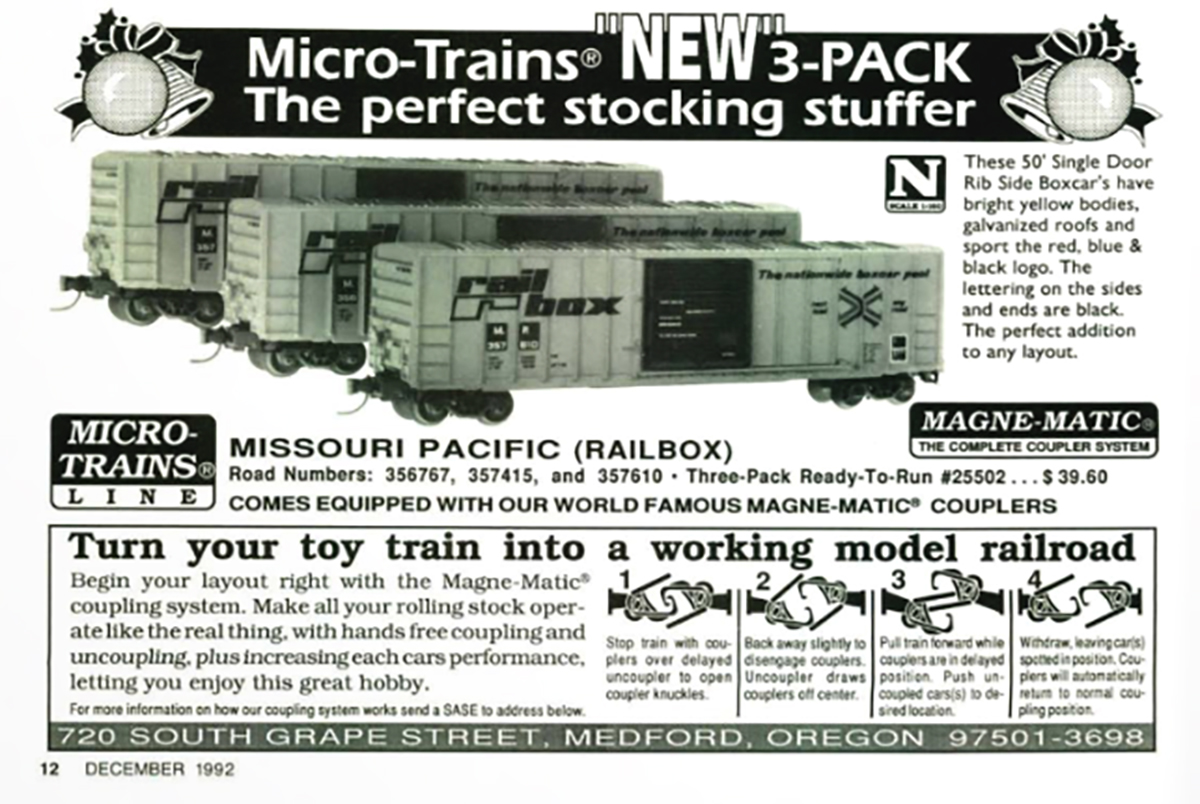
In December 1992, Micro-Trains Line was still a new company. While the company was started by Kadee in 1972 to produce models, it split off from that firm in 1990 to pursue production of N and Z scale trains exclusively. Although just recently sold to Atlas, the company’s N scale couplers are still the most widely used by modelers.
This ad is for a three-pack of Missouri Pacific single-door 50-foot Rail Box cars. While it would be several years yet before Micro-Trains would get rid of the standard deep-flange wheels for those with lower profiles, its models featured some of the finest details produced in N scale. If you’re wondering about the price, $39.60 is just over $90 in today’s prices. At around $30 per car, the three-pack prices match pretty closely to models offered today. It would be ten years yet before I would dive headlong back into N scale railroading, but I was fully aware of what Micro-Trains was doing and appreciated their models, which were part of what lured me back.
For Better or For Worse
Cartoon, page 25
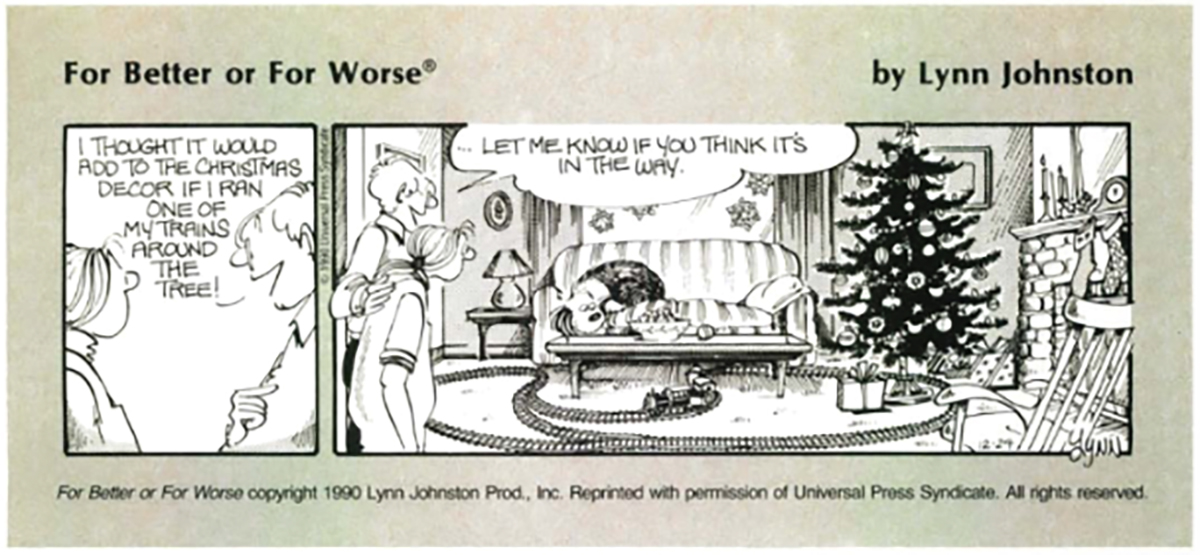
MR has had a long tradition of running cartoons in the magazine, and once in a while, such as the March 1954 issue, even on the cover. Syndicated cartoonist Lynn Johnston’s work from “For Better or For Worse” appeared several times in the pages of MR. In this panel here, showing John Patterson (the father of the family) and his train set “around” this Christmas tree. (My own Christmas train setups look much the same!) In Lynn’s daily strip, John, a dentist by trade, decides to take up G scale railroading, and over the course of several years, his model railroading exploits made appearances in the story. I read the strip religiously (along with Peanuts and Calvin and Hobbes) during the 80s and 90s, so it was a pleasant surprise to see it here.
If someone would have told me that my wife and I would eventually be Lynn’s guests at her home years later to photograph her then-husband Rod Johnston’s outdoor ride-on model railroad for Model Railroader magazine, I would have told them they were nuts, but that is exactly what happened in 2003. Lynn and Rod were very gracious to my wife and I, and I remember the trip fondly. Rod’s layout story appears in the October 2003 issue of MR on page 100, and you can find it in the digital archive on Trains.com. It’s funny to think of that connection now, but I had no clue it was coming when I read this issue in 1992 – I just enjoyed the cartoon for what it was.
CAD Rail software
Display ad, page 54
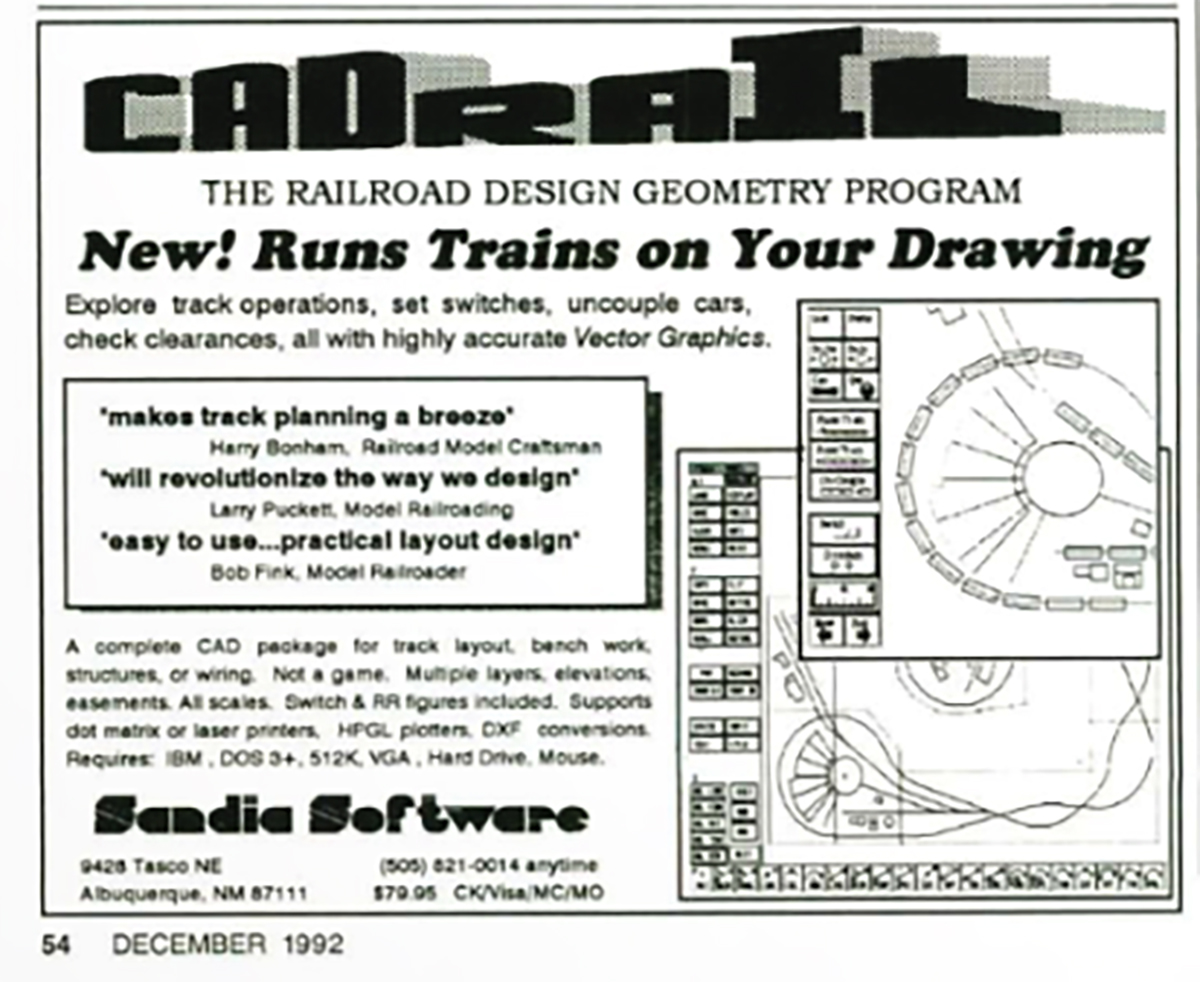
This one totally surprised me. I often think that computer-aided design software programs for model railroaders didn’t come along until the 2000s, but as this ad shows, CAD Rail by Sandia Software was already on the scene. The company started in 1990, in fact.
I shouldn’t be surprised, really. Even though I was still using the computers in the lab at school in 1992, the 90s were the age of people really embracing the home computer. Email accounts soon followed, and by the late-90s, the internet would be upon us in a big way.
CAD Rail is still around, and many people prefer this type of tool for designing model railroads – particularly since CAD Rail and others can offer simulations and 3D rendering. At $79 in 1992, the software was not overly expensive (around $180 in today’s dollars), as long as you already had your own computer. In the fine print, it does explain that the software is “not a game,” which doesn’t surprise me, as the typical 90s home computer was mostly used for word processing and playing games (anyone remember Doom?). Good job Sandia Software for being ahead of the curve on this one.
Radio Remote Control for PFM Sound Systems
Product review, pages 77, 79, and 81
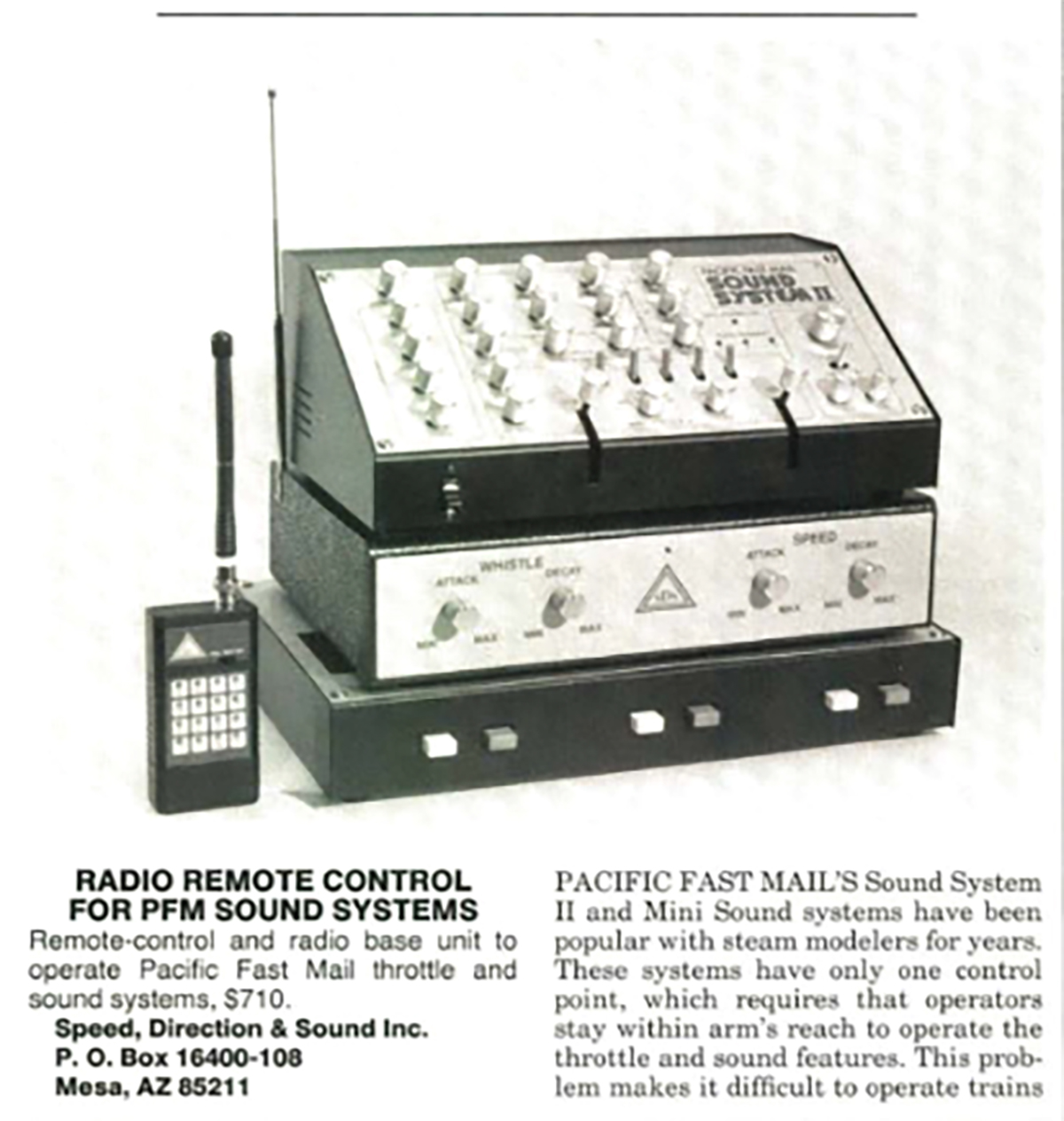
The product review on page 77 for a radio remote system for PFM (Pacific Fast Mail) Sound Systems was a shocking reminder that while we take sound-equipped models for granted today, 34 years ago, that was definitely not the case.
In case you’ve forgotten (or weren’t alive then), PFM sound hit the scene in the in the 1970s and used recordings of actual locomotives on tape and played them through speakers mounted in the locomotive by sending the single through the rails. One of my hometown hobby shops, Dave Methlie’s Crystal Lake Hobbies, had it set up on the in-store demonstration layout in the late 70s/early 80s, and I remember very well being completely impressed with it, but it was also really pricey.
The analog system used a base station that also acted as the throttle for the locomotive, as well as contained the tape deck, so there was no real way for that apparatus to travel with your train – that is, until the introduction of the radio remote shown here. As Jeff Wilson pointed out in his review, the small, pushbutton throttle was easy to use and had great control range (75 feet), but involved sending your PFM system in to the manufacturer to be altered to use it. That, and the $710 price tag on top of the initial investment in the PFM system probably meant that few were ever put into service. It’s a good example of taking a risk with pioneering technology – model railroading would be a poorer hobby indeed without that spirit!
Building the Berkshire Division
Feature story pages 94-101
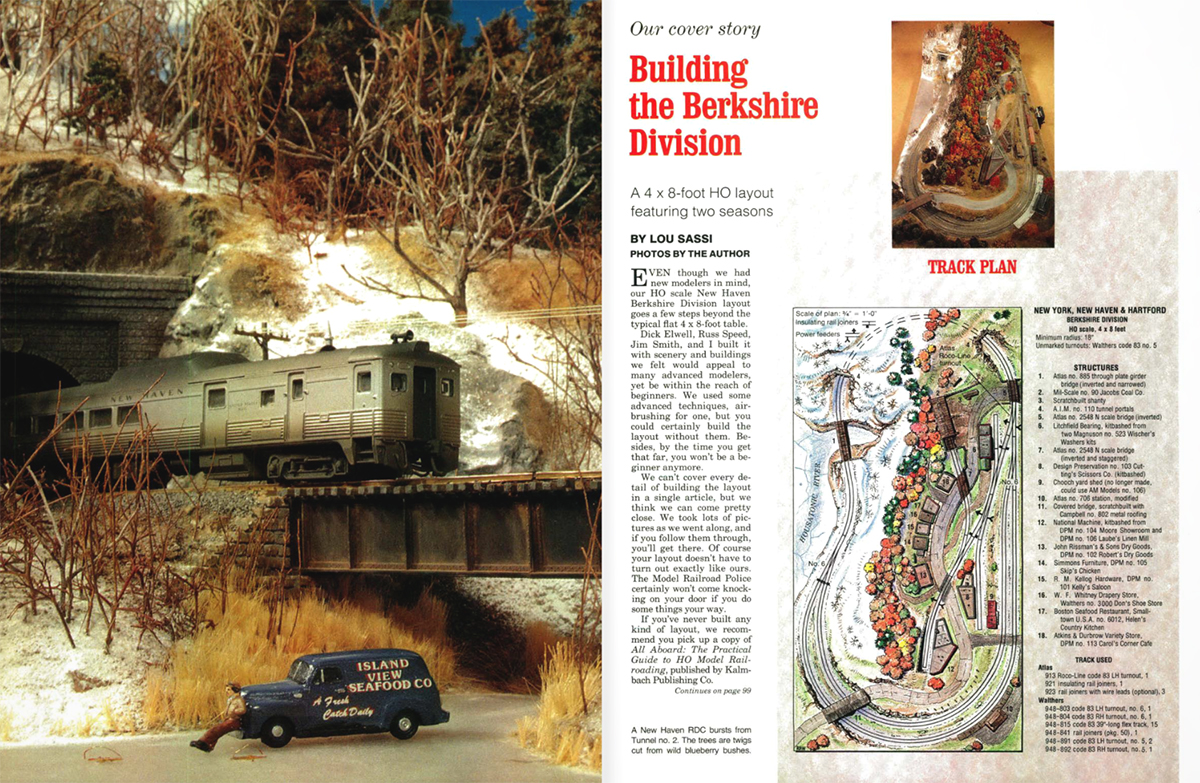
Model Railroader has featured seemingly countless project railroads in its pages since the Pine Tree Central appeared in the December 1952 issue. Of them all, the Berkshire Division is still my favorite. Built by Lou Sassi and his friends Dick Elwell, Russ Speed, and Jim Smith, the 4 x 8 HO layout featured the New Haven RR, and included a winter scene on one side and an autumn one on the other.
At first glance, it appears to be a typical beginner layout, with a single siding, four spurs, and the obligatory tunnel on one end. However, as Lou points out in his introduction, he and his team wanted to go a few steps beyond the beginner to provide inspiration. At closer examination, the railroad features elevation changes and uses cookie-cutter benchwork to place some of its most interesting scenery below track level. And speaking of scenery, the artistry and detail with which the buildings, roads, frozen lake, and tree-covered hills are put together places the layout on par with many of the finer railroads featured in the magazine over the years.
While I didn’t know it in 1992, the layout would go on to influence me and my time at MR in many ways, including awaking an interest in the New Haven RR., a line I knew little about until this feature, and would eventually come to explore in great detail to build my N scale layout. It also has served as a benchmark for me when I designed project railroads for Model Railroader, MR Video Plus, and Trains.com. When planning a new layout for those titles, I’ve always tried to make sure the layout would look as captivating as Lou’s Berkshire Division did and includes something for more advanced modelers to enjoy. It’s not always possible, but it has always been the goal.
As an interesting side note, I had a large G scale layout residing in my parent’s home at the time this issue came out, and while I enjoyed it very much, it was this article that got me looking back to HO scale and modeling a prototype more faithfully.
The Peppermint Central and Buzzard’s Cove
Hand drawn track plan illustrations pages 130-133
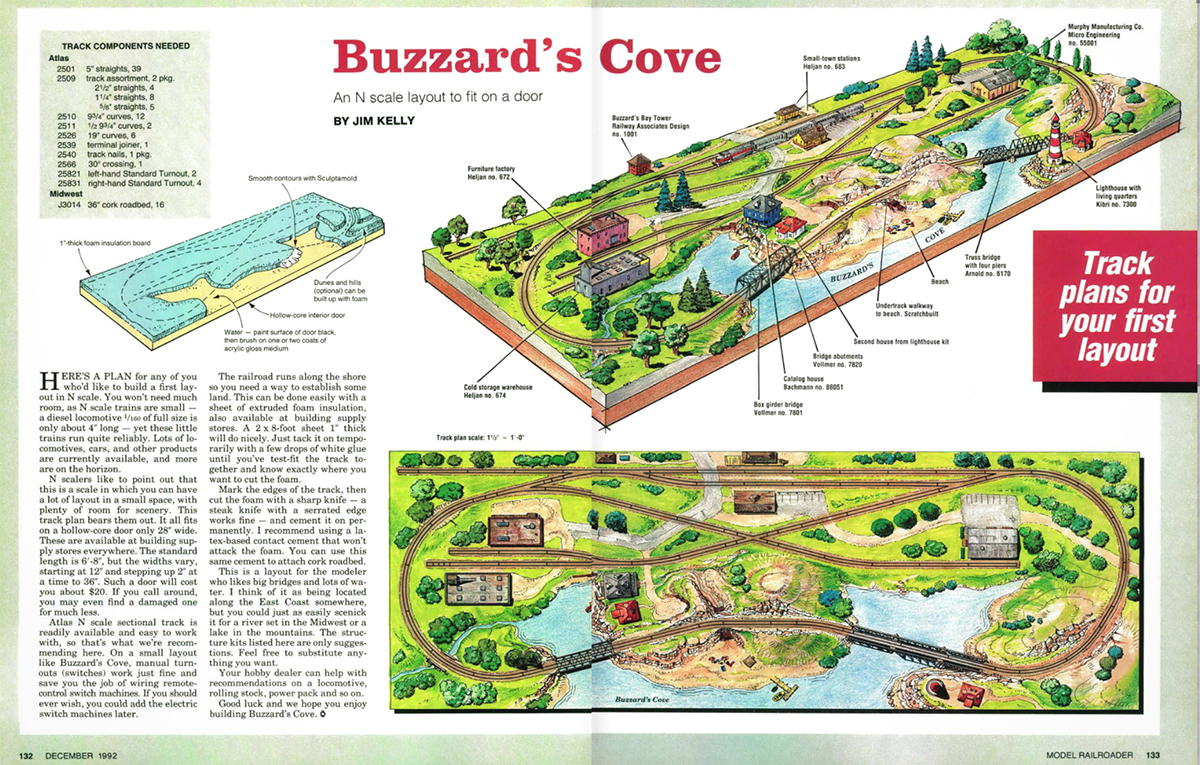
Something I really miss from the old days of MR were the hand-drawn track plan illustrations. This issue featured not one but two track plans also rendered as three-quarter, three-dimensional views. Although the illustrations are uncredited in the article, Bob Wagner and Lee Vande Visse are listed on the masthead, so it was likely the work of one of these two very talented gentlemen. The color artwork, complete with renderings of the buildings and scenery, were enjoyable to explore.
While the plans themselves are simply beginner layouts using set track pieces (typical for a Christmas issue), Jim Kelly’s N scale plan (shown below), features the use of a hollow-core interior door for benchwork with a foam layer as a base for the track and scenery. MR utilized the concept in several of its project railroads, and I would incorporate it again on my Naugatuck layout (April 2006) and in my design for the Red Oak RR (January 2015). Doors do make a handy starting point for N scale layouts, and they don’t require any carpentry on the part of the modeler. You can set the door up on sawhorses or on a folding table. My Naugatuck Valley got its simple start as a folding table layout when my wife and I were living in an apartment while our house was being built.
Art Curren detailing article
Feature article with illustrations pages 138-143
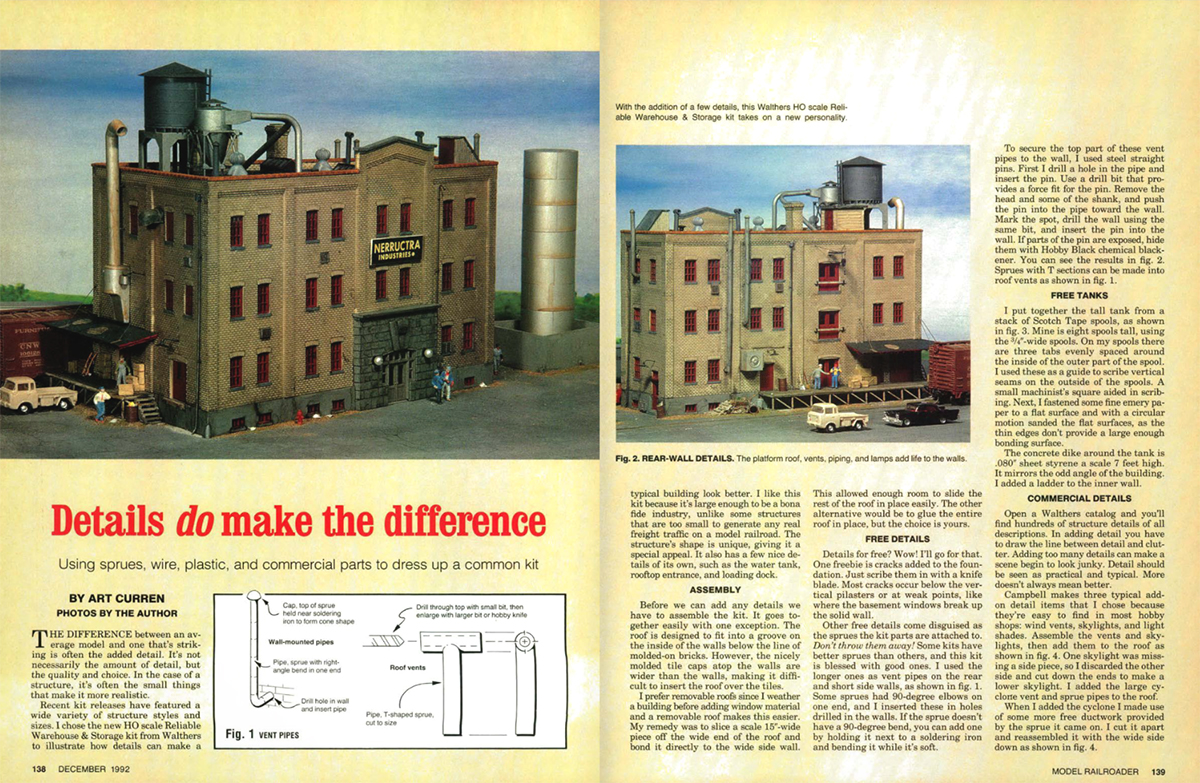
Former Kalmbach employee Art Curren was a kitbashing master. His article on detailing structures is a goldmine of ideas. While I wasn’t ready to start cutting up my locomotive shells to get louvers for ventilation systems, I did build a number of his tape spool tanks. (Being a high school teacher in the 90s and being married to a woman who worked for a university, I had access to a lot of empty and near-empty tape spools.)
Working at MR all of these years, I’ve gotten to examine some of Art’s models up close, for at one time, they were everywhere on the MR&T (I have one of his houses in my personal collection). I’m always amazed at how Art could take ordinary items, sometimes even those found around the kitchen, and he’d work them into structures in such a way that you’d never guess what you’re looking at didn’t start as part of a model kit. Art, and another MR inventive genius, Gordon Odegard, had both passed before I came to the staff in 2001, and I always wished I could have met them, if for no other reason than to thank them. I learned a lot from their work in the magazine.
Conclusion
At 244 pages, the December 1992 MR was a hefty tome, although as mentioned above, many of those extra pages were devoted to mail-order advertising. It’s also been fun to look at it again almost 34 years since I first saw it, particularly since at that time I had no idea I’d ever work for MR – I was just wrapping up my first career in retail and busy completing my degree for my second one, teaching high school English. Feel free to take a look at the magazine for yourselves, and leave me a note in the comments below if you find something you liked. I’m always curious to know what you found interesting.
Share this article
You’re so awesome! I don’t believe I have read a single thing like that before. So great to find someone with some original thoughts on this topic. Really.. thank you for starting this up. This website is something that is needed on the internet, someone with a little originality!