





If you’ve followed Model Railroader’s Facebook page, you’ll probably know that periodically over the past several years, I’ve made posts called “Lunchtime Reading,” which are simply my musings on products, articles, and innovations as found in past issues of Model Railroader magazine. For this expanded installment, I chose to do a deep dive on the January 1980 issue and look at some of the innovative 1980s model railroad products featured in the issue. At that time, I was a sophomore in high school and was working with my dad and middle brother on our family’s HO scale layout, so I tended to absorb just about anything “model railroading” I could get my hands on.
In digging through the issue again today, I found that the January issue had many points of interest, including an article about converting N scale Rapido-style couplers to Kadees (later Micro-Trains) for better operation (page 132). There was also Don Robinson’s Gerriton & Western RR, an HO scale layout which featured a one-and-a-half turn, partially exposed spiral loop to gain elevation that today we’d simply call a helix (page 80).
However, it is quite likely that my teenaged-self paid little attention to those things as they simply didn’t apply to our layout at hand. Still, nearly 50 years later and seeing the issue with fresh eyes, I’m amazed at how the hobby was progressing in 1980. The following are a few of the 1980s model railroad products, features, and other observances that caught my attention for various reasons, even if they are sometimes personal ones. So, join me back in the winter of 1980 for some model railroading fun.
OptiVISOR
Off the Train Wire (News and Products) page 4
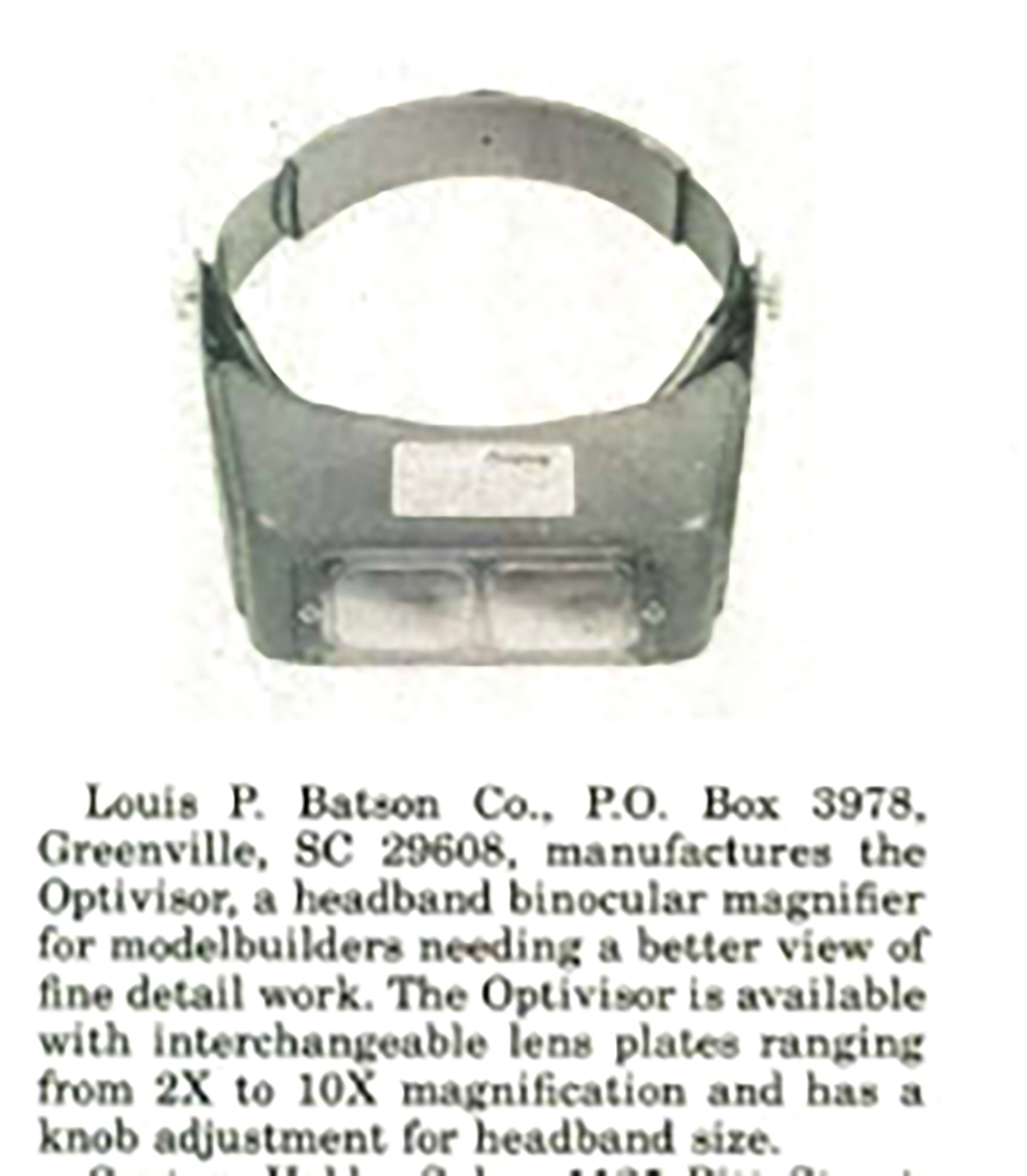
Although it is my understanding that the OptiVISOR, a head band binocular, has been around for a far longer time than 1980 to the present (Google AI says it came to market in 1960), the January issue’s news section has it listed as a “new product” from Louis P. Baston Co. As featured, the OptiVISO included Lens plates ranging from 2x to 10X magnification. While the tool is highly useful for fine detail work, particularly for those of us whose eyesight is not what it was when we were 20, it is also a tool many of us have a love/hate relationship with it: It’s probably regarded as the least sexy item owned by model railroaders. However, despite its short comings as a piece of fashionable headwear, it is undeniably a useful tool, particularly when working on smaller scales with tiny gears, detail parts, or when soldering wires to miniature circuit board pads. I own a couple of pairs (one for home and one for the office), and I have to use them more that I care to admit these days.
Walkaround analog train control
TrainPower, Inc. fractional ad page 141
Troller full-spread ad pages 26-27
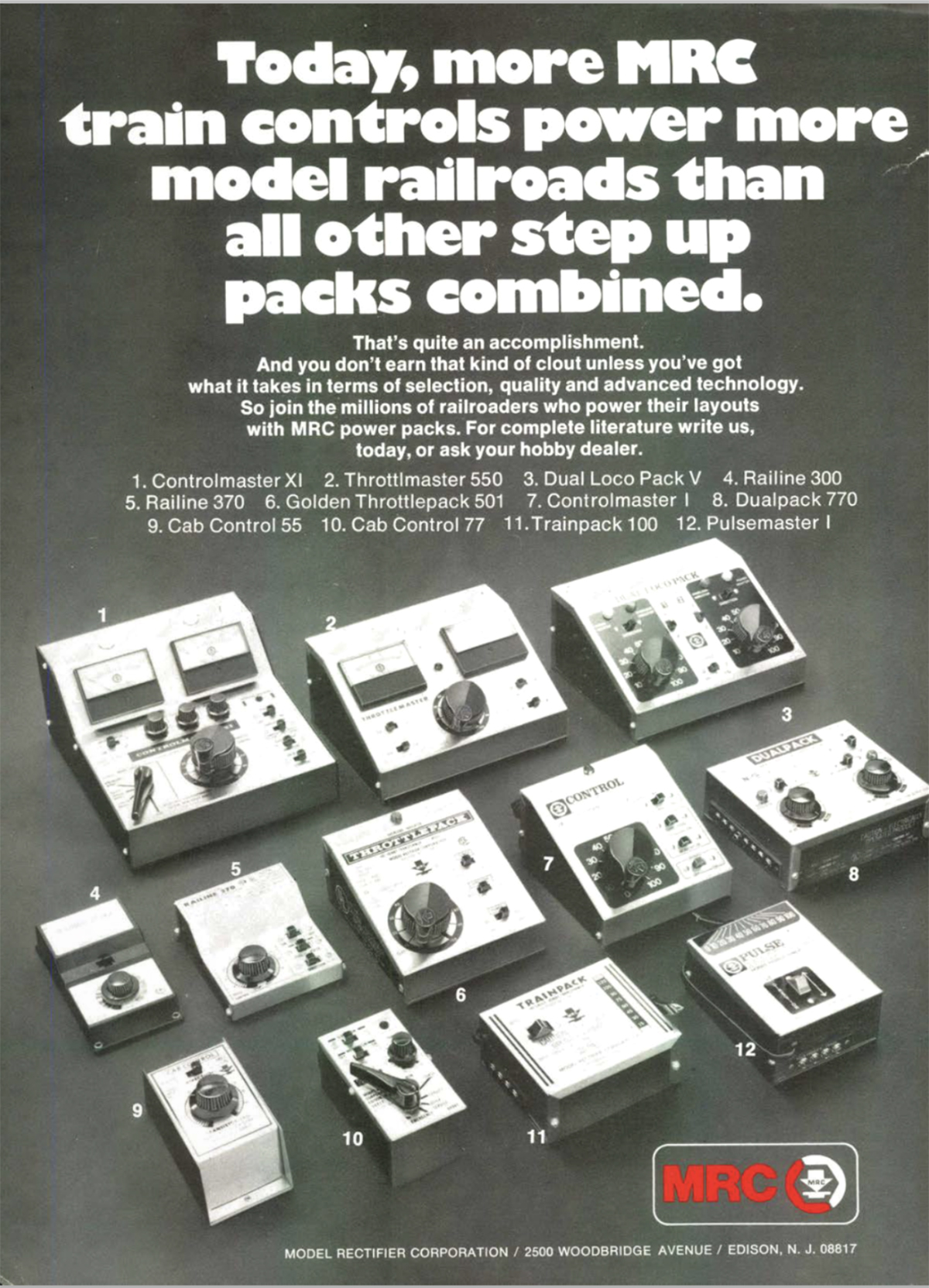
While I’ve written on this subject before from its appearance in the 1960s, the desire to follow your train around the layout continued to grip the hobby in 1980, and assorted manufacturers, including TrainPower, MRC, Troller, and others produced an assortment of walk-around cab options for analog control. (As we’ll see at a couple of points bit later in the issue, command control was making big inroads at this time as well.)
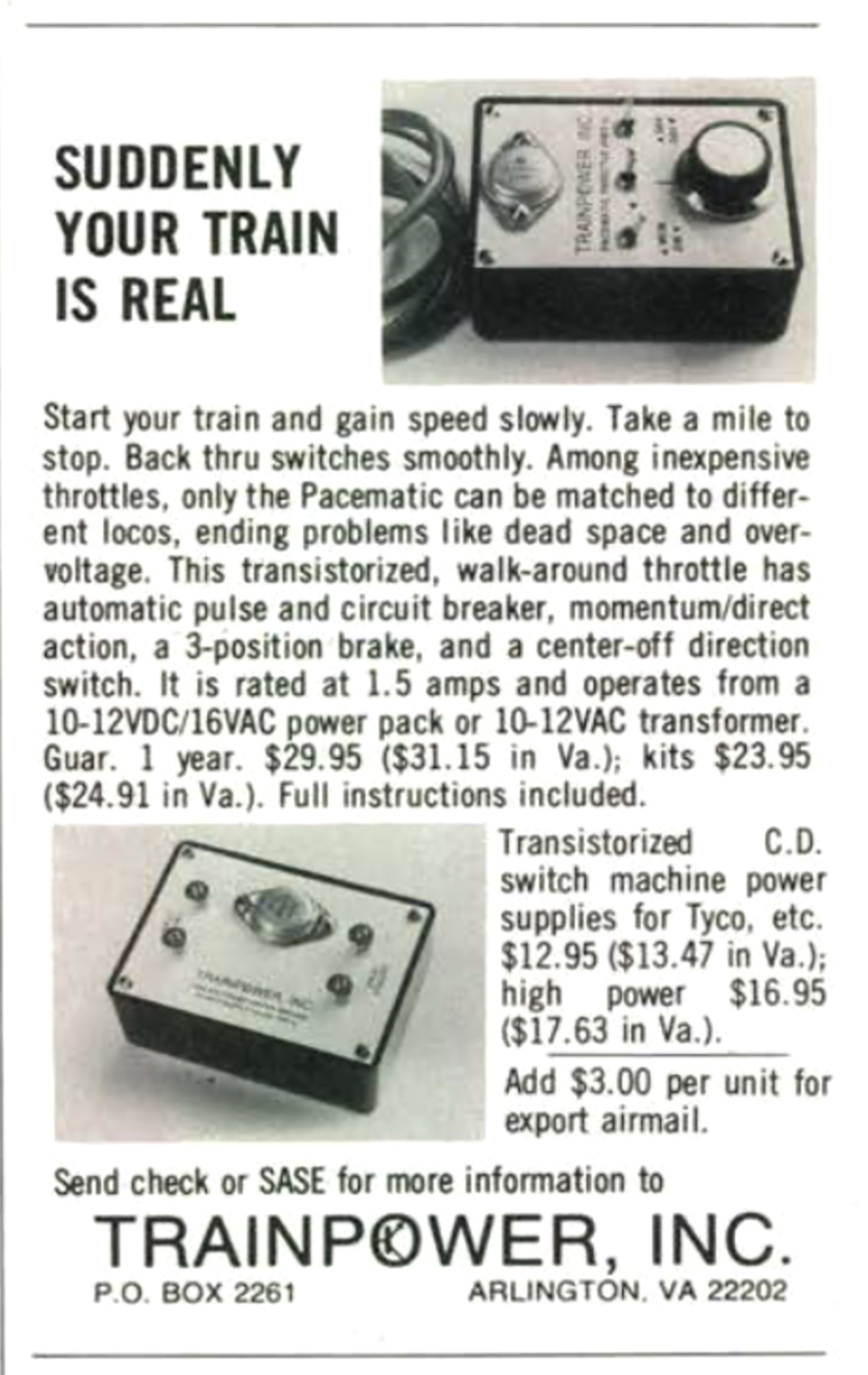
On page 141 was a small add for TrainPower, Inc.’s Pacematic walk-around transistorized throttle, featuring automatic pulse power, momentum, and a three-position brake. This was designed to be the controller for a standard 10-12 volt transformer. You could buy it assembled or as a kit. It was tethered to the layout, but you could make that cable as long as you wished.
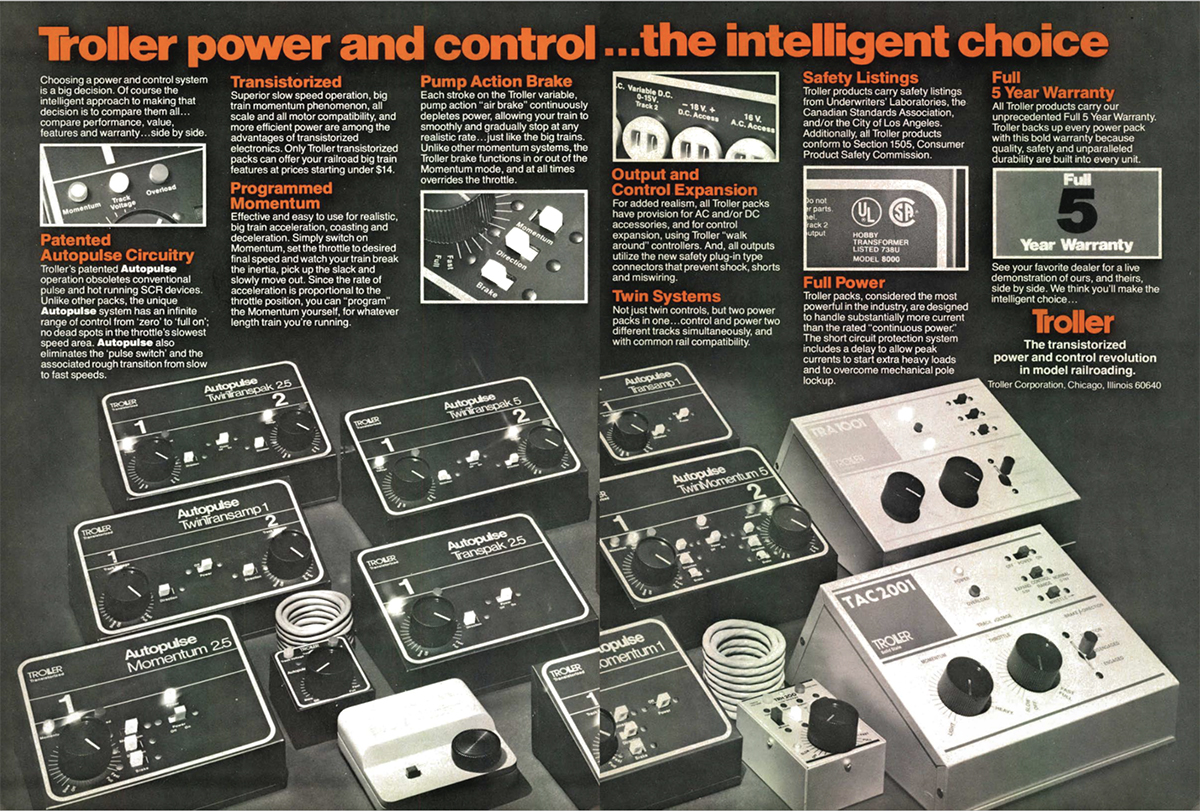
Troller had its own walk-around cab options, to be used with its line of Autopulse power packs. While my dad and I were running our HO scale layout with a Troller Autopulse Twin Momentum 5 powerpack, we never did come up with the funding to buy at least one walk-around throttle for it, despite the fact that I really wanted one. Still, having the momentum and brake features were cool enough, making the trains respond more realistically. The tethered cabs duplicated those features, and they plugged into the back of the power pack.
And while it may be cheating a bit, just to drive the point home, the MRC ad on the inside cover of the February 1980 issue featured that firm’s no. 55 and 77 hand-held cabs. Like the others, these were analog walkaround cabs that tethered to an existing power pack. However, improving operation by being able to follow trains around the layout was definitely on everyone’s mind.
I should point out that all of the systems mentioned here were fully tethered. Unlike today where you can unplug a tethered cab and move to the next point on the layout while your train keeps running, these cabs needed to stay connected to the system or everything stopped. It wouldn’t be until a few months later that Starr-Tec’s analog Hogger 80MW hit the scene. With this system, (MRC also produced something like it), you could unplug the cab from one location then plug back into another while your train kept rolling. I’d eventually install three of these to run my first large HO scale Soo Line layout while I was in college. They used standard 4-wire telephone jacks to make a throttle cab bus (you needed a separate bus for each throttle). At long last, it was true walk around control, allowing you to follow your train wherever you wished.
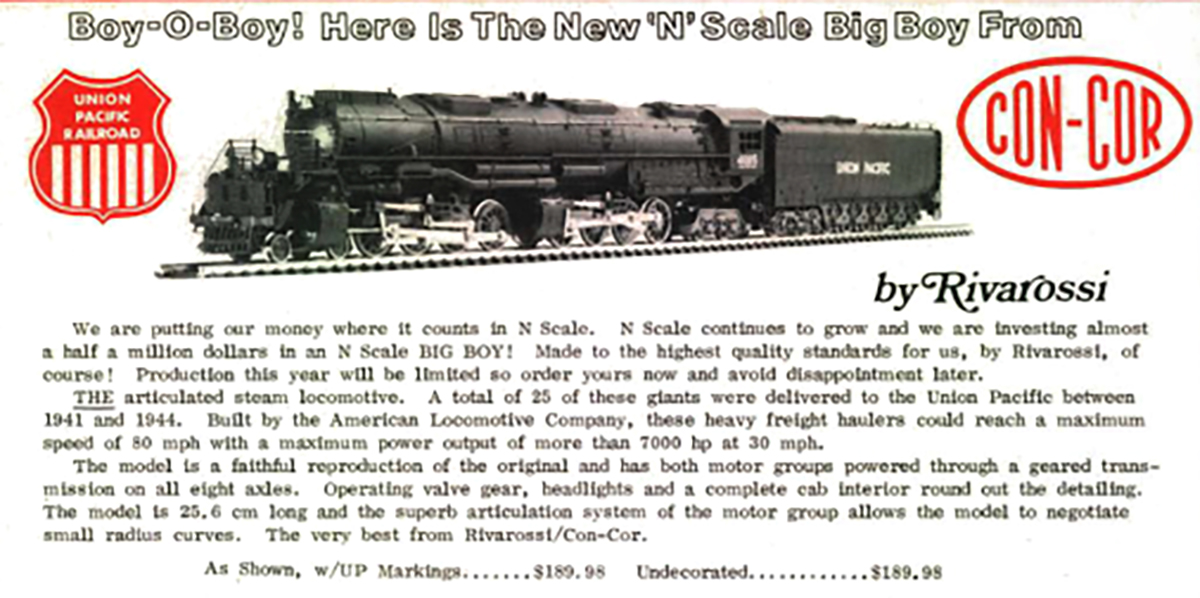
Con-Cor N scale Big Boy
Display ad page 29
Con-Cor’s N scale Big Boy was made in conjunction with Rivarossi and new to market in 1980. As the ad copy states: “We’re putting our money where it counts in N scale. N scale continues to grow, and we are investing almost a half a million dollars in an N scale Big Boy. Made to the highest quality standards for us by Rivarossi…” As far as I can tell, this was the very first commercially available Union Pacific 4-8-8-4 offered in N scale.
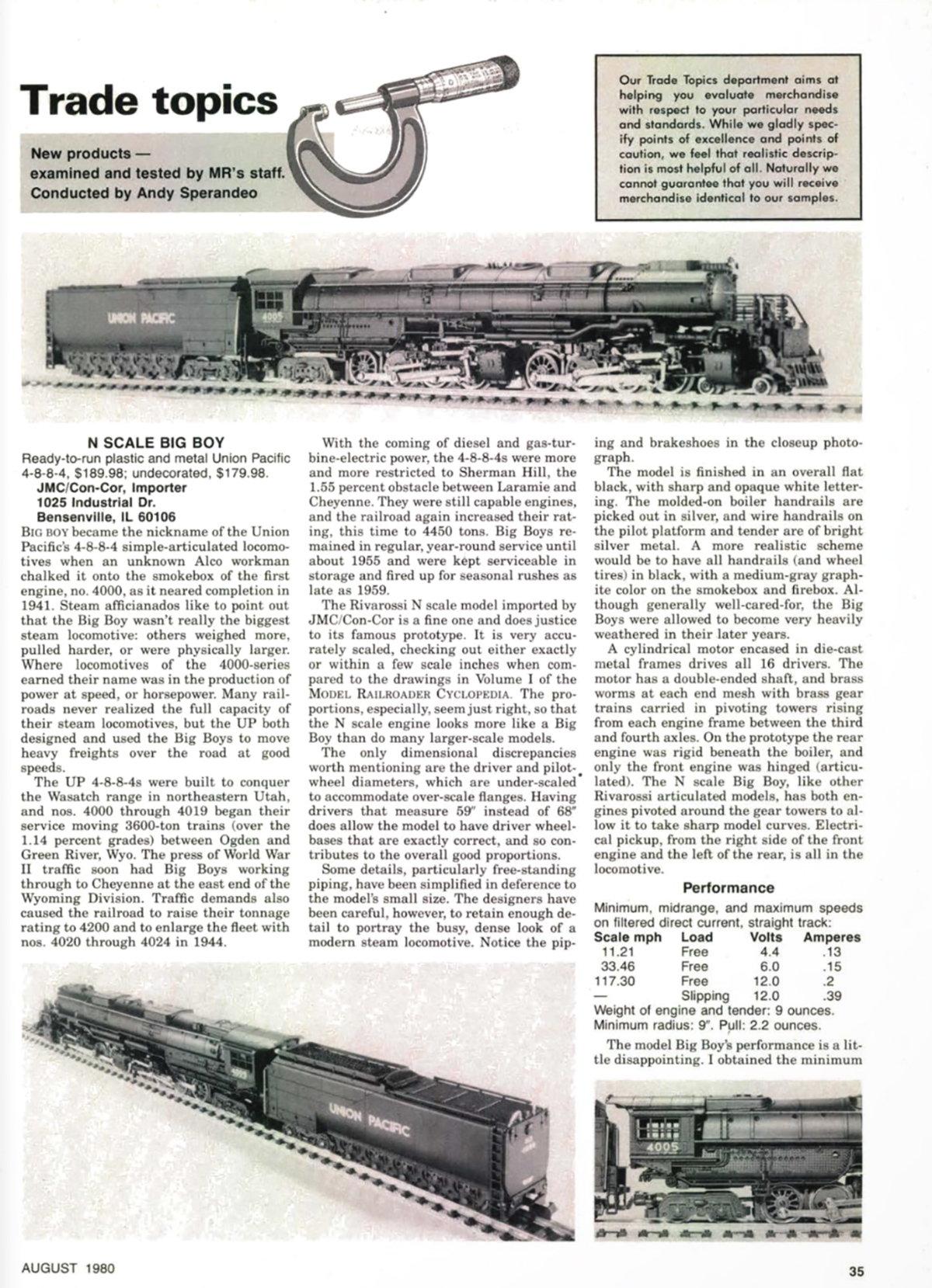
Model Railroader reviewed the locomotive in the August 1980 issue, praising it for its overall looks and attention to detail, particularly the piping molded into the shell. The model, however, shared the general problems of most all early 1980s N scale locomotives, including oversized flanges requiring the drivers to scale out to 59” instead of the prototypes 68”. It also struggled to run well, particularly at lower speeds. The staff noted that better operation was to be had using a power pack equipped for pulse power.
Despite its deficiencies, the model looked good and was not cheaply built. Its $189.00 list price in 1980 is the equivalent of $743.00 today. Despite the price, it was a model many N scaler’s dreamed of owning. It’s always tough being the “first” to do something, and kudos for Con-Cor and Rivarossi for taking the risk. By comparison, however, today, you can pick up a Kato N scale Big Boy for about $300 that runs like a Swiss watch and has enough detail on it to keep your OptiVISOR busy for a while!
Polly S acrylic paint
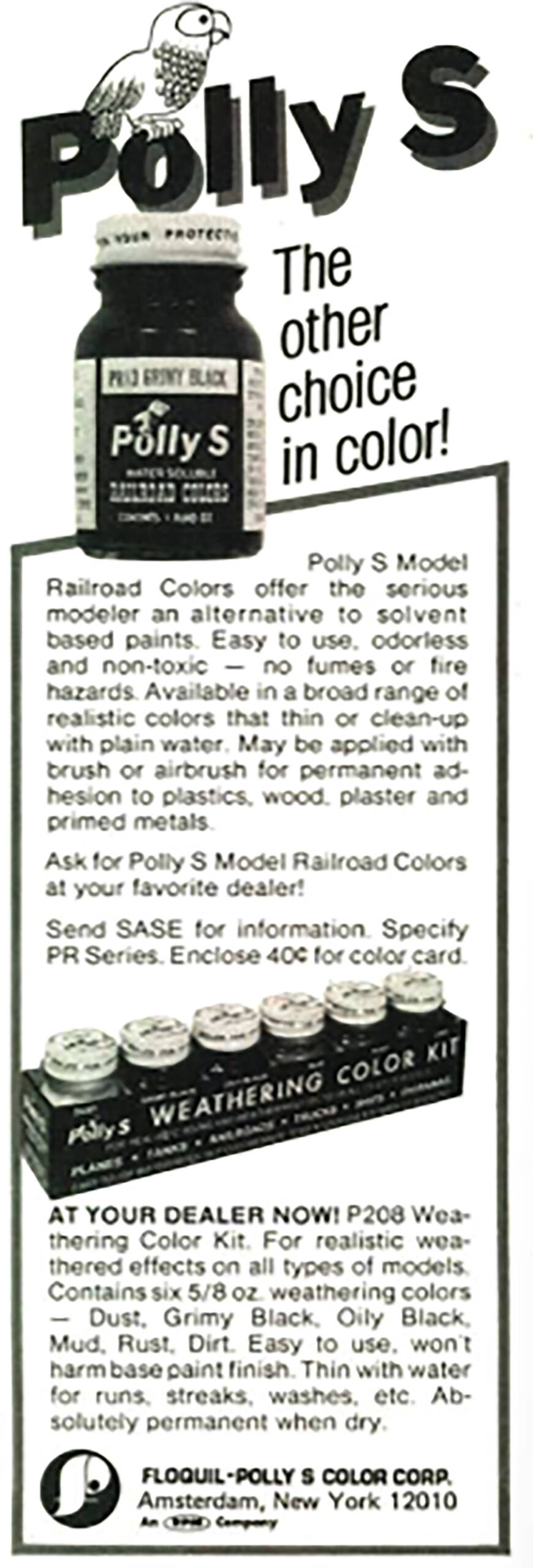
Fractional ad page 38
While this black and white ad for Floquil’s Polly S acrylic paint line might not seem all that important, the product was actually a big deal for modelers. The Polly S line eventually included many railroad-specific colors, and while not always dead-on accurate, it gave modelers a good benchmark to work from.
The water-base acrylic brand from Floquil appeared in the mid-1970s to compete directly with the likes of Testors’ and Humbrol’s solvent-based hobby paints. It was the first serious attempt at producing acrylic modeling paints for model railroaders, and it found wide-spread acceptance in a variety of applications. Eventually Floquil and its Polly S brand were purchased by RPM, along with competitors Testors and Pactra. Polly S received a name change at that point to Polly Scale, and lost the parrot icon from the bottle.
The paint was discontinued by RPM in 2013, though many modelers still maintain personal stockpiles of the aging product. I, for one, have never found a dust weathering color to match my favorite Polly Scale color, L&N gray. And while Polly Scale may be gone, acrylic hobby paints are now mainstream materials for model train guys and kit builders alike.
How to Build Model Railroad Benchwork by Linn Westcott
Display house ad page 50
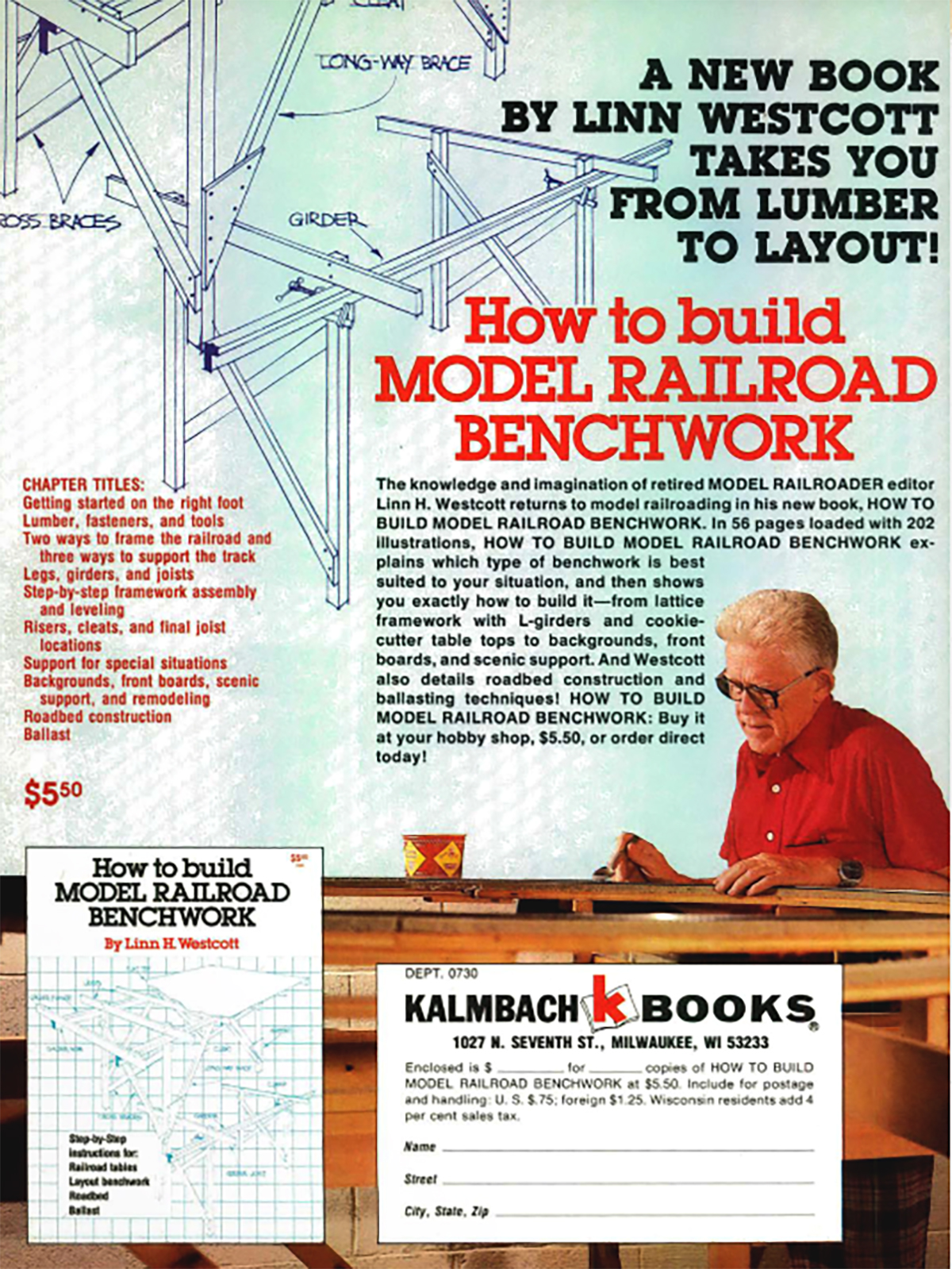
Although release in 1979, Linn Westcott’s How to Build Model Railroad Benchwork had prominent placement in the pages of MR in the 1980s. The ad, featured Linn near the end of his life (he passed away in September 1980) and showed him at work ballasting track on a layout built using his L-girder system. Although his 101 Track Plans book would outsell this one 10-fold, the concepts share by Linn in the pages of MR and his benchwork book live on to this day. Our recent East Troy Industrial Park, State Line Route, and Winston-Salem Southbound layouts all use variations on his benchwork-building techniques. In fact, the layout dad and I were building in 1980 used L-girder benchwork too. My dad met Linn at his model railroad club in the 1960s, when Linn gave a clinic on L-girder benchwork – dad was a solid convert!
CTC-16 Article series by Keith Gutierrez
Feature story, pages 86-93
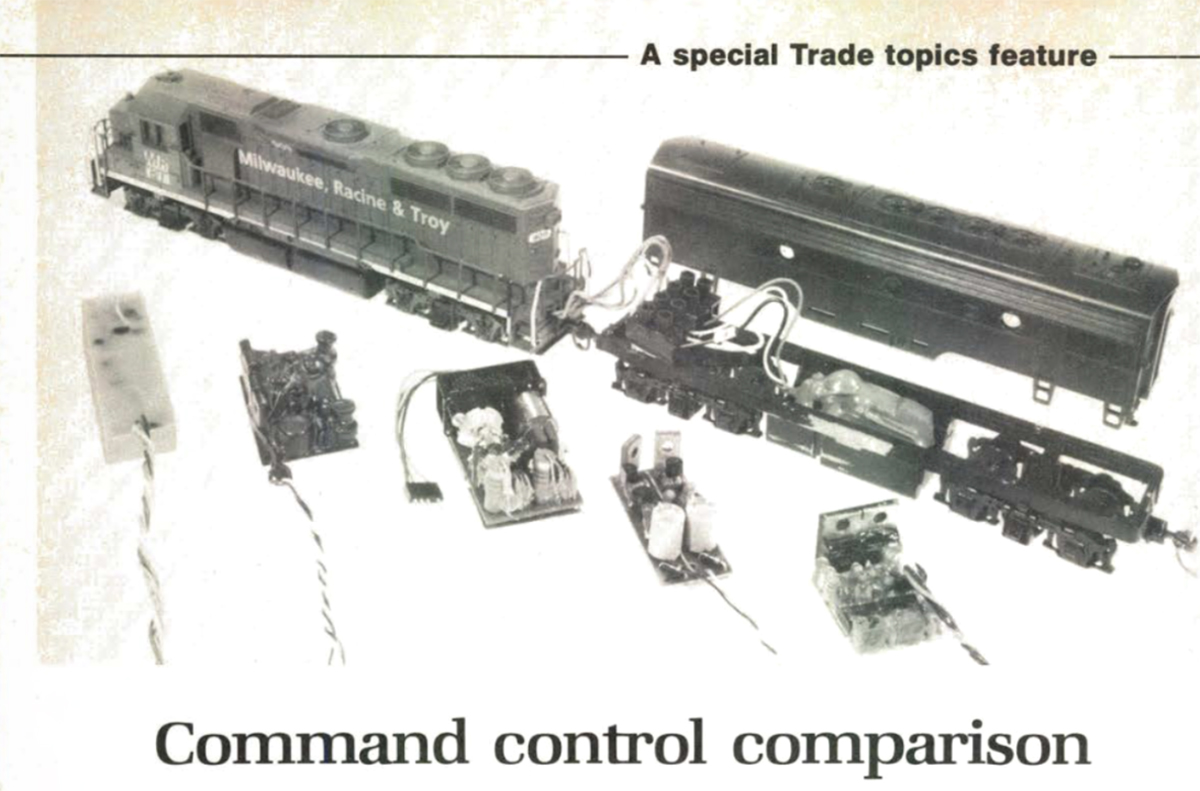
First featured in the December 1979 MR, CTC-16 was an early command control system designed and built by Keith Gutierrez utilizing most of the components of modern DCC users are familiar with, including the command station, power supply, cabs, and locomotive decoders. Like DCC, CTC-16 sends command signals through the electrical power supplied to the rails, allowing decoder-equipped locomotives to operate on the same track without separate electrical blocks. The system could operate up to 16 cabs and decoder-equipped locomotives at a time. In the version describe in his 1980s article series, operation was basic, including forward, reverse, and variable speed control.
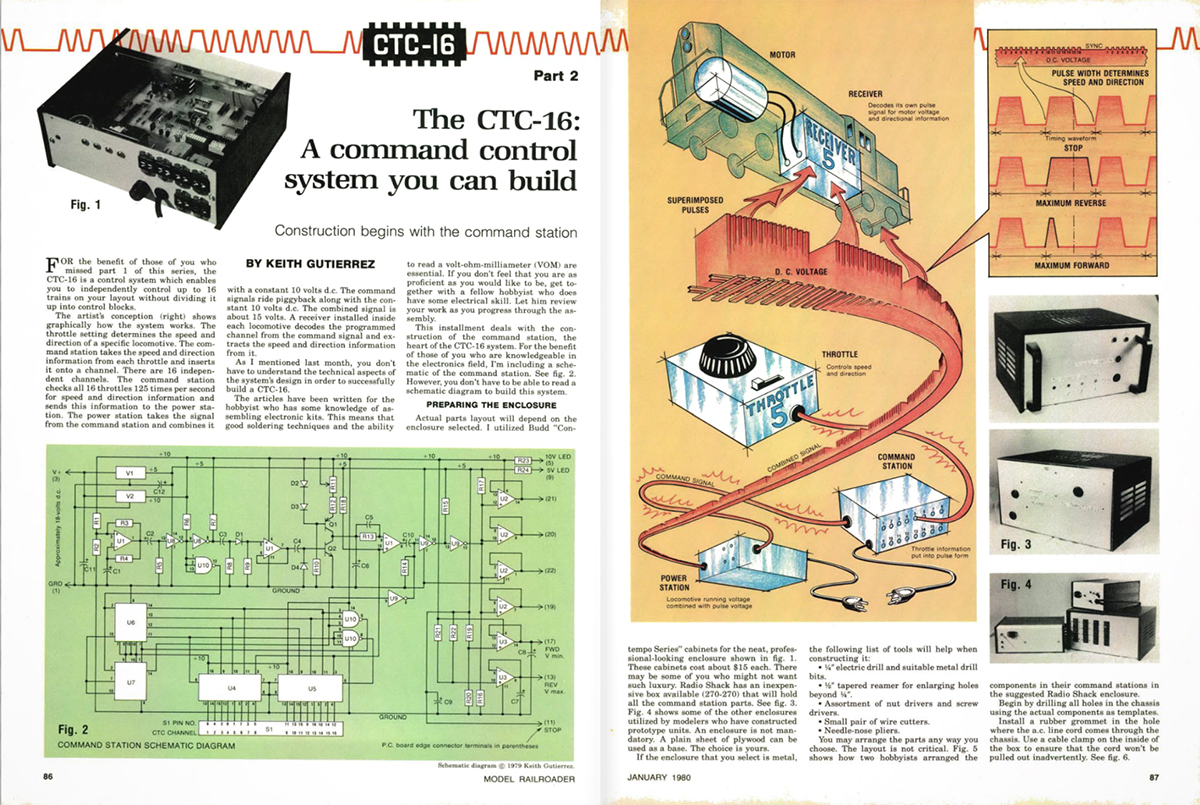
Decoders and cabs were semi-permanently paired by using address programming wires soldered to the circuit boards of both components. As shown in the illustration, cab (throttle) 5 would always run locomotive decoder 5. Although both components could be readdressed, the process involved resoldering the programming wires.
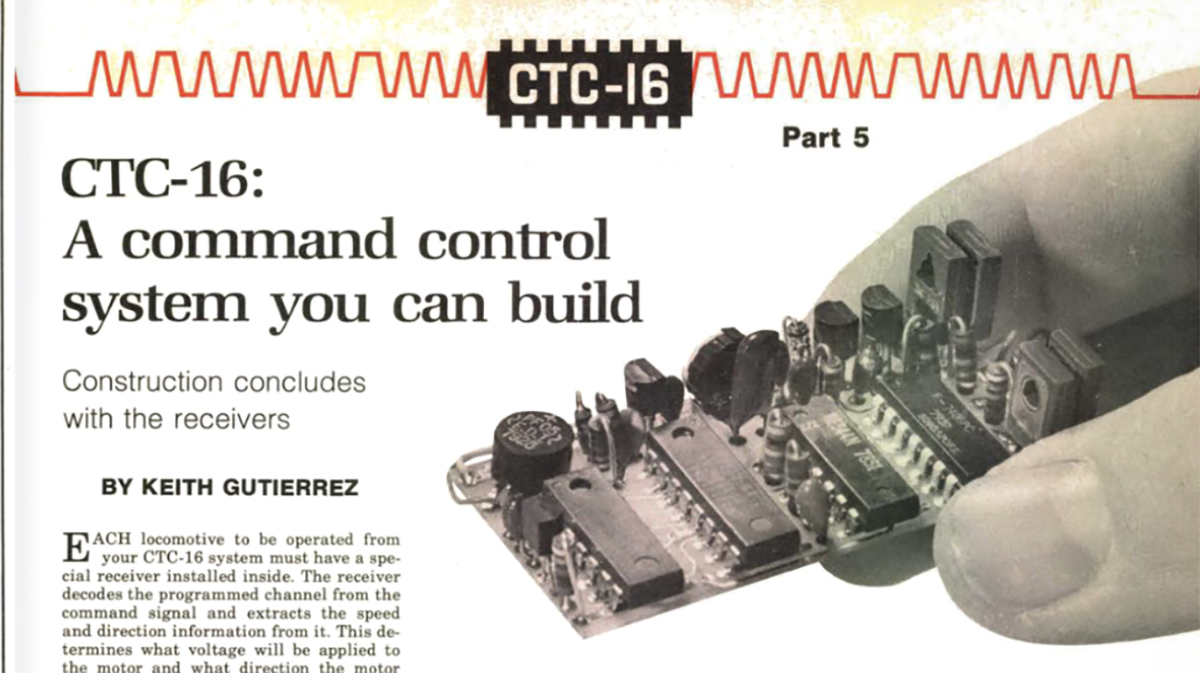
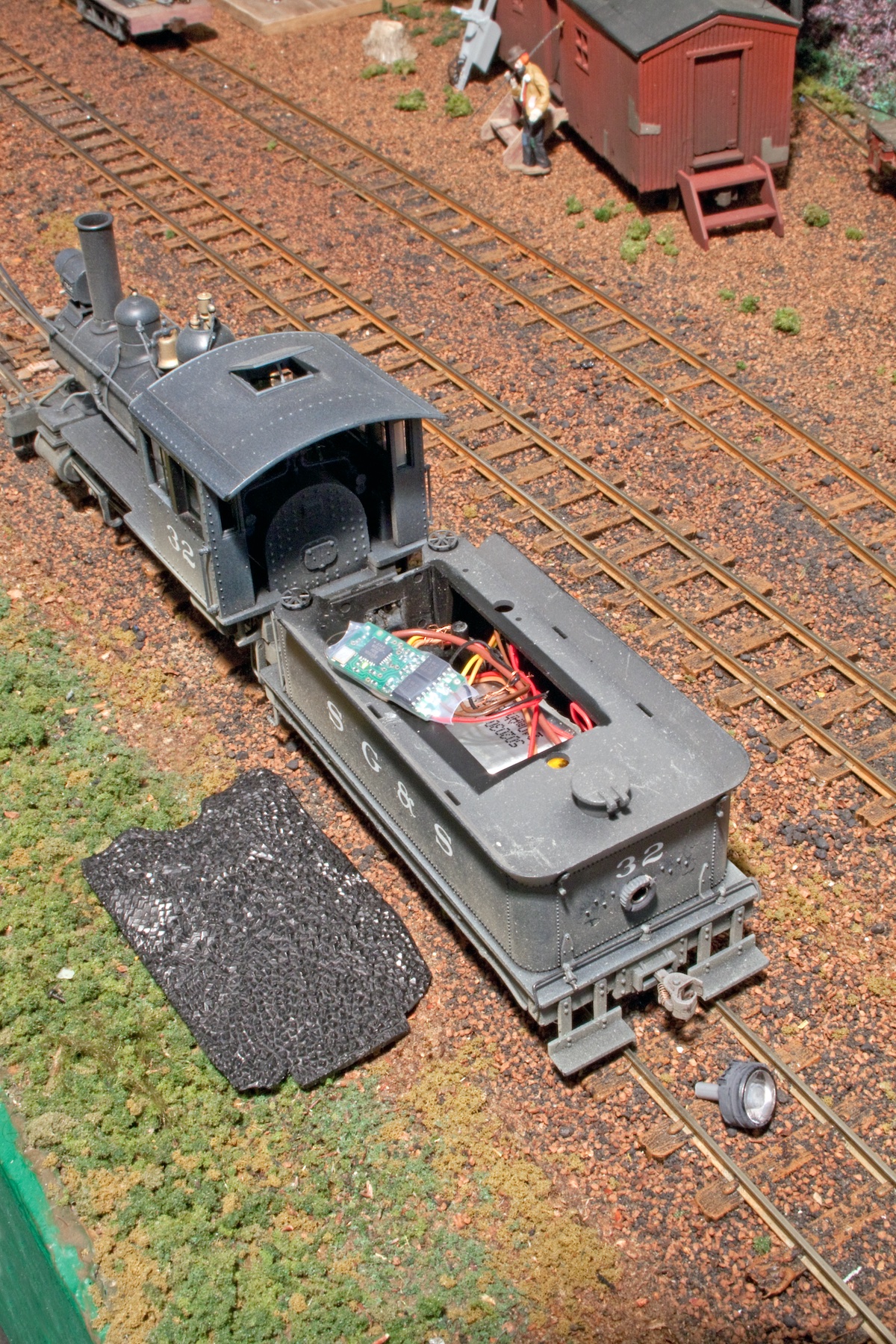
The decoders themselves were quite large by today’s standards, even for HO scale locomotives. Operators of smaller diesel locomotives needed a dummy in the consist to hold the decoder. Steam operators had more options with the tender usually being large enough to hold the decoder, as shown in the photos. Despite the limitations, a number of modelers built and used the system on their layouts during the 1980s, as it offered true command control operation.
After the NMRA established standards for Digital Command Control in the 1990s, Keith would return to the pages of Model Railroad in February 1997 with the first of a six-part series of articles explaining how to build his Easy DCC system, a much more robust form of command control. It was also the first DCC system I used, wiring it into my HO scale East Moline Subdivision layout in 2000. (All that telephone wire from my 1980s Hogger 80MW cab buses went to that layout’s signal system.)
Model Retailers Directory
Directory ads pages 175-185
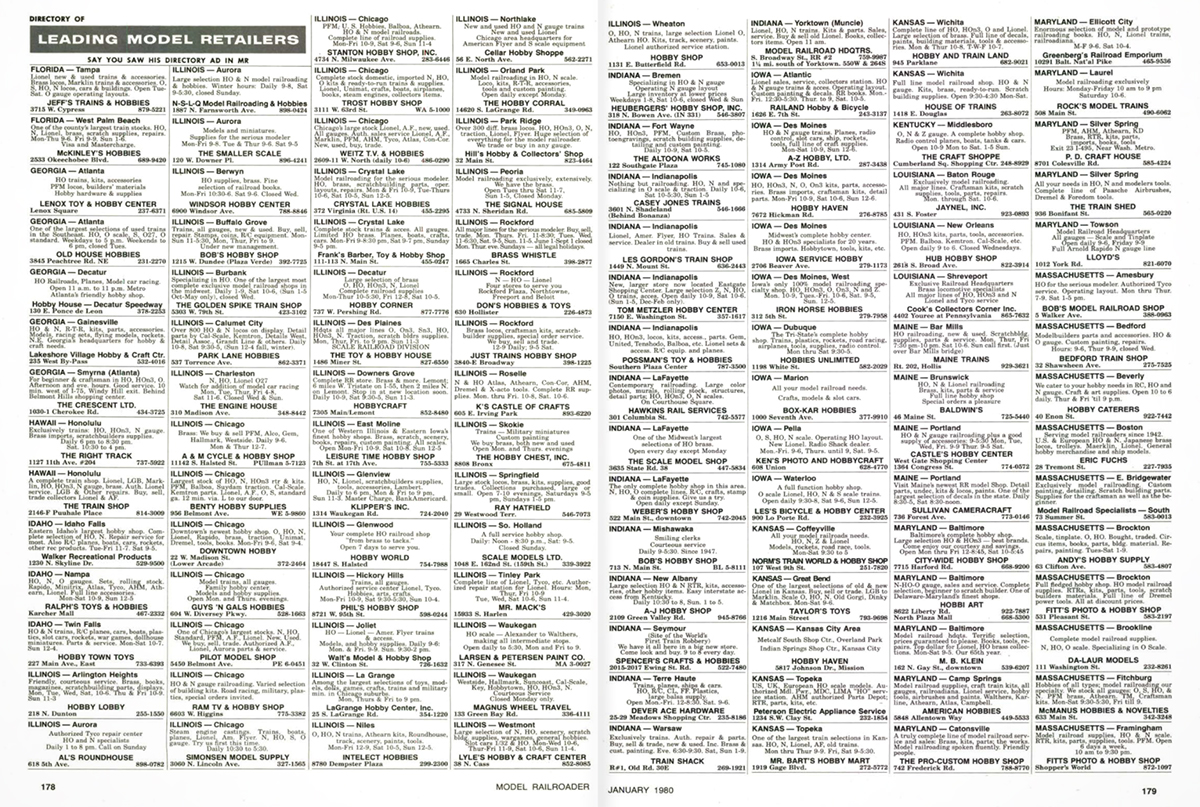
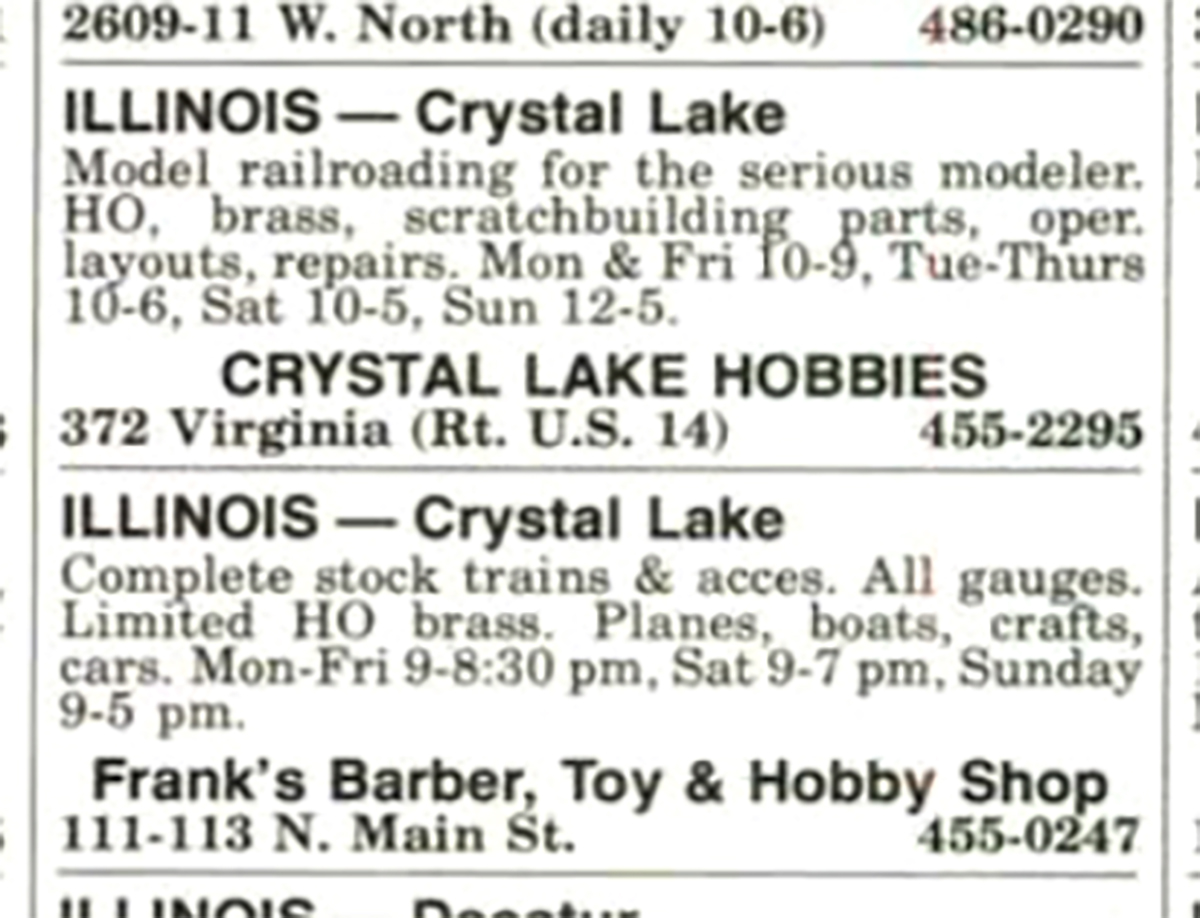
When looking at MR from decades ago, I’m always surprised by the vast number of hobby shops listed in the retailers classified ads section. If you add together the two half pages, you wind up with 9 full pages of listings for the US and Canada. Even with the headline on each spread, it totals more than 530 shops! And those are just the hobby shops that paid to have their directory ad in the magazine, meaning there were many more than that.
As shown in the inset photo, my two local stores are listed as well: Frank’s Toy and Barber Shop and Crystal Lake Hobbies. Crystal Lake Hobbies was run by Dave and Maggie Methlie. The strip mall store-front shop had a large HO display layout depicting the Pennsy that Dave used for modeling classes in the evenings. (See “Dave Methlie’s school for model railroaders” on page 106 of the March 1980 issue – it includes a track plan for the layout.) My dad and I learned how to apply ballast at one of them. Dave also built custom layouts for people, and he was hired by MR in 2005 to build the Stoney Creek 4 x 8 HO layout and write the project series that began in the January 2006 issue.
Frank’s was started by Frank Repp, a local barber in my hometown, after he added a small selection of toys and model kits to his shop in 1948. Over time, Frank sold more hobby supplies than haircuts, so he expanded the store into the neighboring building, and customers passed through a hole cut in the wall with a very low ceiling that connected the two shops. Frank’s stocked Z to G scale trains (including TT), slot cars, model rockets and RC airplanes, as well as dollhouse materials, stuffed animals, action figures, strategy games, and eventually metal Dungeons & Dragons miniatures.
For many years after Frank had passed away, his family still ran the shop, and I spent a lot of hours looking through the glass display cases dreaming of the railroads and models I would build some day. I have a lot of good memories of that shop, and most of my childhood allowance was spent at Frank’s. The shop was located less than a block from the Crystal Lake train station. When a train came into the station, it rattled the windows and you could see it from the front door – it was the perfect location for a train shop, if there ever was one! Though the shop is gone, you can learn more about it on its memorial Facebook page.
Amtrak Superliner Report in Bull Session
Column item on pages 144-145
In the Bull Session column in the January issue, Kalmbach’s librarian, George Drury, reported on his trip aboard Amtrak’s all-new Superliner cars. He had taken part in a media event offered by Amtrak in Chicago on October 11, 1979. Keep in mind that issues of the magazine are typically put together three months ahead of the publishing date, so the January 1980 MR is the soonest issue the Kalmbach team could get the “breaking news event” into print.
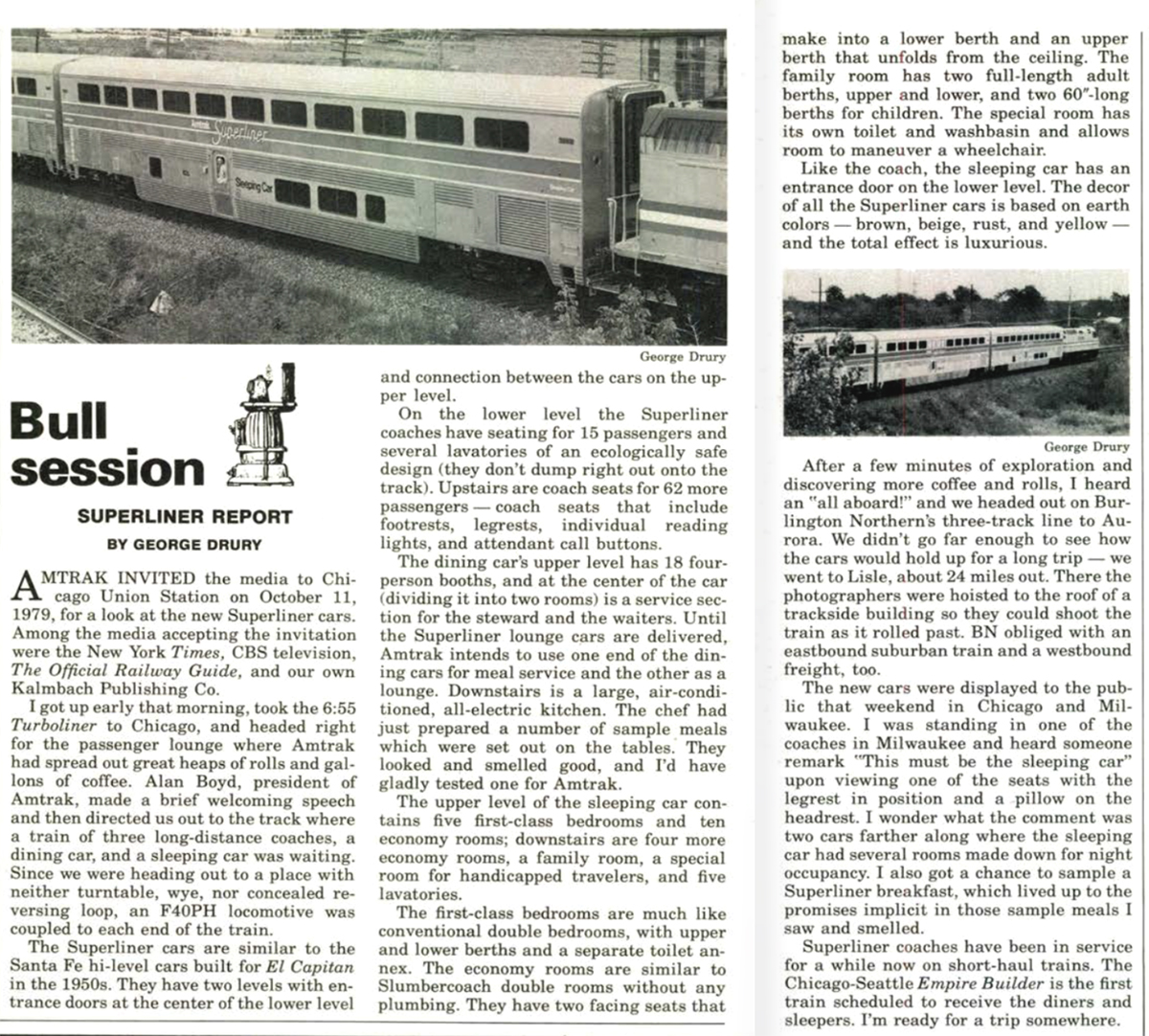
Pullman Standard delivered the 284 Superliner I passenger cars to Amtrak from 1975 to 1981. By 1979, the operator had acquired a critical mass of the two-level cars to more fully equip its long-distance western trains. Amtrak used the event to show off the all-new diners that were to be added to the Chicago-Seattle Empire Builder later that year, as well as sleeping cars and coaches already in service. (As of George’s writing, he noted that the lounge cars with their large scenic windows, had yet to be built and delivered.)
George indicated that he enjoyed a 24-mile trip to Lisle Illinois before returning to Union Station. For the next week, Amtrak then displayed the train to the public in both Chicago and Milwaukee, where George again caught up with it, this time to sample breakfast in the diner. 46 years later, many of these cars are still rolling, which is a testament to the quality of construction used by Pullman, even if the cars are now showing their age.
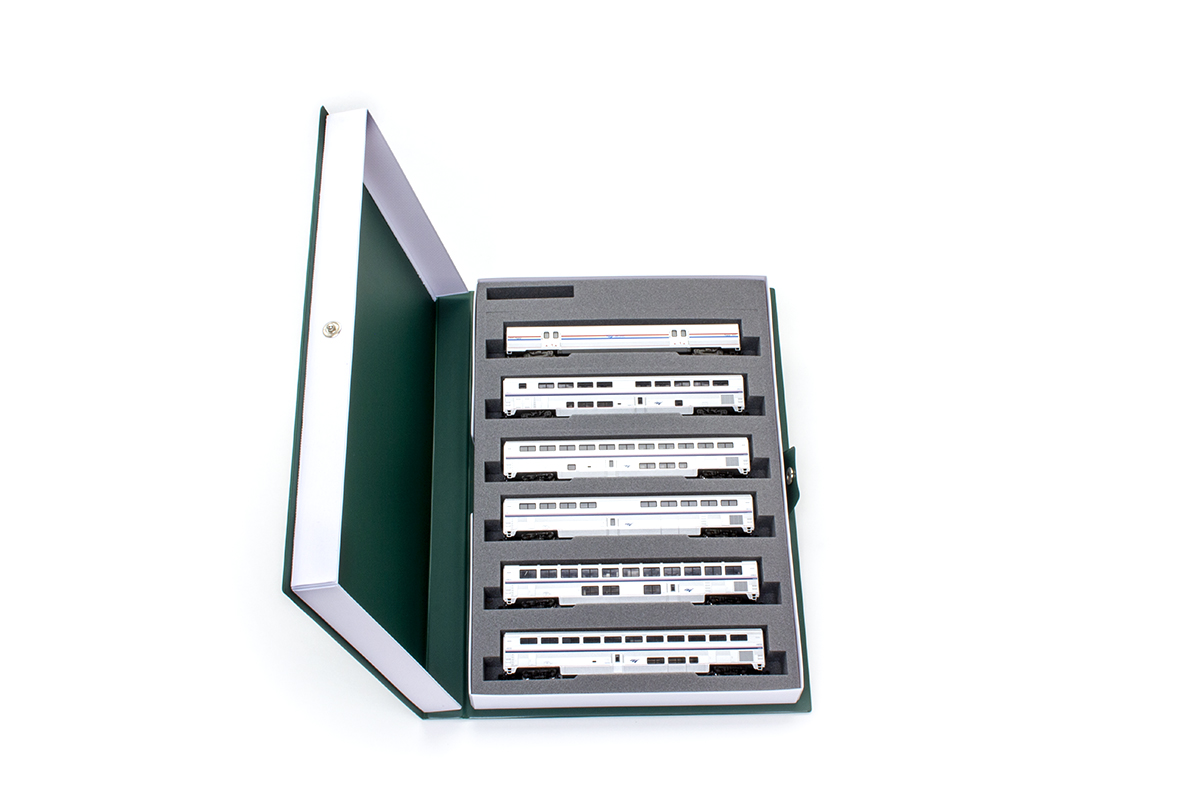
Being the newest passenger railroad cars in North America, “Superliner fever” would hold the railroad enthusiast and modeling communities all through the 80s. Jim Hediger wrote a more comprehensive article on Superliners in the November 1982 issue on page 84, complete with drawings for all of the Pullman-Standard cars. Early models were produced by Pacific Fast Mail in brass, as well as by Con-Cor. Later Superliner I and II cars have been produced in plastic by Walthers, Kato, and in brass by Overland Models. I personally own a set of N scale cars from Kato (above) depicting the California Zephyr, which I rode in 2023.
SALOTA command control system ad
Full-page display ad, page 170
Chalk this up to one of those products that I never knew it existed until I opened this issue a few weeks ago. SALOTA, which according to the internet stood for Signal, Animation, Lighting, Or Train Accessories, was made in West Germany and was a proprietary command control system, billed for use with O, HO, and N scales. The SALOTA 5300 advertised in MR featured 5 channels, allowing the operator to run 5 decoder-equipped trains independently on the same track. The “miniaturized” receivers that needed to be mounted in the trains were huge by today’s standards, and I’m not sure how you’d be able to fit one into any N scale locomotive or piece of rolling stock. In all fairness, the receivers for all command control systems in 1980 were too large for realistic use in N scale equipment. However, dummy F-units were perfect for HO modelers.
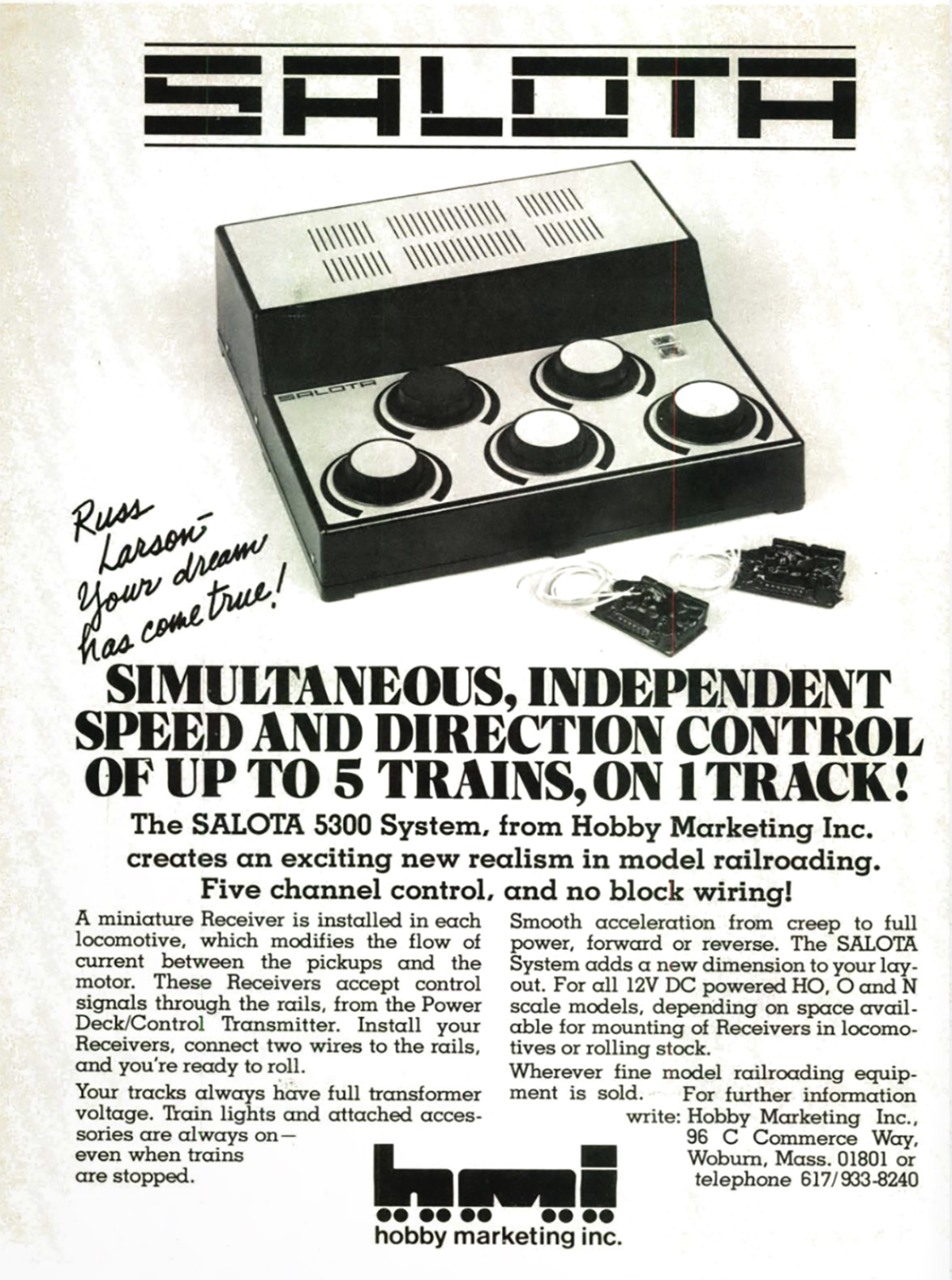
Also, with all five speed controllers mounted into the same cab, it would be difficult for more than two operators to run their trains at the same time. On page 90 of the April 1980 issue of MR, SALOTA is mentioned briefly as part of an article comparing available command control systems at that time, and author Andy Sperandeo mentioned that he knew of one modeler who disassembled his SALOTA 5300 and reassembled the throttle components into hand-held tethered cabs. While that is a better solution to support multiple operators, the system is hardly “plug-and-play” at that point.
While the Ad doesn’t mention G scale at all, from doing some web searching, it appears that LGB Trains made a reference to the SALOTA system in its 1979 catalog as suitable for its 1:23.5 models. If that is the case, the large receivers would work well in that scale. To further support this theory, the ad in MR shown here has the penned inscription, “Russ Larson – Your dream has come true!” Being that the former MR editor and publisher was heavily into large scale trains, it seems to bear out the idea that the SALOTA system was intended for something bigger than N scale.
If you’re really curious about the system, check out eBay. I found several of them listed for sale there. I know people collect vintage computers – do people also collect vintage command control systems? You could be the first!
Conclusion
So that’s just a quick look at some of the features and products that caught my eye from the January 1980 issue of MR. Undoubtedly, if you peruse it from either your personal collection or the archive on Trains.com, you’ll find different things that attract your attention. If you care to look through the issue, leave a note in the comments section below. I’d like to hear what you found in your review.

I, too, have many fond memories of Frank’s Barber, Toy, & Hobby Shop. To this day, it’s still the best hobby shop I’ve even been too. It just had so much character, and Frank was super cool to kids like me. I really miss the place.
I spent my formative years, from 1959 to 1967, in Cary. Our house was a couple of blocks south of the C&NW station. In the early years my parents would go shopping, every couple of months, in Crystal Lake and we’d always make a stop at Frank’s. Though at that time I was more into models and HO slot-cars. The last couple of years that we lived there, mom would let hope the train and ride to Frank’s on my own. Pretty darn cool for a 12-13 year old.
In 1980, now living in Williams Bay WI, my older sister bought me an Aurora Red Ball Express train set. I quickly realized it was mostly junk. Particularly the “track”. So I jumped in my car and drove down to Frank’s for some Atlas N-scale track. When I got home I discovered that the Aurora rolling stock would not run on it. The wheel gauge was too wide. So It was back to Frank’s for an engine and some freight cars. (To show what a dork I was, back then, I bought a Bachmann Amtrak F9 & a few 70-ton ore jennies. Just ’cause O thought they were cool looking.) I recreated the Aurora layout using the Atlas track, and my N-Scale career was underway. I expanded that layout a couple of years later. Then in the mid 90’s scrapped it and started over. Now, in 2026, I’m still in N-Scale.