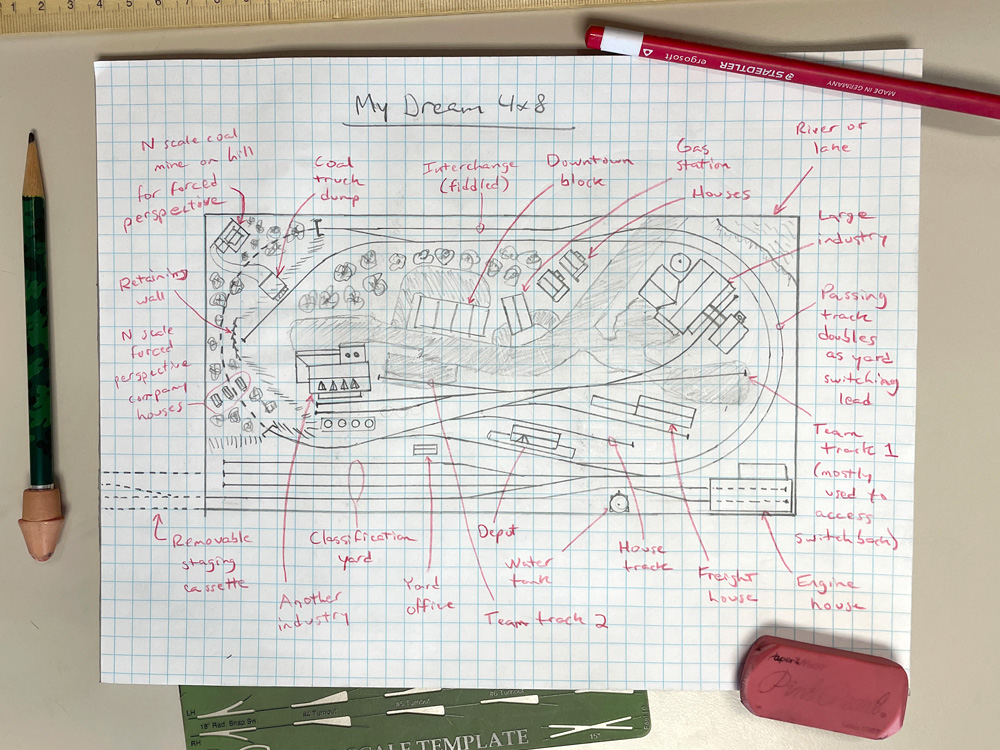
What’s in my dream 4-by-8 model railroad? A yard, continuous operation, and lots of places to switch. Just because you don’t have a lot of room for your model railroad doesn’t necessarily mean you need to give up on your dream layout. You might just need to scale your dreams back a bit. While that could mean modeling in a smaller scale, it doesn’t have to. You can still get a whole lot of model railroading fun in a small space with careful planning (and a pinch of pie-in-the-sky). So, let’s see what I can wedge into my dream 4×8 layout.
Let’s start with a list of John Armstrong’s givens and druthers. Armstrong, whom many regard as the founder of the school of realistic track planning, coined those terms for the criteria that govern a track plan. Givens are unalterable factors and must-haves, like layout space, scale, and minimum radius. Druthers are things we’d rather (“we druther,” get it?) include, but can be more flexible on. My list includes:
Givens: 4×8 size, HO scale, 18″ minimum curve radius, no. 5 minimum turnout, staging area (removable if necessary), passing track.
Druthers: Continuous operation option, short power and rolling stock, a town scene, a classification yard, numerous industries (including several universal ones).
Right off the bat, these requirements and desirable factors determine the basic shape of the plan. In a 4×8 footprint, continuous operation means an oval. To maximize the length of the yard, it should go outside the oval, along one long side. Even the shortest wheelbase four-axle diesels require a minimum radius of 18”, which leaves room for a four-track yard.
To allow the yard to be switched without fouling the main, I position a passing track around the outside of the right side of the oval and attach the yard to it. That way, the passing track can serve as a switching lead. Only when a road train needs to run around a train to position it for switching does the yard switcher need to stay out of its way. I push the passing track as far into the top-right corner as I can to make room for a two-track engine shed at bottom right, then build a compound yard ladder to maximize the length of the yard tracks.
No matter how small a layout is, if you want to operate it realistically, it needs staging. Staging represents the unmodeled rest of the world beyond the edge of the layout. Unless you’re modeling a railroad on an isolated island, you need somewhere for trains to come from and go off to. Since I’m limited to 4×8 here, I’ll cheat a bit by adding a removable two-track storage cassette, like the one we built for our Winston-Salem Southbound project layout (see our January 2018 and February 2018 issues).
Now that both ends of the oval are fixed, I can connect the two curves. I draw a straight line across the top of the 4×8, connecting to the left-side curve with a pair of offset turnouts. It’s a no-no on the prototype to route the main line through the diverging route of a turnout, but this space-saving tactic gives me a spur in both directions. I can place my first two industries.
Since there’s no room for a structure or even an unloading ramp between the top spur and the edge of the table, I curve the track off the edge to represent a connection to an unmodeled second railroad, turning this into an interchange. During an operating session, cars can be fiddled on and off this track to represent cars picked up and dropped off by a connecting railroad. “Universal industries” like this can ship and receive any conceivable car, making them indispensable for boosting operating variety.
Although ovals are good for continuous operation, they’re undesirable for realism. Therefore, I hide the left end of the oval in a tunnel. While my trains build up mileage running laps on the oval, I can tell myself they’re going to and returning from unmodeled locations. This gives me a hilltop on the left side of the 4×8, which gives me an idea. I curve the other spur about 45 degrees to maximize its length and draw in a coal mine truck dump on the hill overlooking the spur. Truck dumps are great space-saving industries, since the size of the truck dump is no indication how big or busy the mines it serves are. To maximize the visual size of the layout, I forest the hill with trees that diminish in size the farther they get from the truck dump, then place an N scale mine at the far corner. This forced perspective trick will make that corner of my dream 4×8 layout look bigger in photos than it really is. On the bottom left side of the hill, I add some N scale company houses for the same effect.
To break up the oval racetrack effect, I decide to add a cosmetic curve to the bottom side. This has the beneficial side effect of giving me room for a small yard office. Once I add a passenger depot – in the early diesel era, passenger service is still a must – there’s room for only one turnout leading to the interior of the oval.
Not a problem. I can still maximize the number of workable spurs by a switchback arrangement. First, I place two turnouts leading to a house track behind the depot and a spur to a freight house. These tracks receive and ship boxcars of less-than-carload-lot cargos, another versatile operating option.
Next comes a turnout facing the other direction to form the switchback. Since I have a natural aversion to tracks that look like they don’t have a function, I pave the area around the switchback tail, making it look like a team track.
A couple more turnouts split the other end of the switchback into three spurs. Two remain parallel to serve a large industry. I want it to receive and ship multiple kinds of cargos, so I draw a row of tanks or silos along the outer spur. Depending on what kind of industry it ends up becoming, these tanks or silos might receive petroleum products, cooking oil, liquid sweetener, grain, or plastic pellets. Maybe it’s a paper mill, receiving tanks of chemicals and kaolin slurry. Who knows? I’ll figure that out later.
The other spur becomes another team track. Since the first “team track” will have to stay vacant most of the time to serve as the switchback tail, I need another one to actually fulfill the function of a team track. If Team Track 2 fills up, Team Track 1 may be pressed into service, increasing the switching challenge.
One last spur track serves another large industry, at top right. I imagine this one as a food processor, like a cannery or large creamery, with a separate boiler house across the track from the main building.
Finally, I add a body of water at top right, a main street down the middle of the layout, and some non-rail-served town buildings to complete the layout.
To help you fulfill your modeling dream, check out the book How to Design a Model Railroad by Lance Mindheim, available now in the Kalmbach Hobby Store. How well does my dream 4×8 layout match yours? What would you add or subtract? Let me know in the comments below.
Share this article