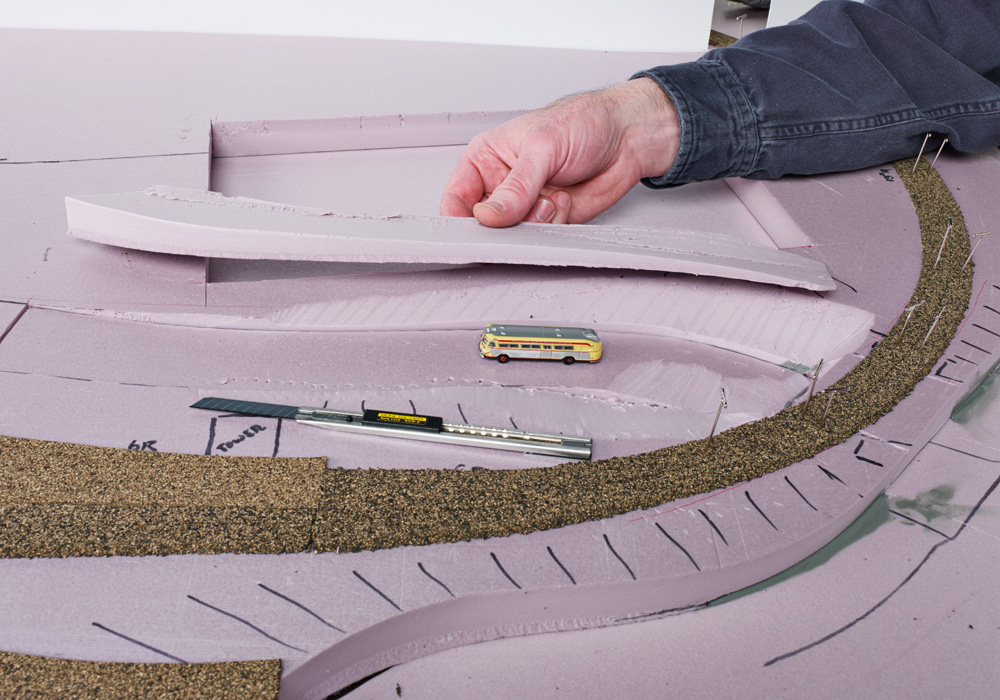
Q: What are the drawbacks of extruded-foam insulation board benchwork? Much has changed with model railroading since my childhood. As a retiree, I’m re-entering the hobby with a modest HO scale layout in a 10 x 15-foot room in my garage. I’ve consulted several articles, books, and videos on benchwork, but I’m still uneasy about my plans. I just completed basic benchwork using a modified L-girder framework with 1/2″ plywood tabletop. I was initially going to just lay cork roadbed and track on top of the plywood. But now I’m considering adding 1″ or 1-1/2″ extruded-foam insulation board on top of the plywood to let me create ditches, small streams, or other terrain features without having to lower the plywood. This will probably add some additional difficulty with laying roadbed, track, and under-track switch machines. Is this a reasonable approach? Do you foresee any other issues or problems? – Barry Kenyon
A: Extruded-foam insulation board benchwork is no longer considered an experimental or innovative model railroad scenery material; it’s been around long enough to be considered mainstream. Model Railroader staffers use it on most of their project layouts. The reason is that it’s light, rigid, conveniently sized (in 4×8 sheets and 2×4 “handy panels”), and easy to cut, shape, and glue.
As you mentioned, foam makes it easy to carve out below-grade scenic features like drainage ditches, culverts, waterways, and underpasses. The biggest drawback to extruded-foam insulation board benchwork is availability. Since it’s sold primarily as a construction material to insulate buildings against the cold, it can be hard to find in hotter climates.
Just because you can’t use nails to hold down your track on extruded-foam insulation board benchwork doesn’t mean track laying is harder on foam. We usually fix cork roadbed to the foam using a foam-safe construction adhesive caulk like Liquid Nails for Projects or Loctite PL 300. Simply run a bead of adhesive caulk down the future track centerline, spread it thin with a putty knife, press the roadbed into the adhesive, and use foam nails (T-shaped pins; see the photo above) to hold it in place while the adhesive cures. Once it’s cured, use the same technique to glue your turnouts and flextrack to the roadbed. Just make sure to drill holes for your switch machine actuator wires before gluing down the turnouts, and don’t get the adhesive under the switch rods.
If you add foam to the top of a plywood table, you can still use under-table switch machines. Most switch machines come with an adjustable fulcrum you can slide up or down to adjust the distance the end of the wire moves when the machine activates. Adjust this so the end of the actuator wire’s travel isn’t excessive. Test your switch motor before attaching it permanently; if your machine is mounted more than a couple inches below the turnout, you might have to replace the actuator wire that came with the machine with a length of stiffer piano wire. Also called music wire, this is available in 12” lengths from the manufacturer and through hobby vendors like Walthers.com. Use a hardened-metal cutting plier and wear eye protection when you snip it to length. Music wire will ruin rail nippers and sprue cutters, and the cut ends can go flying.
But all-extruded-foam insulation board benchwork isn’t your only option. For better control of your track elevations and easier mounting of switch motors, you could use the traditional open-grid benchwork with plywood subroadbed on risers. Then, fill in the empty spaces between the subroadbed with foam terrain. This hybrid approach gives you the best of both worlds.
For more about using foam benchwork, check out Lance Mindheim’s article “Bench tops made easy with foam” in our July 2012 issue.
Send us your questions
Have a question about modeling, operation, or prototype railroads? Send it to us at AskTrains@Trains.com. Be sure to put “Ask MR” in the subject.
Share this article