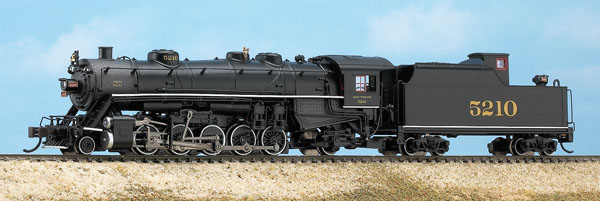
A war baby. When America entered the war in 1917, the nation’s railroads weren’t up to the task of moving the men and materiel needed for the war effort. President Woodrow Wilson nationalized the railroads in December of that year, creating the USRA to take over the nation’s rail network. One of the first steps taken to improve efficiency was to standardize locomotive designs, reducing the time, training, and cost necessary to service and repair them. A locomotive built to USRA specifications could be fixed in any railroad’s shops, regardless of origin. One of these standard designs was the light 2-10-2, or Santa Fe type.
The Atchison, Topeka & Santa Fe bought three 2-10-0 Decapods for pusher service over Raton Pass in 1902. But the long, rigid-wheelbase locomotives had trouble backing downgrade after detaching from their trains. So the Santa Fe ordered a set of 10-drivered locomotives with two-wheel trailing trucks to help guide them around the curves while backing. These 2-10-2s, first delivered in 1903, were therefore known colloquially as Santa Fe types.
Based on the Santa Fe’s locomotive, the USRA came up with two standard designs for 2-10-2s, heavy and light. At the time, the heavy Santa Fe was the largest non-articulated steam locomotive ever built. The light version, after which Bachmann’s N scale model is patterned, was also impressive, weighing more than 270 tons and exerting almost 35 tons of tractive force. With its small-diameter driving wheels, the USRA 2-10-2 was built for strength, not speed. The locomotives were typically assigned to drag freights, such as coal, ore, oil, and steel.
Though the wheel arrangement was originally invented for mountain service, the USRA versions were popular with non-Western railroads, as well. Ninety-four were built, more than half of them going to the Southern Ry. Today, just one survives, Duluth, Missabe & Iron Range no. 506, on display at the National Railroad Museum in Green Bay, Wis.
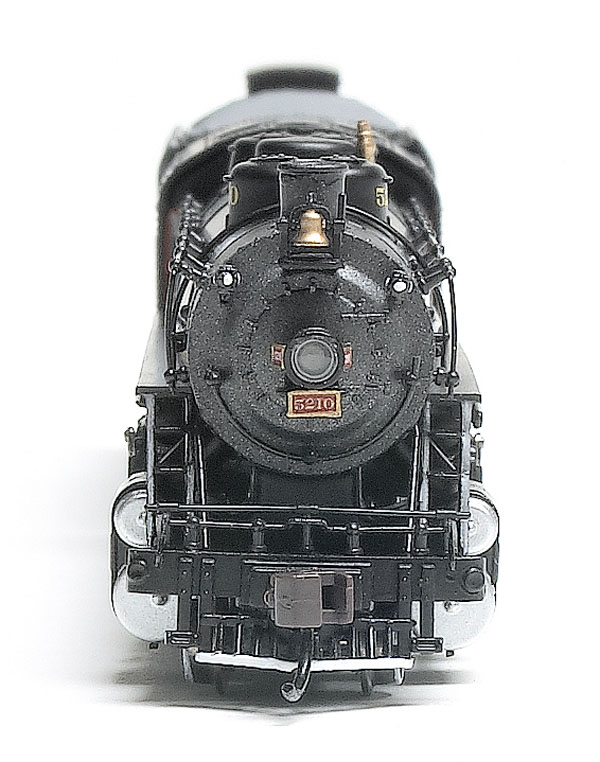
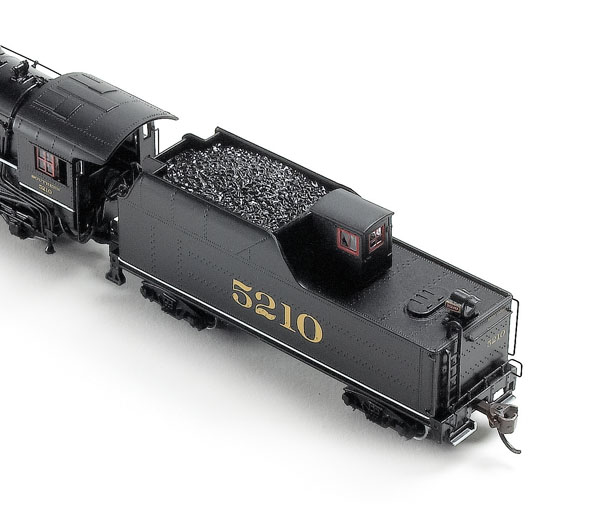
The plastic boiler has fine rivet detail. The locomotive chassis is die-cast metal. Wire grab irons, handrails, and uncoupling levers are bent from thin wire. The window sash on the cab and doghouse are sharply painted red. The cab interior is painted green, and there’s a detailed boiler backhead.
A photo of a Southern Ry. USRA 2-10-2 in the 1922 Locomotive Builder’s Cyclopedia (Simmons-Boardman, out of print) strongly resembled our sample model. The locomotive’s major dimensions also matched drawings I found in that reference book. Even the wheelbase matches; Bachmann accomplished this by using 53″ drive wheels in place of the prototype’s 57″ wheels to cope with the added space needed for N scale flange clearances. The white bands around the rims make the wheels seem bigger, though.
To improve the model’s tracking around sharp curves, the center set of drivers is blind, i.e., flangeless, just as it was on the prototype. Traction tires on the second and fourth sets gives the model a surprising amount of pull, letting it haul 26 standard N scale cars on straight, level track.
All the locomotive’s wheels are in gauge according to National Model Railroad Association standard 4.2, though they were on the tight side.
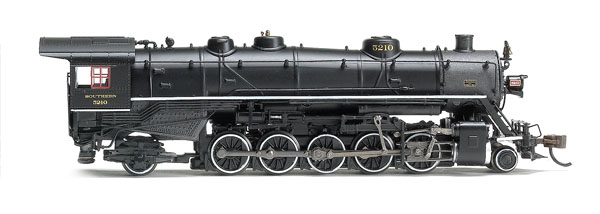
Electrical power is picked up from the rails by the first, third, and fifth set of drivers, as well as the front tender truck. Power from the tender truck is transmitted to the engine via a pair of contacts on the drawbar. Though the drawbar readily snaps on and off the engine, there didn’t appear to be an easy way to detach the six wires connecting the cab and tender without disassembling the tender.
The model is equipped with E-Z Mate Mark II magnetic knuckle couplers, which looked oversized next to other brands. The couplers were also mounted .05″ too high, though they still coupled with N scale rolling stock equipped with McHenry and Micro-Trains couplers.
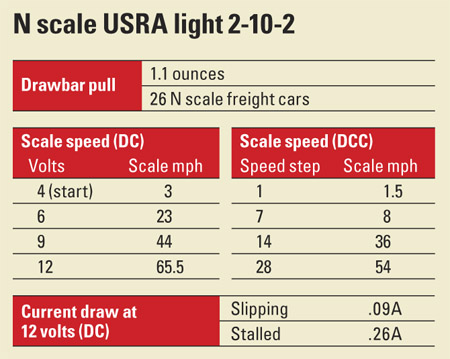
The locomotive started creeping quite slowly at 3.5 volts, though its motion was unsteady at this speed. It smoothed out at 4V, rolling steadily at 3 scale mph. It reached just over 65 mph at 12V DC, a high but still plausible top speed for a small-drivered freight engine.
When I tested the locomotive on DCC, it didn’t start moving at all until I reached speed step 5. At that setting, it crept along at an impressively slow 0.6 scale mph. However, an engine wouldn’t be very useful with 1/7 of its speed range disabled, so I consulted the DCC decoder manual on Bachmann’s website. After programming a value of 25 into configuration variable 2 (starting voltage or Vstart), the model responded to speed step 1 by rolling at 1.5 mph.
I also put the locomotive through its paces on our N scale Salt Lake Route project railroad. It had no problems with the layout’s 11″ radius curves and no. 6 crossovers. The engine would look better on broader curves, though.
A real workhorse. The USRA designed the light 2-10-2 to last. Built for World War I, many of them kept working through World War II and beyond. The Duluth, Missabe & Iron Range retired the last of them from freight service in 1960. One of these long-lived, hard-working engines would look great hauling a long string of coal or ore hoppers on an N scale layout set anytime in the last four decades of steam.
Manufacturer
Bachmann
1400 E. Erie Ave.
Philadelphia, PA 19124
bachmanntrains.com
Road names: Southern Ry.; Canadian National (ex-New York Central); Chicago & Illinois Midland (two road numbers available); Duluth, Missabe & Iron Range; Kansas City Southern (ex-Ann Arbor); Seaboard Air Line. Also painted black but unlettered.
Era: 1918 to late 1950s
Features
- Die-cast metal frames
- Digital Command Control
- motor decoder
- Light-emitting-diode headlight and backup lights
- E-Z Mate Mark II magnetic knuckle couplers, mounted .05″ too high per National Model Railroad Association S-2
- Minimum radius: 91⁄2″
- Operating valve gear
- Prototype-specific tender
- RP-25 contour wheels, in gauge
- Traction tires on two axles
- Weight: 31⁄2 ounces (engine only), 5 ounces (with tender)
- Wire handrails, grab irons, and uncoupling levers