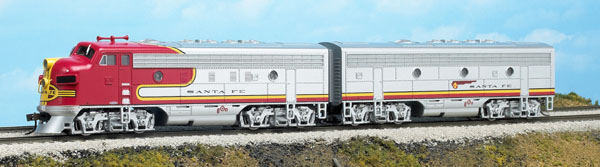
History. Electro-Motive Division’s F units, colloquially known as “covered wagons,” cemented the dominance of the diesel locomotive on American rails. And the F7, introduced in 1949, was one of EMD’s most successful models. With its 1,500-hp 567B prime mover, the F7A and cabless F7B sold a combined 3,849 units across the continent. Practically every North American railroad from the Alaska RR to the Ferrocarriles Nacionales de Mexico ran them. The versatile locomotives were used in both freight and passenger service.
Most F7s were operated in A-A, A-B, or A-B-A sets. Railroads loved them because they were reliable and economical to maintain; many remained on the rails through the 1980s. As the locomotives aged, however, some were relegated to yard work, where crews objected to their lack of rear visibility and difficulty in getting in and out of the cab. The Atchison, Topeka & Santa Fe addressed these concerns by converting 233 of its F units to more utilitarian-bodied CF7 road switchers, starting in 1969. Other railroads simply replaced their covered wagons with more versatile hood units.
First impressions. Our sample model came painted in the Atchison, Topeka & Santa Fe’s iconic red-and-silver passenger warbonnet scheme. The red paint was smoothly and evenly applied, and the silver was a fine approximation of the prototype’s brushed stainless steel sides. There was no bleed or feathering of the border between the red and the yellow stripe. The lettering was crisp and opaque; under magnification, the oval builder’s plates just ahead of the cab ladders were legible.
The models’ major dimensions and the placement of most details matched drawings in the April 2000 issue of Model Railroader, but there were some detail discrepancies.
Details such as the body’s horizontal Farr-Air intake grills, horizontal louvers, and the square window on the rear door mark the locomotive as a Phase I model built before November 1951. (Locomotive phases aren’t official designations, but are terms used by modelers and railfans to refer to changes in construction details over time.) However, the model has a 48″ dynamic brake fan, a feature not introduced until August 1952.
The nose of the model has two light enclosures, an option available on F units of all phases. On the model, the top light is the headlight, and the bottom is non-functional. On the prototype, the headlight is in the nose door, and the top is a signal light (such as a Mars light). The headlight should be in the upper
position only if there is no signal light.
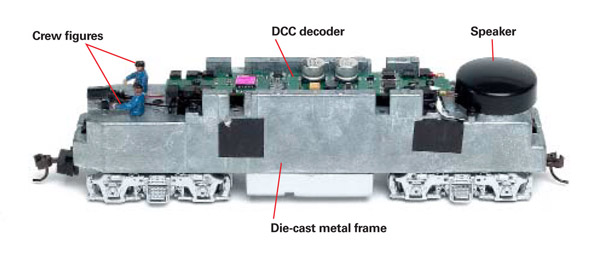
Four screws surrounding the fuel tank hold the body shell to the frame; after removing these and the front coupler, the body came off easily. (Later, I figured out how to slide off the shell around the front coupler, which is retained by a small plastic clip that’s a bit tricky to reinstall.) The SoundTraxx Sound Value decoder occupied the top of the hefty cast-metal frame. Beneath it nestled the can motor and two brass flywheels. The speaker enclosure is on top of the frame, in the back. Painted engineer and fireman figures occupy the cab of the A unit. The cabless B unit fills this space with additional weight, which accounts for its higher drawbar pull.
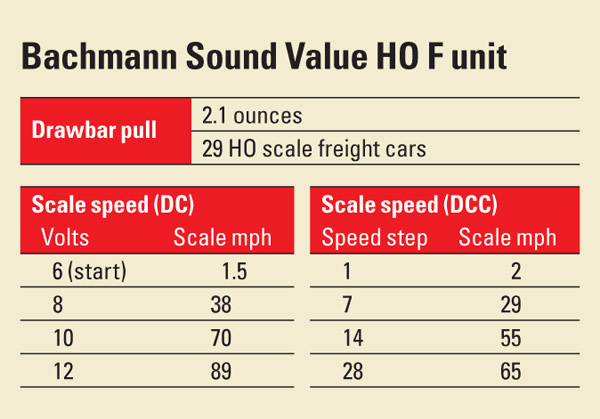
Our test bench force meter registered more than 2.5 ounces of pull for the B, enough to haul 35 standard HO scale 40-foot freight cars (or close to 12 streamlined passenger cars) on straight and level track. The A mustered just over 2 ounces, equivalent to 29 freight or 9 passenger cars. An Bachmann F7A-B set should have no problem hauling a full 11-car Super Chief consist.
Since the sound functions of DCC sound decoders draw a lot of current, locomotives equipped with them take a lot of voltage to start rolling under DC. Our sample A and B units started at 7V, with engine sounds playing at full volume, at an impressively slow and steady 1.5 scale mph. Each single unit topped out at 89 scale mph at 12V, within the prototype gearing range.
Both units performed consistently and smoothly under DCC. At first, neither responded to speed step 1, but
I only had to increase the value of the Vstart configuration variable (CV2) to a value of 2 to remedy this. The A unit rolled a little hesitantly at this value, so I set CV2 on both units to a value of 4 to smooth out the F7A’s performance. At this setting, both rolled steadily at 2 scale mph on step 1. Throughout all speed steps, both units stayed within a couple scale mph of each other; in fact, their top speeds at step 28 were less than 1 scale mph apart, making them easy to speed match for m.u. operations.
The Sound Value DCC decoders support advanced consisting. After programming each unit to a unique address, I programmed a consist address of 10 into CV19 of both decoders. The pair thereafter responded as one to commands sent to address 10.
I could trigger functions like playing the horn or bell on the A unit using either the consist address or its own. Setting CV19 back to a value of 0 let both locomotives respond to their separate addresses again. The decoder supports CVs 21 and 22, which controls which effects are triggered by the consist
address. Downloadable user manuals, including specific documentation for the Bachmann Sound Value models, is available at www.soundtraxx.com.
The decoder also has configuration variables that let you control individual sound effects. I tested a different horn type and lowered the bell’s volume.
A solid F7. No transition-era model railroad would look complete without at least a few F units hauling trains. The Bachmann model is accurately decorated and captures the overall look of the prototype. With its many programmable sound effects, the SoundTraxx decoder makes the F7 a lot of fun to operate.
Manufacturer
Bachmann Industries Inc.
1400 E. Erie Ave.
Philadelphia, PA 19124
www.bachmanntrains.com
Road names: Atchison, Topeka & Santa Fe (red-and-silver passenger warbonnet scheme); New York Central (lightning stripe); Norfolk Southern (modern logo); Pennsylvania RR (Brunswick green, single stripe); Southern Pacific (black widow); and Western Maryland (speed lettering).
Era: 1949 to 1970s
Features
- Blackened metal RP-25 contour wheelsets, in gauge
- Can motor with dual flywheels
- Crew figures in cab (A unit only)
- Directional dimming headlight (A unit only)
- Kadee-compatible E-Z Mate Mark II knuckle couplers, at correct height
- SoundTraxx Sound Value Digital Command Control sound decoder
- Weight: A unit, 15.5 ounces; B unit, 1 lb. 1.5 ounces