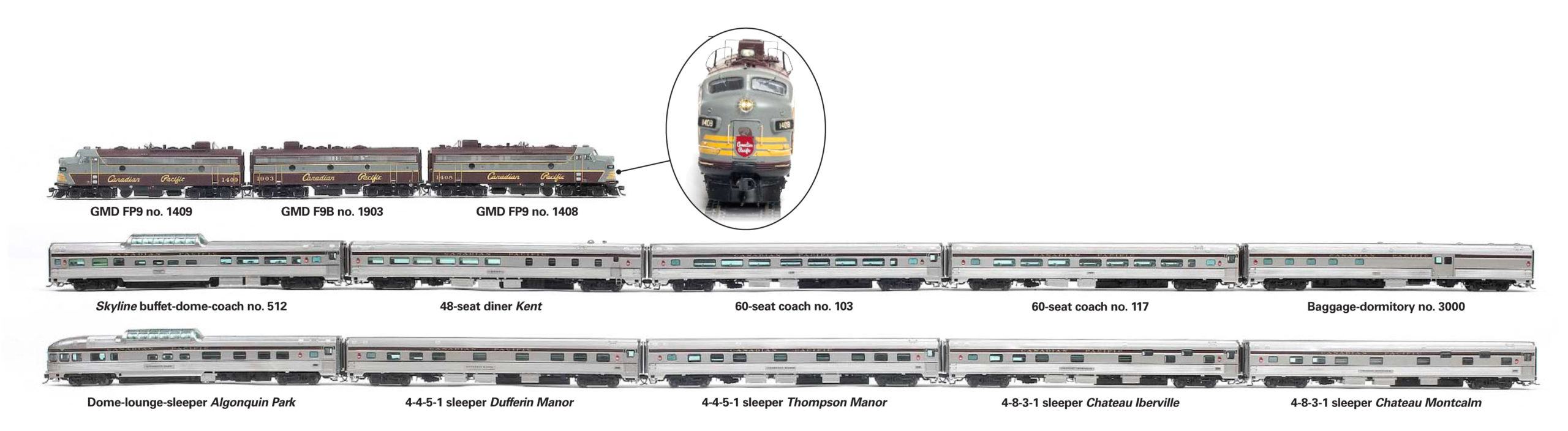
Two General Motors Diesel Division FP9 units and one F9B unit lead The Canadian. The 10 passenger cars included in the set are one baggage-dormitory car; two 60-seat coaches; one Skyline buffet-dome-coach; one 48-seat diner; two 4-section, 4-roomette, 5-double bedroom, 1-compartment Manor-series sleepers; two 4-section, 8-duplex roomette, 3-double bedroom, 1-drawing room Chateau-series sleepers; and one 3-bedroom, 1-drawing room Park-series dome-lounge sleeper.
Prototype. On April 24, 1955, the Canadian Pacific Ry. launched a new streamlined passenger train named The Canadian that ran from Montreal and Toronto to Vancouver, B.C. The Budd Co. built the train’s new stainless-steel cars, including dome cars, to take advantage of the route’s stunning scenery. GMD of London, Ont., built the 1,750 hp FP9 locomotives to haul the consists as well as F9B booster units.
Via Rail Canada took over CP passenger operations in the 1970s. Although there have been route and service changes, The Canadian still operates today.
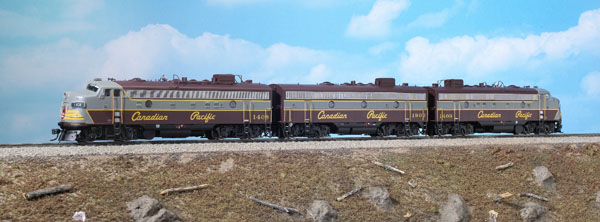
The models are meticulously detailed for the CP prototype and include rooftop icicle breakers and searchlights.
The paint and lettering match prototype photos. There’s sharp color separation and all striping is straight.


The plastic cars feature 1-piece bodies with fluting that matches each Budd Co. prototype. The satin silver finish does a good job simulating stainless steel. All the lettering and heralds are correctly placed and crisply printed.
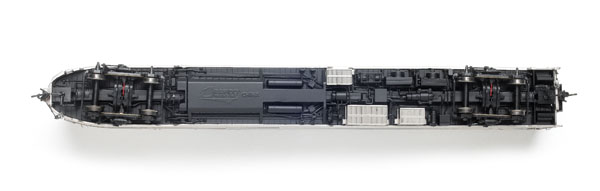
The separately applied diaphragms are sprung and almost touch when the cars are coupled together.
After removing a car’s couplers I carefully lifted off the 1-piece body shell and had access to the interior. This is helpful for adding passenger and crew figures, which aren’t included.
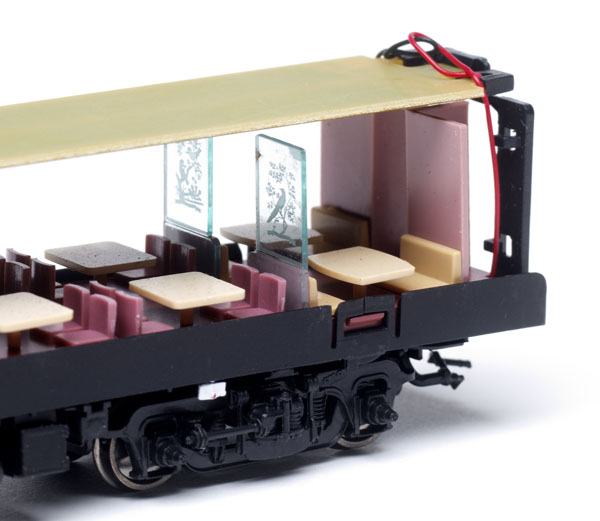
Each car features overhead lighting provided by surface-mount light emitting diodes. The Park car also features red markers and an illuminated tailsign.
The set includes some railroadiana reproductions – swizzle sticks, cocktail napkins, and a wine glass.
Sound, lights, DCC. After placing the FP9 on our DC test track, I heard the rumble of the 567 diesel once I applied 6 volts to the track. The rpm increased as I advanced the throttle. According to the manufacturer, the decoder features sounds from a prototype FP9 – Via Rail no. 6505.
On our DCC test track, the sounds started as soon as I addressed the locomotive. I especially enjoyed the grade-crossing signal (function 12), which has a realistic Doppler effect.
The FP9 has some user-controlled functions that I haven’t seen before. The class lights can be toggled between green, white, and off with function 10. On the prototype, CP engineers would rapidly move the throttle to notch 8 when starting out the train. This effect can be simulated by pressing function 3. (As with other DCC sound decoders, you can also program the FP9’s decoder for manual notching, where the RPM sound is controlled independently from the locomotive speed.)
The volume level of individual effects can be adjusted independently as well as the overall volume level using configuration variables (CVs). Other programmable CVs control speed table curves, acceleration and deceleration momentum, and much more. An online user manual is available at www.soundtraxx.com.
Both FP9 units are factory programmed to address 3, so the modeler will need set up an advance consist according to the instructions of his DCC system. Although the models aren’t factory programmed as a consist, I appreciated that Rapido pre-programmed CVs 21 and 22 in each unit so that the lighting and sounds functioned correctly for an A-B-A configuration.
The F9B unit included with the set is unpowered with headlights on each end that turn on or off when a modeler waves the included magnetic wand over the hidden reed switches. An F9B powered chassis is available separately.
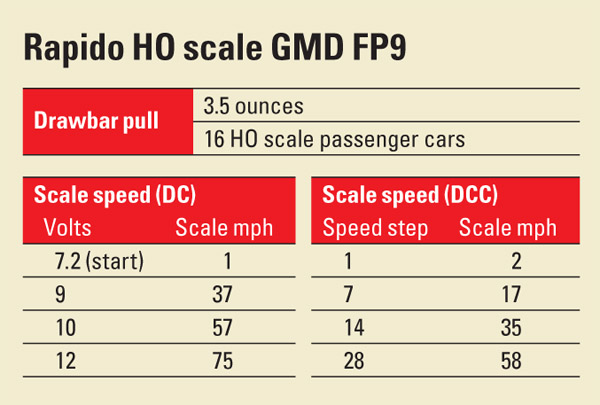
The two FP9s in our set had no trouble hauling the 10-car consist. The pair also pulled the train up a 3 percent grade at speed without any hesitation.
As you can see in the charts below, the FP9A had impressive slow-speed performance and smooth acceleration on both DC and DCC test tracks. The 75 scale mph top speed on the DCC test track is lower than the 89 mph top speed of the prototype, but it’s still fast enough for most model railroads. Switching to 128 speed steps in DCC, the FP9 crawled along at less than 1 scale mph in speed step 1.
The Canadian deserves to be run on broad curves. It looks best on 28″ radius or wider. I also appreciated that Rapido includes long-shank couplers for those who need to run the train on tighter 24″ or 22″ curves. The instructions include modifications that can be made to the car skirts to allow them to run on 18″ curves, but I think seeing a train of this caliber run on such sharp curves really detracts from its appearance.
With superdetailed cars and realistic sound-equipped F units, Rapido’s The Canadian is a fitting tribute to Canada’s premier transcontinental streamliner.
Manufacturer
Rapido Trains
445 Edgeley Boulevard, Unit 1
Concord, ON L4K 4G1 Canada
www.rapidotrains.com
Paint schemes and eras: Canadian Pacific maroon/block lettering (1955 to 1968), Canadian Pacific script lettering (1963 to 1968), Canadian Pacific Action Red with 5″ stripes (1968 to 1978), Canadian Pacific Action Red with 8” stripes (1970s), Via Rail Canada/CP (1978 to 1982), Via Rail Canada (1979 to 1992)
Locomotive features
- All-wheel drive and electrical pickup
- Can motor with dual brass flywheels
- Dual-mode SoundTraxx Digital Command Control decoder
- Stainless steel wheels in gauge
- Metal Macdonald-Cartier knuckle couplers mounted at correct height
- Weight: 16.8 ounces (A unit), 12.8 ounces (B unit)
Car features
- Metal Macdonald-Cartier knuckle couplers mounted at the correct height
- Stainless-steel wheels in gauge
- Weight: 7.2 to 7.7 ounces (0.45 to 1 ounce too heavy per National Model Railroad Association RP-20.1)