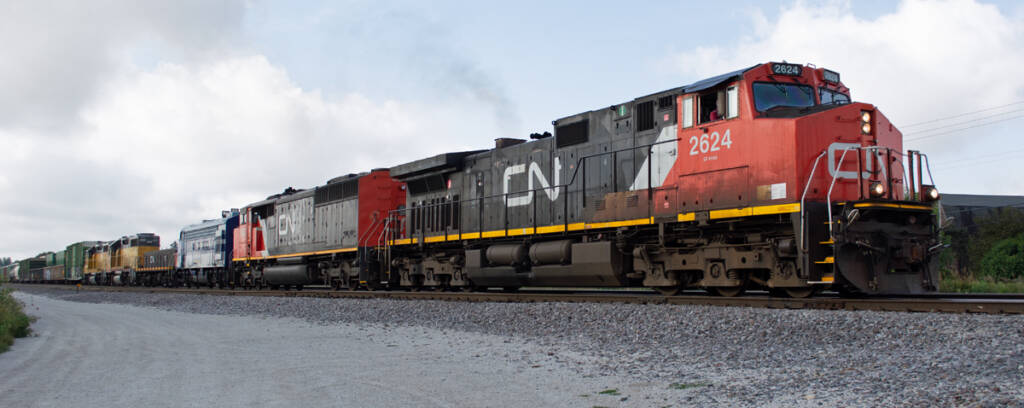
My daily commute to our former Kalmbach Media offices at 21027 Crossroads Circle in Waukesha, Wis., conveniently crossed the Union Pacific, Canadian National, and Canadian Pacific. Most days I didn’t encounter a train. If I did, I was usually stuck too far back in the cue of traffic to get any meaningful photos. But the morning of Aug. 18, 2015 more than made up for those empty trips and missed opportunities. A northbound train on CN’s Waukesha Subdivision featured a collection of six units that, if seen on a model railroad, would probably leave you saying “That’s not prototypical.” But there was no way I was going to pass up a train with Electro-Motive Division cab and hood units, a General Motors Diesel Division cowl-body diesel, and a GP9 slug.
When I spotted the EMD F7A, I immediately pulled off to the side of the road, safely hooked a U-turn on Duplainville Road, and drove across the Weyer Road grade crossing to get on the sun side of the train. My timing was perfect, as the northbound was waiting in the siding for a signal. I had enough time to call the office and let Hal Miller, then MR’s managing editor, know I’d be running a few minutes late. Hey, I figured an F unit on a mainline freight in 2015, even if dead in tow, was a fair reason to be tardy!
After I got off the phone, I grabbed my Nikon D5200 and got ready to document this unusual assortment of motive power. Once the signal turned green, the train started inching ahead and I let history roll into my camera’s viewfinder. Let’s take a closer look at the six diesels in this memorable consist.
Canadian National General Electric Dash 9-44CW No. 2624
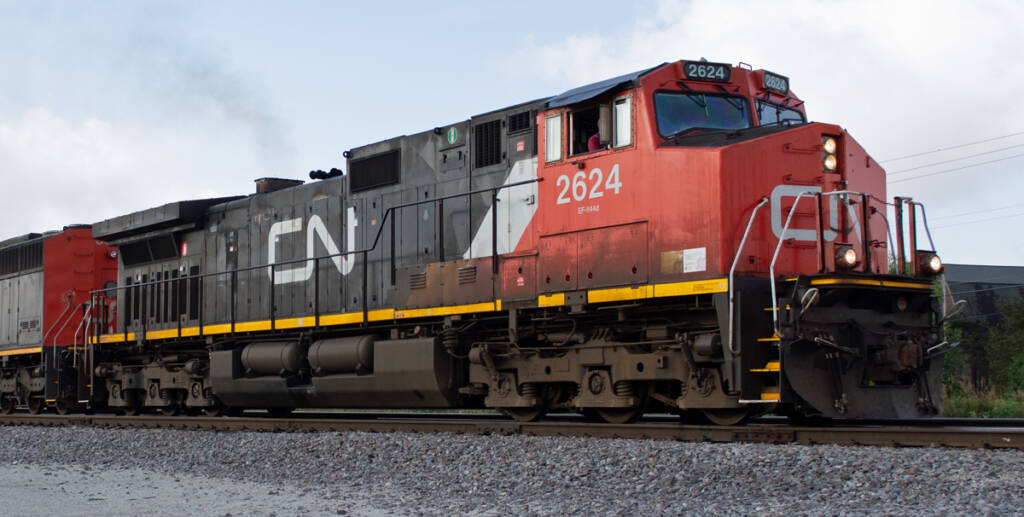
Canadian National No. 2624 was the newest engine in the consist. The six-axle road unit, part of the railroad’s 2603 through 2642 series, was built in late 2000. Under the road number was a small stencil that read EF-644d. That’s CN’s classification for the unit (E = General Electric, F = road freight, 6 = six-axle unit, 44 = horsepower to the closest hundred, and d = the locomotive is from CN’s fourth order of Dash 9 diesels). The diesel is still in service today.
Canadian National General Motors Diesel Division SD60F No. 5537
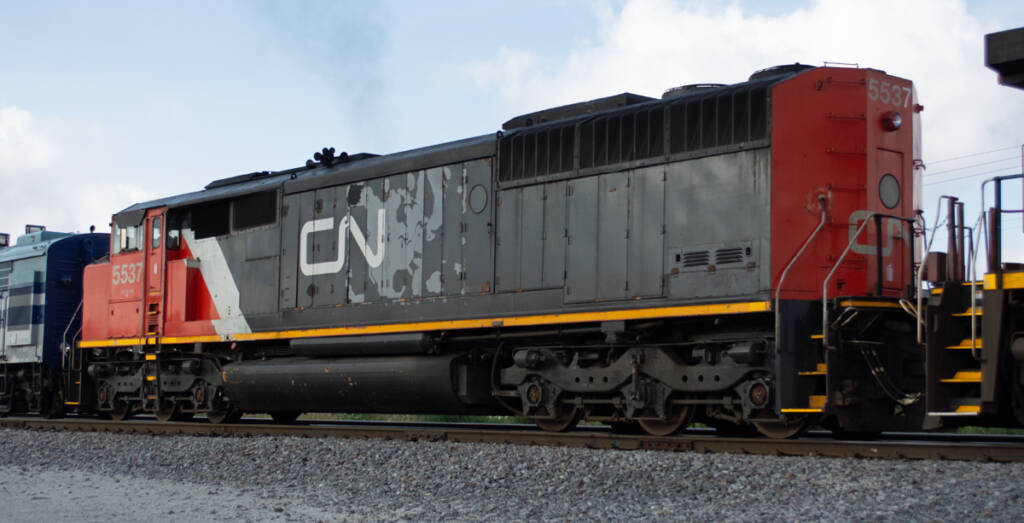
The second unit in the potpourri of motive power was CN 5537, a General Motors Diesel Division SD60F. The cowl-body diesel was still in CN’s North America paint scheme from the early 1990s, but the silhouette of the continent wasn’t as crisply defined as it once was because the paint was peeling on adjacent doors.
In this view, you can clearly see the taper in the carbody behind the cab. This feature, which offered improved visibility to the rear, was called a “Draper taper” after CN’s Assistant Chief of Motive Power William L. Draper.
The 5537 was built in 1989 and rated at 3,800 horsepower. The engine, part of CN’s GF-638b class (the G indicating General Motors Diesel Division), was retired in 2017.
Wisconsin Great Northern Electro-Motive Division F7A No. 1951
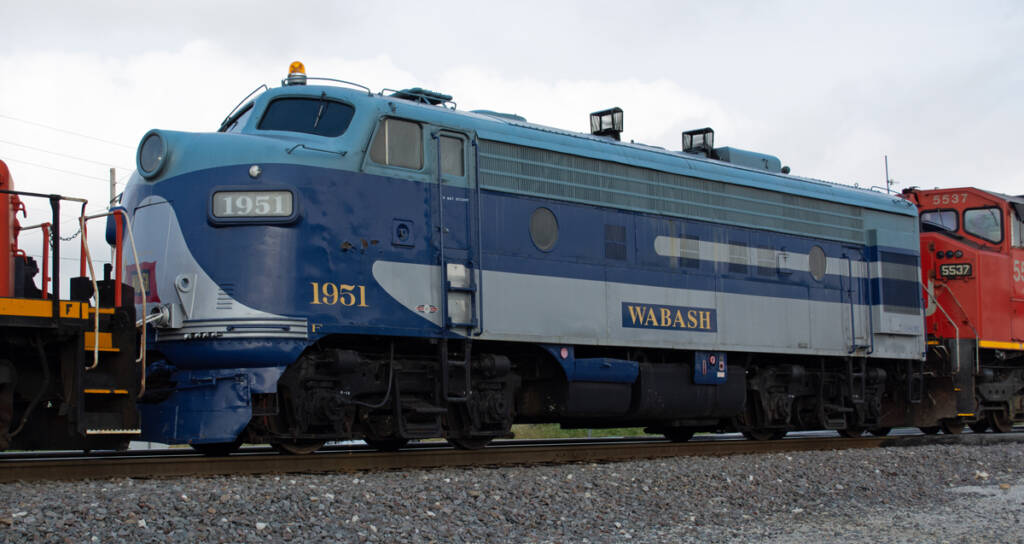
Wabash-painted Electro-Motive Division F7A No. 1951 was the unit in the potpourri of motive power that caught my attention. The cab unit was on its way from the Columbia Star Dinner Train in Missouri to the Wisconsin Great Northern in Trego, Wis., as covered in this Trains News Wire story.
I did some research on the F7A and learned it had led quite a life. Following the merger that created Burlington Northern, Great Northern 464A became the new railroad’s No. 684, spending its career on the West Coast. The locomotive was sold to the Seattle & North Coast RR in December 1980, becoming SNCT No. 102.
After some time on the Iowa Northern (I couldn’t find exact information on the years), the F7A went to Michigan in the mid-1990s where it was used on the Grand Traverse Dinner Train. The locomotive was repainted and renumbered 1951 during its time in the Wolverine State.
In 2007 the cab unit went to Missouri for use on the Columbia Star Dinner Train. It was repainted in the Blue Bird scheme as the train operated on a stretch of former Wabash track between Columbia and Centralia, Mo.
Canadian National GP9 slug No. 217
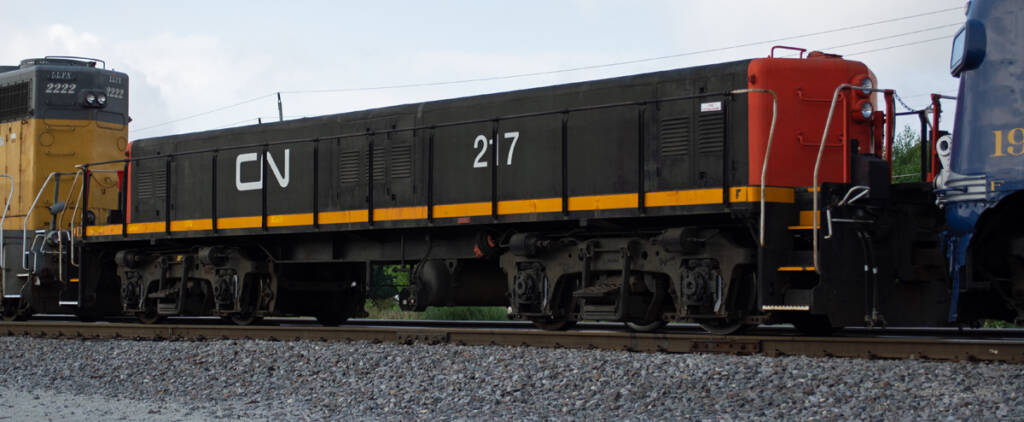
Behind the slug was Canadian National GP9 slug No. 217. The cabless, four-axle unit was built in June 1957 as CN GP9 No. 4597 (later renumbered 4215). The high-hood Geep was rebuilt as a slug in 1986.
Back in the May 2012 issue of Model Railroader, Gary Hamilton wrote about modeling a CN GP9 slug using an Atlas EMD GP7 as a starting point. More recently, Rapido Trains produced GP9RM mother-and-slug sets in HO scale. The powered slug model has a die-cast metal frame, prototype-specific trucks, and metal side handrails.
Locomotive Leasing Partners Electro-Motive Division GP38AC No. 2222
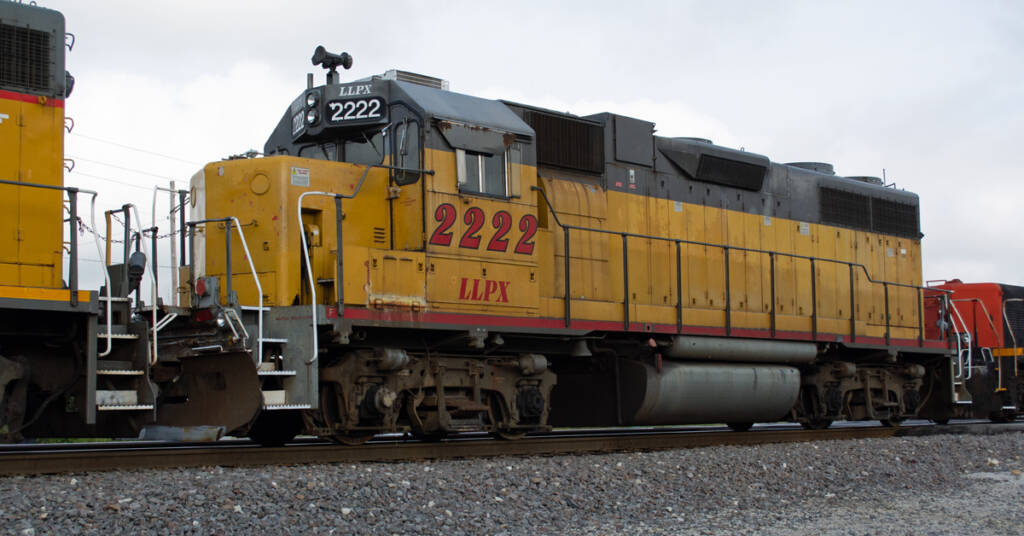
At first blush, I thought Locomotive Leasing Partners GP38AC No. 2222 was a former Union Pacific unit. After all, it was painted Armour Yellow and Harbor Mist Gray with a red sill stripe. But then I looked closer. Under the peeling paint on the nose was some red-orange paint. A few patches of blue paint were visible on the blower duct housing behind the cab. After a quick internet search, I learned the 2222 used to be Grand Trunk Western No. 6221. The four-axle road switcher was built by EMD in July 1971 as Detroit, Toledo & Ironton GP38-2 No. 220.
Locomotive Leasing Partners Electro-Motive Division GP38-2 No. 2202
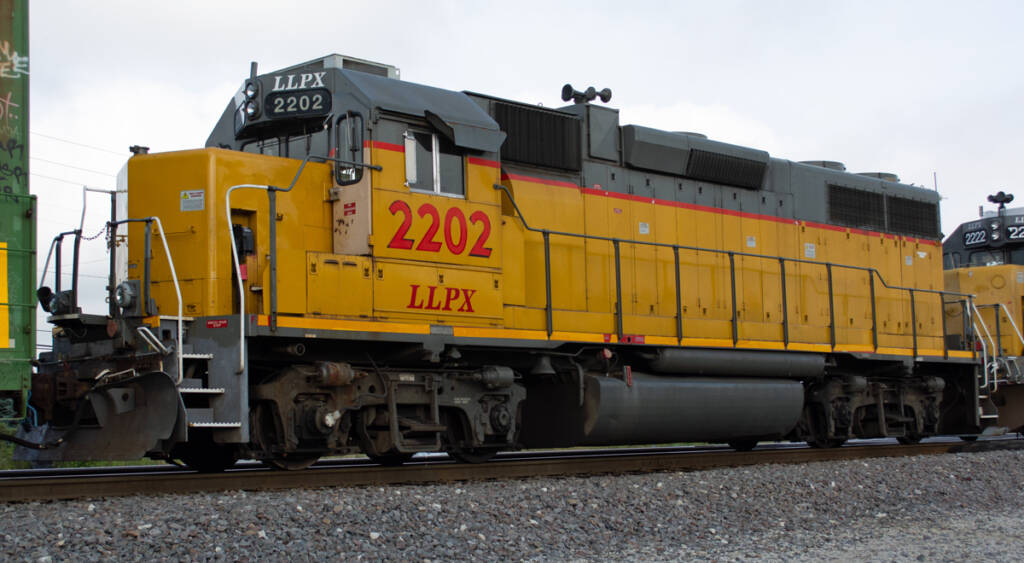
OK, this locomotive had to be a former Union Pacific engine, right? Nope! It turns out this lease engine was built in September 1969 as Southern Ry. 2733, a high-hood GP38 set up to run long-hood forward. The locomotive became part of the Norfolk Southern fleet following the 1982 merger between Southern Ry. and Norfolk & Western, retaining its pre-merger road number.
The unit was rebuilt to GP38-2 standards for LLPX by Alstom in the late 1990s. Though the high short hood was replaced with a low short hood, take a close look above the radiator screens. You can see where the walkway light was located, a common feature on Southern Ry. diesels.
A few days after I caught this train, the CN slug and LLPX diesels wound up in Winnipeg, Manitoba, Canada. The LLPX units were acquired by Cando Contracting Ltd., with LLPX 2202 becoming CCGX 4203 and LLPX 2222 becoming CCGX 4204. Online sources indicate both locomotives were assigned to Regina, Saskatchewan, Canada. I was unable to locate information on the CN slug.
I haven’t caught a consist quite this interesting in my commutes since then. But it’s a good reminder to keep your camera ready as you never know what you might find when you’re trackside.