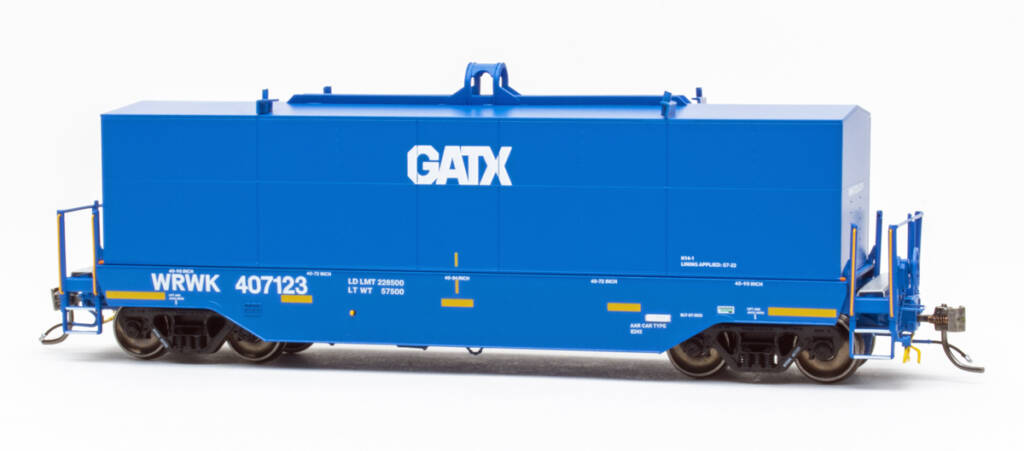
Looking to add a model of one of the newest freight cars on the rails to your HO layout? Then you’ll want to check out the Greenbrier 5-trough transverse coil gondola from Rapido Trains. The model, based on a prototype introduced in 2021, features plastic and die-cast metal construction, 36″ metal wheelsets, and metal semi-scale couplers.
Prototype history
The Greenbrier Companies offers its transverse coil gondola in 5- and 10-trough versions. A video on the freight car builder’s YouTube channel notes the various benefits of the car’s design. The lined bunks prevent the coils from shifting, eliminating the need for dunnage to block or secure the load. The one-piece hood features a sloped roof, allowing it to shed rain and snow.
The gondola can carry coils in various sizes. The outer troughs can hold coils between 40″ and 90″ in diameter. The middle trough is designed for 40″- to 84″-diameter coils. The remaining troughs hold 40″- to 72″-diameter coils.
The sample we received is decorated as Providence & Worcester 407123, part of the 407000 through 407199 series built by Greenbrier in July and August 2022. The cars, which have WRWK reporting marks, are in service today and can be found throughout the North American rail network.
Model features
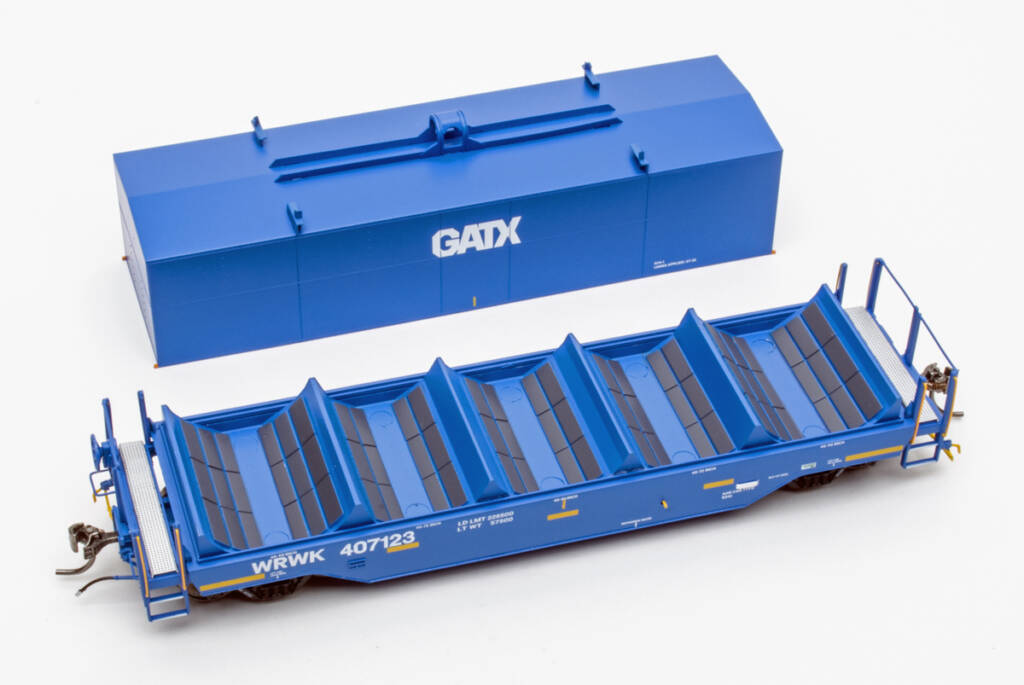
The Rapido model has a die-cast metal underframe, which accounts for much of the car’s 4.7 ounces of weight. The bunk liners are painted dark gray. There are ejector-pin marks on the flat surfaces of each trough.
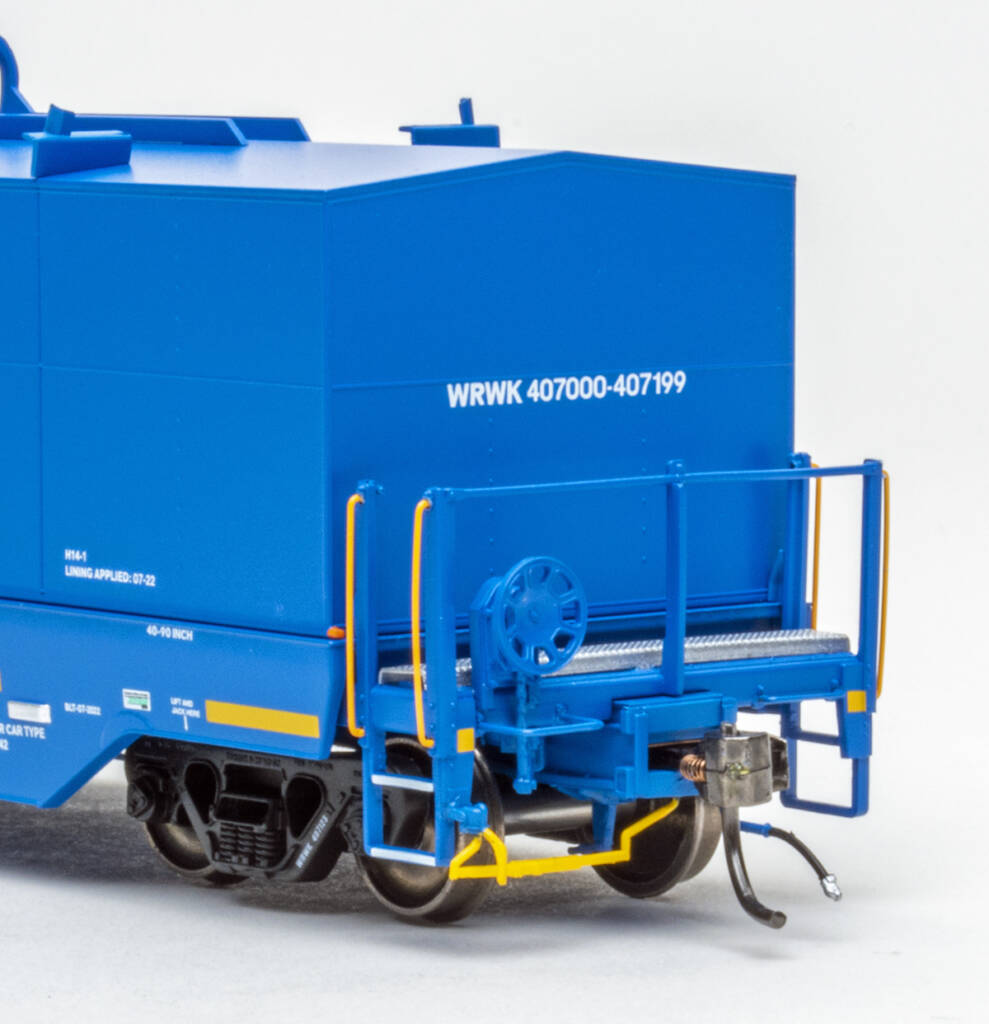
The sides and ends of the coil gondola are plastic. Molded details on the sides include billing card holders and Automatic Equipment Identification tags, the latter painted silver.
The car ends have platforms that are neatly appointed with see-through, etched-metal walkways; formed wire grab irons and handrails; and plastic uncoupling levers. The B end of the car features a freestanding brake wheel and hand brake with chain and handbrake rod fulcrum detail.
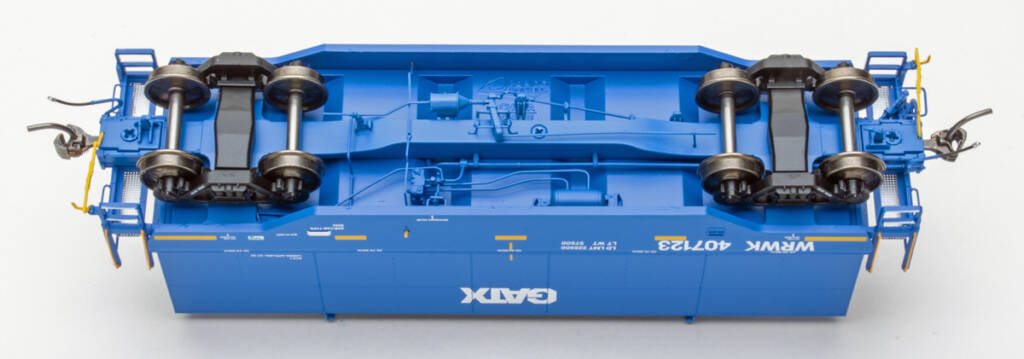
Underneath, the model has screw-mounted 100-ton trucks with raised foundry data, separate brake beam detail, and the car’s reporting mark and road number printed on the sideframes. A plastic plate with two pins fits into holes on the bolster. I used a flat-blade screwdriver to remove the plates to reach the mounting screws.
The center sill, body bolsters, and draft-gear boxes are cast as a single plastic piece. The brake system is well executed, with a freestanding air reservoir, brake cylinder, and control valve, along with the associated levers, pipes, and rods. The parts are a mix of plastic and formed wire. Screw-mounted draft-gear box covers hold the metal semi-scale couplers in place. The couplers use centering springs similar to the Kadee No. 5.
The coil hood is plastic with weld seam and rivet detail. The hood stacking brackets and lifting bail are factory-applied parts.
A closer look
Our review sample is painted blue with opaque white and yellow lettering. Graphic placement follows prototype images that I found online. A yellow stencil located on the sill above the angle cock on both ends was omitted.
The April 2023 Official Railway Equipment Register and sales literature on The Greenbrier Companies website contained dimensional information for the modern-era freight car. The model closely follows published data.
I put the coil gondola in a train and did some switching on our Winston-Salem Southbound layout. The car performed without issue, easily navigating a No. 4 turnout and 30-degree crossing.
The boxy profile of the Greenbrier 5-trough transverse coil gondolas makes them stand out next to other coil cars. I know we’ll be adding a few of them to our Milwaukee, Racine & Troy East Troy Industrial Park layout. Will you be getting some coil gons for your layout?
Facts & features
Price: Single car, $59.95; six-pack, $359.70
Manufacturer
Rapido Trains
382 High St.
Buffalo, NY 14204
rapidotrains.com
Era: 2021 to present
Road names: Providence & Worcester (WRWK reporting marks); Arkansas-Oklahoma RR; Chicago Heights Terminal Transfer; Chicago, South Shore & South Bend; Norfolk Southern; Railroad of Lies (single cars only); and Union Pacific.
Features
- 36″ metal wheelsets, correctly gauged
- Recommended minimum radius, 18″
- Semi-scale metal couplers, at correct height
- Weight with hood, 4.7 ounces (.9 ounce too heavy per National Model Railroad Recommended Practice 20.1)