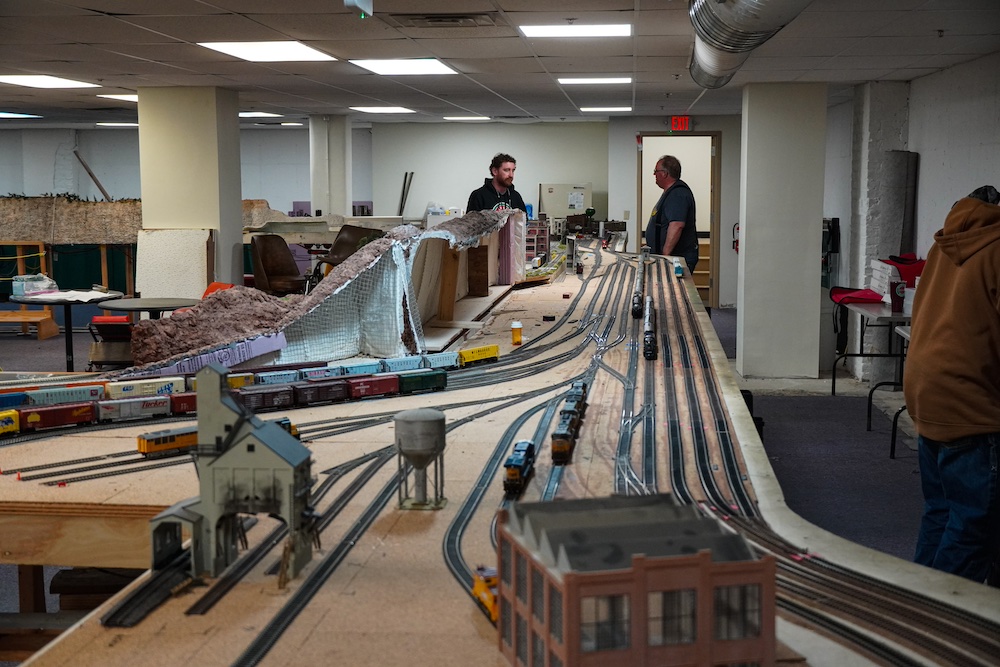
For as long as there has been model railroading, there have been model railroad clubs. Many of these groups and organizations, with some dating back to the 1930s, remain active today with well-established roots to weather the highs and lows. While the world has changed significantly, starting an all-new club from scratch is still possible.
The core steps are still the same: find a group of people who share your passion and expertise; fundraise; find a suitable meeting and layout space (whether for a permanent or portable layout); collect the necessary materials for your planned layout; do more fundraising; and start building away. However, in today’s landscape of established clubs, liability concerns, and digital media, starting a model railroad club requires extra dedication and strategic planning.
Define your vision
We all enjoy model railroading, but that’s where the similarities stop. Tastes within the hobby are diverse, with various scales, time periods, operation types, and levels of accuracy to favor. Clubs often reflect this diversity. For example, you might find an HO scale club focused on operations, or an O gauge 3-rail club that’s a freelance paradise.
When starting your club, it’s vital to determine your modeling vision early on. Consider if your planned layout will attract enough members for long-term sustainability (more on that later), especially if there are existing clubs nearby. Collaboration, not competition, is often the key in the hobby.
But the vision goes beyond just the layout, permanent or modular. It’s also the foundation — figuratively and literally — the benchwork will eventually sit on. Even before the first lumber is brought in, due diligence and decisions must be made regarding goals on where and how the club will function going forward, regardless of how big or small it plans to be.
Ask yourself these questions: Does the club want to own or lease property? For the former, what are the correct ways to do so; for the latter, how should we prepare ourselves for possible evictions and relocations? Should the club start or eventually evolve into a professional organization, albeit a non-profit? How strict will the rules and guidelines be, regardless of the direction the club goes?
A strong leadership
A common origin trend for most established clubs is the initial coming together of a group of around five people; a preferable number to start with, according to Milwaukee Lionel Railroad Club member Bill Hitchcock. Each would have their own unique skill sets, knowledge, and relationships to complement one another. A common trait from the core group is their dedication to come together and form the club, perhaps, as Hitchcock puts it, being crazy enough to pull it off.
From that core, the group would usually need a top dog (ex. Club President). One that’s crazy enough to take on the main leadership role with multiple responsibilities, though still be the needed straw to stir the drink. “What you really need is what I call a benevolent dictator,” Pasadena Model Railroad Museum Treasurer Bruce Bloch elaborates. “Someone who has a lot of money may dictate what you’re gonna do. But if you build it, they will come. Field of Dreams, right?”
Yet the strong leader and core group won’t amount to anything without a solid culture that’ll make new members feel welcome. For Michael Frezell, secretary of the Lansing Model Railroad Club, it was looking at the membership from a customer-based perspective as a past president. “You have to honor what people bring to the table,” he said. “You have to be inclusive in what they say and be part of that group. That’s one of the goals that I’ve always looked for.
“I can remember when I was president, I held what I called a town hall for the membership. I’ve held a few of those so that we could all sit down, hear what people have to say, and get on the same wavelength because everybody comes in with different viewpoints, and that’s great. You want that. You want to respect that people have different viewpoints and different views of what the club is.”
“You gotta get the word out.” — Bruce Bloch
Consistent outreach is essential for attracting funds, resources, skills, and expertise. Both Hitchcock and Milwaukee Lionel Railroad Club Vice President David Rohr praise the late honorary members, Jerry Brettschneider (Founder) and Chuck Zehner (Former President) for their expertise in traditional outreach in the 20th century. Now in the 21st Century, there’s a heavy reliance on digital media. However, a balanced approach combining digital and traditional methods can still remain effective.
For digital outreach, there are obviously social media platforms like Facebook and Instagram that are great for sharing updates and photos. Group chats, such as Discord, can facilitate real-time communication among members. Industry-specific online forums are still excellent for reaching dedicated hobbyists. Even entertainment platforms such as podcasts and other online content can attract new members.
Despite the rise of “new” media, traditional outreach can still be effective, including setting up posters at local train stores and hobby shops, making an appearance at train shows with flyers to pass out to attendees, and simply offering word of mouth.
Eyes toward the future
The transition from startup to sustainability is immediate. This involves managing short-term responsibilities while also planning for the long term. The short term will involve regular chores that we all don’t like doing, but must do. There’s handling administration tasks, paying bills, and making sure the liability for the club and assets are insured and covered. The work can even further itself if the plan is to apply for a federal income tax exemption with the Internal Revenue Service by reorganizing as a nonprofit corporation with their state, preferably in a 501(c)(3) educational-type status.
But then there’s forecasting the long term in terms of goals and potential challenges. Starting a model railroad club is just the beginning; the real dedication lies in keeping it thriving for years to come. “I remember the one town hall I held in the mid-2000s and was looking at the future of the club,” Frezell reminisces. “Where do we want our money to go that we’re saving? And overwhelmingly, people wanted to see the expansion of our [1890-built Millett Depot that is owned by the club] and that was the biggest step that we ever encountered. It was a huge investment by expanding, beginning in 2009, because if you don’t do that, you are going to stagnate right there.”