After reading the following review, be sure to watch streaming video of this set in action.
Fielded by the Budd Co., the experimental streamliners were constructed of stainless steel and were much lighter than a conventional train. The silver color suggested something ultra-modern, such as commercial airliners.
Creature comforts were high on the agenda, with air-conditioned cars and a quieter traveling experience through cork insulation, indirect lighting, and better-cushioned seats.
The Boston & Maine and the Maine Central railroads rolled the dice in an attempt to increase passenger traffic by ordering a train set christened the Flying Yankee. The service was a 700-plus-miles-a-day, six-days-a-week, serving Boston, Mass., Dover, New Hampshire, Bangor, Maine, and other towns.
Though the Yankee’s seating was limited, it proved to be a smash hit, but the train was unable to handle seasonal spikes in ridership. The service proved to be so popular that the Budd set was replaced by a conventional train and the streamlined rig was assigned other passenger duties, being re-named the Minuteman (Boston to Troy, N.Y., service) and later the Cheshire (Boston to Bellows Falls, Vt., service).
In 1957, the train was retired and donated to the Edaville RR in Carver, Mass., and in 1997 it was re-located to the shops of the Claremont Concord RR in Claremont, Jct., N.H. Finally, in 2005, the Flying Yankee was transported to the Plymouth & Lincoln RR in Lincoln, N.H., where it awaits restoration.
The model
The Premier line version of this venerable silver bullet is a “hold onto your hat” model. But let me note that this model doesn’t match the real Flying Yankee. Rather, it is a Chicago, Burlington & Quincy Pioneer Zephyr with the signage of the Yankee.
For example, the Yankee didn’t have an RPO function, and the model has two mailbag pickup arms. Blueprints of the prototype show that the area behind the engine compartment was a buffet with seating for 28 passengers. The Yankee had the large door forward of the twin doorway (and the twin doorway was slightly closer to the wider baggage door). Still, this is a great-looking train.
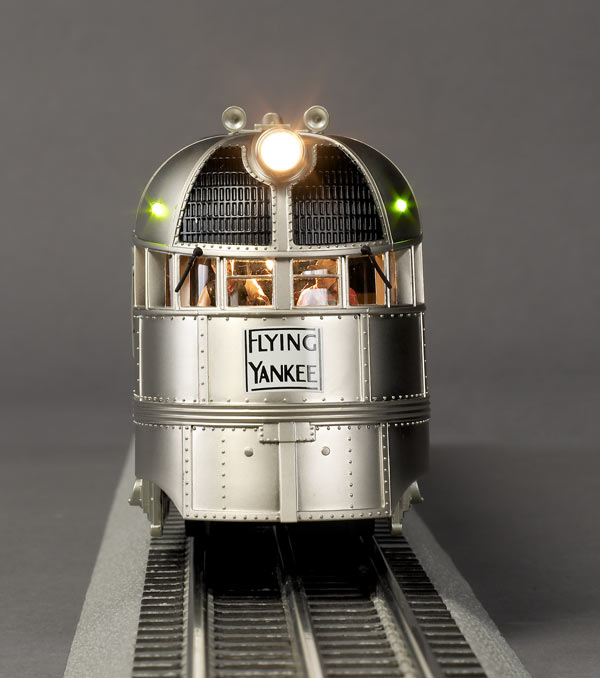
Starting with the snout of the power car, you have a nose that looks one-third steam shovel bucket, and two-thirds rocket ship. Rivet and seam detail is great, and the gentle curves of the nose are an odd – and interesting – combination of engineering and style. Heavy metal meets artistic rendering!
The arc of the cab windows is notable – unlike any other diesel that pops into mind. The crewmen are far lower to the ground than in an F unit or a Geep, which is pretty cool. Window wipers are placed in front of the engineer and fireman. The headlight is high on the face, and there is some nice texture and color contrast with the air-intakes above the window. Marker/classification lights are placed on the sides of the nose, above the window line. The cab has crew figures and illumination.
The roof is pretty intricate for a streamlined rig. The top above the motor is smooth. Two horns crown the top, while a recess accommodates a bell and four-stack exhaust. The exhaust actually looks like a long pipe held in place with brackets. Just past the engine area, the rooftop reverts to now-traditional extruded side streamlining.
Both sides of the power car have three opening doors: One for the cab, one for the Railway Post Office pickup arm, and a sliding baggage car door. There are add-on steps mounted by two of the side doors. You’ll also find an add-on number plate just beneath the MC – B&M signage and a trust plate by the cab doors. Diaphragms are placed on the end of each car.
The Flying Yankee set has four components: the power car, a combine, a coach, and an observation car. The real Flying Yankee consisted of three: the power car, coach, and observation car.
The combine has two rooftop vents, sliding baggage doors, and opening twin doors. You can see passengers and seats inside. There is also a see-through metal vent below and behind the steps by the baggage door.
The coach matches the interior decoration of the combine, though it has a different see-through screen and what appears to be a cast-in fuel or water cap and sight gauge.
The observation car mirrors the detail of the coaches, with twin opening doors on each side, interior illumination, seats, passengers, and clean, aerodynamic styling. The car has wide windows that curve inward, toward the rear of the car. Marker lights are mounted 11/2 inches from from the rear, and atop the high top of tail you’ll find a large backup light. The sides have plates with the name Flying Yankee.
Mating the set is interesting, and fairly easy. The cars connect sequentially – the powered car has a powered truck and an idler truck. The next car has a single truck and requires a tether to be mated to a plug-in mounted on the truck, and the car is eased over a mating post. The train has three cars – the third car, the rear observation car, also has a powered truck.
The limited graphics are well done. The chrome finish is outstanding. It doesn’t look too bright, more like brushed steel.
On the test track
The performance of this train was great. The low speed really crawled and you could almost feel the wind as it was blazing by on my home layout.
Our low-speed average was 2 scale miles per hour and the high-speed average was 75 scale miles per hour.
Because this has a “fixed consist,” we didn’t measure drawbar pull.
Startup sounds are great, as are the general running sounds. Let me note, however, that the sounds weren’t the old-timey pucka-pucka-pucka-kachoom I was expecting, but something more in line with a GP7 diesel. Sound reproduction was first-rate.
The outfit features a passenger station sound package that duplicates the sounds of arriving and departing a depot. It’s pretty cool.
The powered unit features a single pickup roller on each truck, and the observation car has a single pickup roller. The other cars are roller-free, power being distributed through the tether. If this rig did any flickering, it was rare enough not to catch my eye.
The Zephyr-turned-Yankee might be a bit of a compromise in matching the prototype B&M train, but that having been noted, it commemorates a milestone train on the northeastern carrier. The performance was great, and it looks stylish (not garish). In fact, it may well be the most uncommon-looking train on your layout.
Price: $699.95 (no. 20-2887-1)
Features: O-72 operation, two can-style motors, interior illumination, ProtoSound 2.0
Staff comments: Looks sleek, runs smoothly – Bob; Buck Rogers called: he wants his train back! – Carl