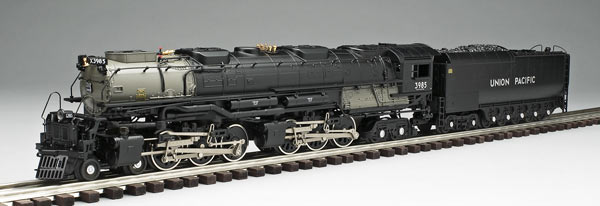
The Union Pacific Challenger needs no introduction to toy train operators. It was one of the big articulated locomotives that helped the UP create a steam transportation legend out west.
This arrival from Lionel offers S gaugers a highly detailed, articulated locomotive that may be operated in conventional or TrainMaster or Legacy command modes and possesses the most advanced electronics in the S gauge world.
Opening the box
Carrying the box down to the photo studio at Kalmbach Publishing Co. was a bit of a surprise. Even though it contained an S gauge die-cast metal model of a 4-6-6-4, it seemed like it should have been heavier. Was it possible I had been shipped an empty box?
The answer is no, the box was correctly packed. This beautiful model is simply smaller – and lighter – than its O gauge counterpart.
This is a body so often seen in O gauge that a quick scan suggested everything was in its place. The model passed the visual test with flying colors. If any selective compression was done, it was done very well. Clearly, this was not a hastily designed project.
The pilot mirrors the Union Pacific’s with a simulated coupler (a hatch swings open/closed, and the coupler is folded out or hidden), grab irons on the front deck, and compressor shields crowned by a headlight.
There is a nice level of cast-in rivet, hinge, louver, and even receptacle detail on the pilot, too.
The face of the smokebox has fastener and support arm detail, the famed UP shield in the middle of the face, a grab iron, and up top, a gold-colored bell, illuminated markers, and number boards.
The body has a tremendous quantity of cast-in and add-on details that includes handrails, grab irons, levers, piping, and sand lines. The whistle, pop-off valves, builder’s and trust plates can also be found, their brass colors nicely accenting the black and silver-gray of the boiler.
The body has more rivet, seam, and boiler band detail. There is hinge/latch detail where appropriate, and the topside has a small steam dome next to the pop-off valves. Two large sand domes bracket this.
For me, the coolest detail point is the steam line from the front traveling to the rear steam chest. The next most eye-catching details for me are the sides of the gray firebox with its appropriate piping details and a bazillion rivets (a bazillion is defined as being “a whole lot more rivets than I want to count”).
The dome just ahead of the cab is held on magnetically. This covering hides access to the on/off switches for speed control and smoke unit operation, and the run/program switch.
The cab is nice, but it is sealed via a solid rear “all-weather” type of enclosure. This is a shame, since I got down, peered in, and saw a fully rigged backhead with red valve handles and even, I believe, a brake lever jutting out. Very classy indeed.
The side windows are partially glazed, though the front and rear windows are empty. The cab is illuminated when the engine is at rest. There are no crew figures (and I’m not sure how you could install them). Firebox glow looks great flickering through slots in the lower portion of the firebox.
The running gear is a full-blown set that is a marvel to watch in operation. The syncopation of the wheels, moving rods, and other gear is amazing.
The tender is a petite die-cast metal rig. It is a seven-axle model with a two-axle leading truck. The car has a cast-in coal load; topside on the water tank, one of the caps is removable to access a volume control. A backup battery can be installed inside the tender.
The body has plenty of cast-in detail, most notably the wood texture in the planking on top of the water tank. There are ladders on the tender sides and illuminated rear marker lights, a backup light, and rear grab irons.
The tender mounts a coupler that can be remotely operated when using the Legacy command system.
Paint application was great, and the points of color separation (as in numbers, letters, and nomenclature) were all clean and crisp.
On the test track
I accomplished most of the testing of this model in conventional mode, since there are only three Lionel S gauge models that have been cataloged as being equipped with Legacy (the Challenger, a U33C, and a 2-8-2). So it seems reasonable to presume that most S gauge operators are not using the Legacy or TrainMaster system.
In a nutshell, in conventional mode you get smoke unit operation, sounds, whistles, and bells as well as excellent speed control.
Legacy offers a firmer control of speed, a great variety of sound/dialogue/crew chatter options, and, for example, the ability to create a lash-up of multiple units. The synchronized smoke performance is enhanced, too.
My job is to look at a train and evaluate it, not to promote conventional versus TMCC versus Legacy. In fact, I run conventional mode in my off-time. That having been noted, operation in the Legacy command mode was substantially more fun for me than testing the same engine in conventional mode. Why? Two reasons.
First, better speed control both in sustained lower speeds and the ability to control the engine’s movement via the thumbwheel controller. When I moved the thumb, the engine sped up or slowed down. There was no jerky motion as you might see with the paddle of a ZW. Find a speed you like? Leave it there, and the engine will cruise along happily.
Second, the uber-turbo stack magic. OK, let me rephrase that.
The puffs of stinky white goodness were amazingly in time with the locomotive sounds, and the torrent of synchronized smoke was so profuse that our company’s maintenance guy, Harold, came into the workshop drawn by the mist drifting out through the door.
Because the Challenger is small in size, doesn’t mean it is small in operating stature. I didn’t see output like this in conventional mode.
Whether in conventional or command mode, motor response was good (better in command). The sounds were terrific, and the whistle could be chilling in its deep tone.
Our conventional low-speed average was 7.5 scale mph, while the command-mode low-speed average was 3.4 scale miles per hour. The high-speed average was 78.6 scale miles per hour.
Drawbar pull was a very satisfying 1 pound, 3 ounces.
The last two Flyer steamers I tested in CTT were the plastic 0-6-0T and the Union Pacific 4-8-4 in the Feb and Sept 2007 issues. After running the new Challenger, I’d say it is time to close the door on old Flyer and embrace a new era of gear that isn’t stuck in 1962 regarding design or performance.
There is an expression we use around our offices when something really stands out, above and beyond our expectations. Suffice it to say that I believe this model was made with “extra awesome sauce.” It looks great, runs very well, and is a top-of-the-line competitor with the best.
Features: S-36 operation, die-cast metal construction, can-style motor, smoke unit, Legacy sound and control system, coil coupler