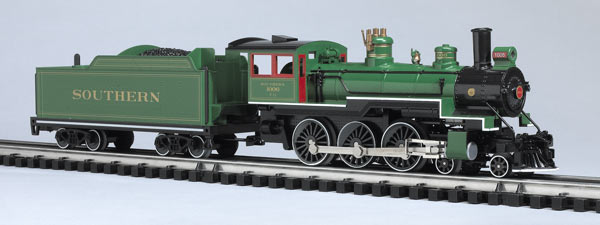
This O gauge model would easily fit into a railroad theme running from, say 1890 to 1940. If you run fan trips or have an O gauge museum on your modern-themed railroad, this would work out fine as well.
Opening the box
This steam locomotive has a nice feel to it, solid, well made, and not fragile at all. The model is die-cast metal, and the design and detailing are not complex. Size-wise, it would be a contemporary steam locomotive comparable to, say, a postwar Lionel no. 2018 or no. 675.
The pilot has representations of a coupler and uncoupler arm, brakeman steps, and grab irons. There are two green jewel markers that bracket the smokebox door, which has a fair amount of cast-in details, such as rivet heads, a number plate, and a grab iron.
The top of the boiler features a headlight atop the smokebox. The smokebox has several rows of rivet detail, and there are three cast-in boiler rings. Obviously, the smoke unit is based beneath the stack.
Seek and ye shall find a Baldwin builder’s plate dated 1908 on both sides of the smokebox.
Farther back on the boiler top are steam and sand domes. There is an add-on bell, and the steam dome has a whistle and two simulated pop-off valves. You’ll find an add-on turbine topside, just ahead of the cab.
There are some cast-in grab irons and piping along both sides of the boiler that are made to look all the more impressive by some outstanding painting contrasting the black of the lines with the bright green of the Southern Ry. paint scheme.
The decks along the sides of the boiler are wide and smooth. You’ll find additional cast-in piping detail on both sides, and add-on compressors on the fireman’s side.
The cab has a simulated “raised” vent hatch (a solid element), and the cab has a nice, low firebox (yes, you can easily see down the railway line through the front cab windows).
The firebox has rivet and gauge detailing cast into it. While the cab is crewless, a number of companies make engineer and fireman figures you can easily install in this locomotive.
The cab windows have no plastic panes, but there’s a nice level of rivet detail along the cab and the windows.
The edges of the pilot and deck are trimmed in white, as are the pilot wheels and drive wheels, as well as those on the tender.
The simple side rods work for me, but some hobbyists will long for a more detailed array of moving metal.
The tender is plastic with no add-on pieces, but has ample rivet detail. However, as with some of the detailing on the metal boiler, some of the cast-in details, notably grabs irons on the front and rear of the tender and the ladder on the rear, benefit from a superbly accented paint job.
The coal load is a cast-in piece that’s nicely detailed with small-diameter coal.
The truck frames are die-cast metal and have simulated springs. The rear coupler is an operating coupler that can be triggered through a standard uncoupling track section.
Painting and decoration are excellent. The 4-6-0’s Southern Railway green is probably the most vibrant paint scheme we currently have in the CTT offices. Painting was flawless, and the decoration – ranging from white accent stripes to numbering and lettering – was amazingly clean and crisp.
On the test track
This baby is a conventional-only rig. All the action is transformer controlled. A wire tether connects the locomotive and tender at an in-jack located just below the cab deck. There is a smoke unit on/off switch beneath the fireman’s side of the cab. Interestingly, there is an empty hole in the opposite spot on the engineer’s side of the cab.
Motor operation was smooth and responsive in all speed ranges. The motor generated a bit of a whine at higher speeds, however.
The True-Blast II steam whistle has the distinctive yet familiar steam whistle grade-crossing sequence. The bell is very audible; the headlight is bright.
The model has traction tires on the rear set of drive wheels.
Our low-speed conventional-mode average was 12.6 scale mph, and our high-speed conventional-mode average was 62.9 scale mph. Drawbar pull was 1 pound, 13 ounces.
All in all, this is a nice, basic locomotive that’s fun to operate. In spite of the 1908 built date, I think this locomotive works in a number of railroad eras, and it may be just the breath of fresh (and affordable) air you are looking for.
Now, if Williams by Bachmann would just offer it in New York Central – or better yet, in undecorated black or gray!
Features: O-27 operation, die-cast metal shell, can-style motor, smoke unit, headlight, operating tender coupler, True-Blast II whistle/bell.