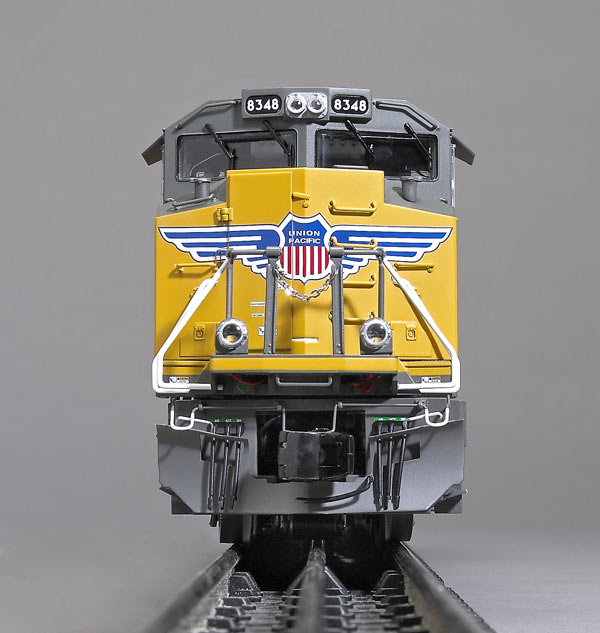
The prototype has plenty of detail points to model, and this new product does an exemplary job of reproducing those reference spots.
Opening the box
The Lionel model features a pilot complete with snowplow and the usual array of cables. It also has a movable (non-functioning) uncoupler arm with white accents where a brakeman would lift the arm. White handrails are mounted on the pilot, and the deck has safety tread. The steps (on the pivoting truck) have drain holes. The last step before reaching the pilot deck is affixed to the frame, and it has drain holes.
Ditch lights are mounted to the deck, and a safety chain adorns the center handrails.
The diesel’s nose has grab irons on the right and left sides, with grab irons running up the fireman’s side to the top of the deck. Sand filler lines/caps are located on both sides of the nose, and four grab irons are on the nose.
While I always marvel at how they are made to function, I’ve always figured that opening O gauge cab doors are kind of pointless. Well, this model does have an opening nose door – though the cast-in door latch/handle was non-functioning. I was extremely impressed with the printing of the Union Pacific winged logo over the nose and door.
I really like modern diesel carbodies with their jumble of angles, boxes, and lumps. This model delivers all of them, from the sharp lines and chopped, sloping angles on the nose to the roof top antenna housing and electric box behind the fireman’s side of the cab. The carbody has a terrific level of cast-in detail. The hinge and latch details are clear and crisp and deeply cast.
There is a series of louvers on the fireman’s side that give the appearance of being deep enough to be see-through. In addition, the side filters behind the cab, the tall screens at the rear of the locomotive, and the radiator wings are all see-through.
The top of the cab is fairly clean. You’ll find some cast-in rivets and seams, as well as a handful of lift rings scattered about. You’ll find a smoke unit exhaust and three fans with see-through screens and fan blades.
I liked the ultra-small louvers above the red UP stripe on the end of the long hood, a very nice detail to replicate. The rear also has grab irons leading upward, rear lights, and a cap for sand on the top.
The frame has a lot of nice conduit/piping cast into it. The trucks are a nice rendering of an HTCR radial truck.
Painting and decoration of the SD70ACe may be the most dazzling I’ve seen on a Lionel product. The general paint job (the UP yellow body, red accent stripe, and gray roof) is excellent – all the more notable since there are so many nooks and crannies for paint to pool in or gunk up. The paint was all neatly and cleanly applied.
Lettering, plus the UP wing and shields, was up to snuff. There are roughly 20 small nomenclature and safety decals on each side, and even on the truck side frames.
Of course, the supreme graphic element on this model is the American flag. Old Glory is remarkably well done, both in color and shape, giving the impression of texture and of a flag waving in the breeze.
On the test track
Performance of the SD70ACe was fine in all speed ranges. Our low-speed average was 2.9 scale miles per hour, and the high-speed average was 64 scale miles per hour (and I’m pretty sure a longer straightaway would result in a faster speed). Drawbar pull was a robust 3 pounds, 2 ounces. Jeepers!
The model has four power pickup rollers, each roughly 3 inches apart and 7¾ inches apart from truck to truck. Two traction tires are found on each truck (on the innermost axle).
All (yes, all) of the controls you need are topside. The lid is held on snugly, and a tiny magnet seals the deal. They are concealed beneath the radiator wings. You’ll see smoke and sound switches, run/program and speed control on/off switches, and a big honking knob for controlling the volume.
The sound system continues to astound me. When starting up the SD and putting it through its paces, I was impressed. Particularly notable is the sound of the prime mover as the model ramps up. But when I hit the horn, it was, well, a “made my day” moment. I want to use a poorly worded exclamation like “It’s More Awesomer!” or something like that.
The functions and options controlled by Legacy all performed well. My Legacy operating tip for the month: If you re-program the number to, say 48, be sure you don’t type in “84” and then spend a half-hour trying to get number 48 to start up. Nuff said.
The only operational bug hearkened back to the early Lionel Alco C-420. The flanges tend to contact the base of a switch and bounce through them. We didn’t experience any operational problems with this, but it does detract a bit from a close-to-perfect model.
The Lionel O gauge SD70ACe looks great, runs like a champ, and has an extraordinary sound package. Give it a look (and a listen)!
Price: $449.99 (no. 28264)
Features: O-31 operation, two can-style motors, coil couplers, traction tires, Lionel RailSounds and Legacy command system
Staff comments: Awesome sounds, mighty pulling power, as close to smooch-worthy as any diesel I’ve seen. It may bounce through some of your switches, however. – Bob; Absolutely loved the ready access to programming controls. – Kent