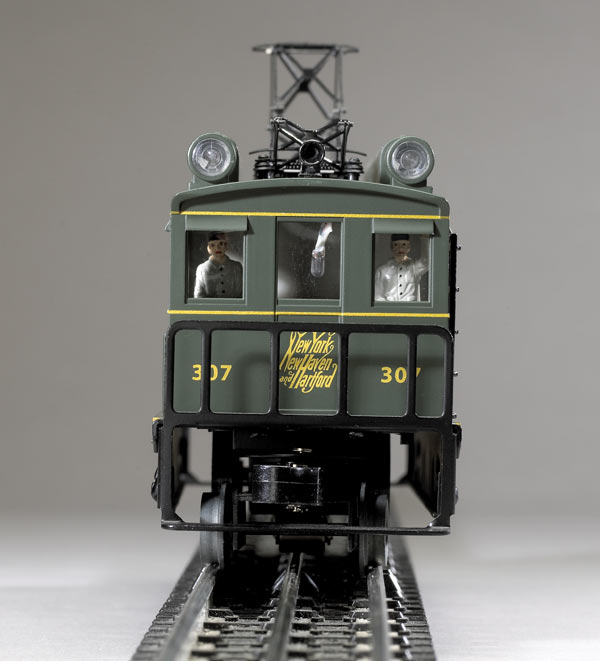
Lionel seems to be steering the K-Line product line in a specific direction – and that direction appears to be smart, economical trains, rather than the high-dollar super-spectacular locomotives we came to know in the final years of the old K-Line. That change works for me just fine.
The same creative thinking that gave us the strange-looking, yet still cute Porter 0-4-0T and the diminutive, but pretty realistic Plymouth diesel is now offering a re-packaged Lionel postwar no. 520 boxcab electric locomotive at a bargain price – under the K-Line flag.
As the story goes, the original Lionel model locomotive was a miniaturization of a real electric locomotive built by General Electric and exported to a South American copper-mining operation. Though a pretty good copy of the real thing, it appeared toy-like, and like many later Lionel products, it suffers from the Rodney Dangerfield-syndrome where it “Don’t get no respect.”
Examined in the context of what it was (a smaller industrial-type switcher) and its place in the overall product line, a kid could have done worse than to receive a no. 520 for a birthday or Christmas present.
Opening the box
I bought this model with my own cash money, and I had pretty low expectations for it. I was very pleasantly surprised by what I found inside the yellow-and-black K-Line box.
Sure, this is a bottom-of-the-line locomotive, but I thought it was pretty well crafted that way – rather than stripped down to meet a lower price point.
The tooling of the plastic shell is clean and crisp. There is a minimum of cast-in details to spot, like on the prototype. I did like the lips on the portholes and the sunshades over the windows.
Topside, there are what I guess are bands arcing up and over the air reservoir tanks. The fore and aft doors are just suggestions of doorways.
Near the bottom of the shell, there appears to be a suspension system cast into the sides of the shell.
Two of the gold stripes you can see along the side of the model are raised texture points that you can feel.
Add-on details are all right in my book. Metal ladders are applied to both sides, and each corner has add-on grab irons. Topside, you’ll find a horn (on the front end) and two pantographs that can be raised or lowered manually.
The cab has two crew figures that seem to be wearing Chairman Mao jackets – one has both hands at rest, and the other is lifting his left arm, presumably to pull a horn tether. A shield behind the crewmen blocks the view of the motor area. Another nice feature is that while the front and side cab windows are clear, the portholes and the rear cab windows are frosted plastic. Like the shield in the cab, this helps hide the motor and circuit boards.
The cab has a bright light, but the light on my copy just dangles in the doorway. There appears to be rubber cement or some adhesive on it, suggesting that it may have been glued to the roof and then became separated.
The lower part of the model has stamped steel sides (with minimal cast-in detail that suggests brake components and journal boxes).
Both pilots are stamped steel and have handrails, side steps, and steps for brakemen.
Flip the model over and you’ll see that the front coupler is a dummy, mounted on a single-axle pilot truck. The rear coupler is an operating thumbtack-style coupler. The model has two power pickup rollers that are about 2½ inches apart. Expect this model to do some stopping in dead spots.
There is a single (come on, guys, would a second have broken the bank?) traction tire.
There is a reverse unit lockout switch on the bottom of the locomotive. My model was a bit quirky. It worked fine on the test track. However, when it was in the photo studio, I was trying to have it shot in neutral with the lights on, but it wouldn’t stand still. Go figure.
Must have been that wacky postwar Lionel LW transformer!
I bought the New Haven road name, planning on re-painting it into a trolley company road name. The boxcab was also available in Pennsylvania RR colors, but I decided that if I never get around to repainting, it would fit right in with the New Haven diesels and electrics I already have at home. The dark green body paint was smoothly applied. The gold New Haven accent stripes, road name, and script on the doors were expertly applied.
On the test track
Our low-speed average was 6.7 scale miles per hour, and the high-speed average was 82.9 scale miles per hour.
Drawbar pull was 5 ounces. What does that mean in practical terms? Well, I had the Weaver aluminum five-car passenger set available for testing, so I coupled them up.
The boxcab could pull one of the cars with relative ease. When I added a second car to the mix, it just sorta sat there and vibrated.
The lesson learned?
Keep your trains short and light and you’ll be happy.
Cab lighting was great, and the twin headlights (the headlights are directional, by the way) cast decent illumination down the rails.
There were no operational bugs we encountered, save for those quirks in the photo studio. Using this K-Line by Lionel boxcab to putter around with a few traditional-sized freight cars demonstrated that this was the right engine for that job.
Price: $89.99 (no. 21268)
Features: O-27 operation, single can-style motor, interior illumination, one operating coupler, single traction tire
Staff comments: Cute, functional, and inexpensive. – Bob; Sorry, but I’ll stick with my postwar 520. – Roger