This is a Conventional Classics-series reproduction of the Lionel no. 2505W Super O Virginian Rectifier freight outfit from 1958. Without the Super O track, of course. Frankly, this isn’t a set that would have wowed me as a kid.
Way back in 1958, fast-running steamers that would roll off the curves like a stunt horse in a Gene Autry western were more my thing.
Of course, I was only three years old when the original set came out. But advance the clock 50-odd years, and I’ll say that this new entry in Lionel’s popular Conventional Classics series packs more than enough unusual or eye-catching equipment than most kids would probably have appreciated.
Opening the box
As we’ve come to expect with the Conventional Classics line, the boxes are a key element of the experience. The boxes and other packaging material are a good-faith attempt to replicate the look and feel of a vintage train set.
No. 2329 Virginian Ry. rectifier-type electric locomotive: The 2329 is a decent representation of the real rectifier locomotive. It has only four axles instead of the prototype’s six, and it is dramatically compressed in size, but this model is still a first-class choice for someone interested in an electric locomotive that isn’t a GG1.
The detailing is pretty basic. The texture is pretty much cut into the side of the shell, so hinges and latches are not raised, but rather are carved into the body. The most distinguished feature – to me, at least – is the large hump on the top of the shell. There is a fair amount of cast-in screen and vent detail present on this landmark.
The O gauge model model has a stamped-steel frame and die-cast metal trucks and operating couplers. On the inside, it is powered by a traditional Pullmor motor. The locomotive also uses traction tires to help enhance its performance.
The unit has an electric horn, bell, and front and rear headlights.
Generally, the application of the paint was satisfactory. I do come away with the impression that there are three shades of yellow on the locomotive, however. The yellow on the metal frame looks to be a brighter yellow than the striping on the upper portion of the shell. The Virginian lettering on the side of the shell has a distinctive hint of green – as though too little yellow was applied, so you had the yellow and blue combine to make a third shade.
No. 6805 Atomic Energy Disposal car: I really, really hope this car wasn’t prototypical. I’d hate to think there were a bunch of 40-foot flatcars rolling around, carrying nuclear waste in containers that would allow train spotters to look into windows to gaze upon the face of fiery nuclear Armageddon.
That being said, this is the coolest car of the lot, and I have at least four modern repros of this design!
The car has power pickups, and the containers are illuminated with the flicker of doom and danger. Pretty cool.
No. 6519 Allis-Chalmers car: This is the first of two branded pieces in the set. This is based on one of several cars used back in the day by Allis-Chalmers to deliver large pieces of industrial equipment, such as condensers. Allis-Chalmers had specialized pieces of rolling stock, and the real version of this car was last used by Voith Hydro out of the old Chalmers facility in York, Pa.
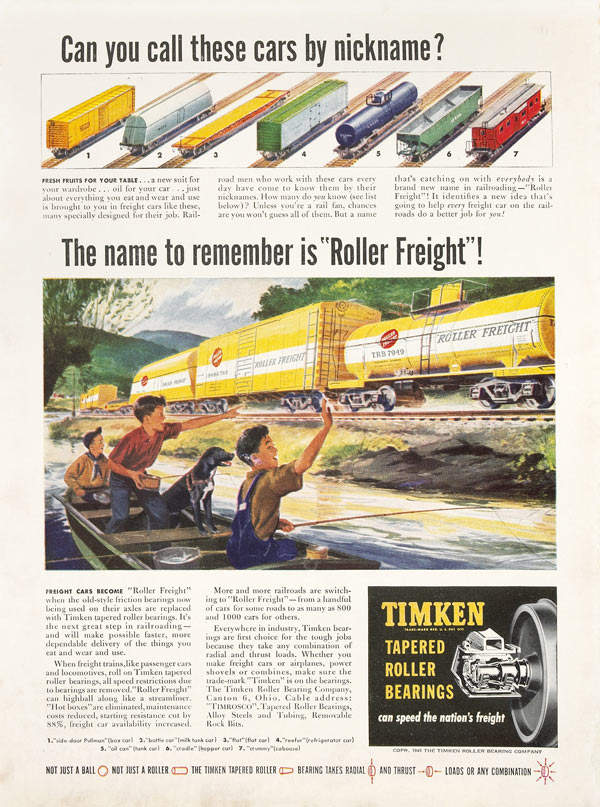
No. 6464-500 Timken boxcar: This is the second industrial brand in the set. This member of the esteemed no. 6464-series of near-scale boxcars advertises Timken roller bearings, which were used in many industrial situations, but closest to our heart are the different railroad applications.
I don’t know whether or not there was a prototype for the car – but Timken did run a series of advertisements in the late 1940s illustrating boxcars, tank cars, and even a milk car in this Timken paint scheme.
The cars in the ads were either yellow or orange, and in the toy train world, yellow and orange Timken boxcars and tankers have been made.
The model’s graphics and paint application are fine by themselves. The main yellow color, however, seems a bit bright to me, it almost looks like a fluorescent marker.
No. 6800 Airplane car: Well, okay. A small airplane is not my first thought for a flatcar load, but remember that in the 1950s private aviation was still pretty new. After World War II, the image of the barnstorming aviator was gone, replaced with a new sense of the possible in aviation.
Sky King ran on TV for nine years, and everyone knew that flying autos were just around the corner. The airplane itself has a Beechcraft Bonanza-style V-shaped tail, not the traditional vertical- and horizontal-stabilizer arrangement on most aircraft.
This is a nifty flatcar load, made even neater by the fact that you can remove the plane, lock the wings in place, and have some high-flying pretend fun.
No. 6357 Caboose: This is the good old SP-style caboose we’ve known and loved for years. The car has die-cast metal trucks and couplers, a metal smokestack, and interior illumination.
On the test track
The whole outfit was fun to operate. It offered an amazingly diverse collection of colorful cars, and it is true to the spirit of postwar kid-style fun.
The rectifier’s performance was satisfactory and in line with it being a re-creation of a postwar locomotive.
The conventional low-speed average was a pretty darned good 8.8 scale miles per hour, and the high-speed average was 97.5 scale mph. Command mode was non-applicable, since this is a conventional-only model.
Drawbar pull was an even 1 pound.
The locomotive has three power pickup rollers, one on the powered truck and two on the dummy truck. A knob for volume control and a sound/no sound switch are on the underside of the frame, next to the speaker.
Motor sound was above my expectations for a postwar-style motor (not quite as grindy sounding as I anticipated), and the horn/bell didn’t work.
This is another nice addition to the Conventional Classic series. Reliability of the rolling stock was good, and the construction of the entire set was solid, ensuring many years of grown-up (or kid-powered) operation.
Features: O-31 operation, locomotive has Pullmor motor and horn, all equipment has die-cast metal trucks and operating couplers.