Railroads changed almost endlessly in 20th-century America, due to bankruptcies, mergers, and takeovers. Regional lines combined to improve efficiency, retain customers, and upgrade their rosters; larger ones blended their networks of rails and brought employees together to remain profitable and counter big rivals.
Among the most significant of those changes was the formation of Conrail in 1976. Several railroads of different sizes joined forces under the guidance of federal authorities to maintain strength in the Northeast and Upper Midwest.
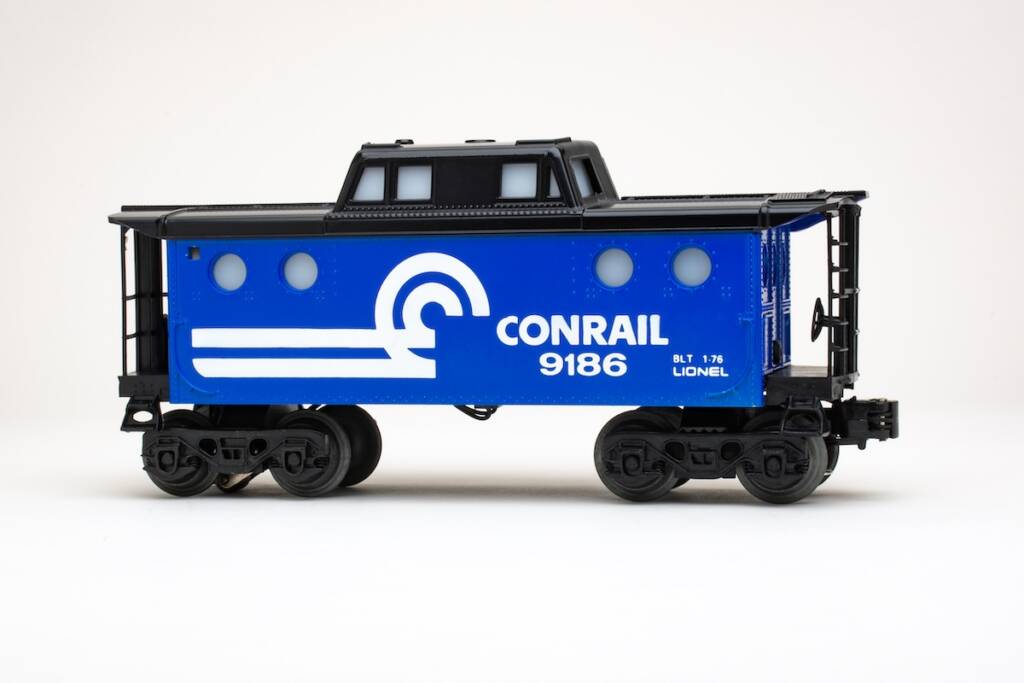
So it should come as no surprise to learn that manufacturers of toy and scale model trains paid attention to the creation of Conrail. They offered hobbyists replicas of the locomotives and cars owned by Conrail. Lionel, then under the direction of General Mills, was no exception to the trend. In fact, it helped launch that trend by releasing an O gauge model of a Conrail N5c porthole caboose in 1977. The No. 9186 captured an important moment in America’s railroad saga.
Desperate move
The formation of Conrail came about after the demise of the Penn Central in 1970 and the Erie Lackawanna in 1972 undermined the railroad industry in the northeastern part of the U.S. Meanwhile, other historic railroads in that important region were also struggling in the early 1970s and found themselves on the verge of declaring bankruptcy. Executives at the Central Railroad of New Jersey, the Lehigh Valley, and the Reading Co., to name three, were raising the white flag.
Congress established a federal agency known as the United States Railway Association for the purpose of solving the problem. A string of possible solutions that involved distributing various lines to other railroads failed to win approval.
Instead, a new entity named Consolidated Rail Corporation – eventually shortened to Conrail – ventured forward. On April 1, 1976, it made national headlines by assuming control of the railroad properties and operations of seven lines, all but one bankrupt: Central of New Jersey, Erie Lackawanna, Lehigh & Hudson Valley, Lehigh Valley, Penn Central, Pennsylvania-Reading Seashore Lines, and Reading. Congress awarded it $2.1 billion in stock and assistance.
Conrail boasted more than 17,000 miles of track (“route-miles”). Statistics compiled in 1977 credited the railroad with a roster of almost 4,600 locomotives and more than 140,000 freight cars. Approximately 95,000 people were employed by Conrail at that time, and there were 278 different labor agreements in effect.
Lionel jumps in
Lionel trains began honoring Conrail almost as soon as its first trains were operating. Right away in 1977, there was an O gauge caboose finished in the deep shade of blue soon to be associated with the gigantic railroad. Also distinguishing the 9186 N5c porthole model was the so-called can opener logo printed in white.
Collectors and operators of Lionel trains immediately took notice. The attractive Conrail model was one of several illuminated bay-window, porthole, and square-window cabooses cataloged in 1977 by Fundimensions, the division of General Mills in charge of manufacturing and marketing Lionel electric trains.
The 9186 used a gray plastic body shell that was painted blue except for the roof, which was black. Graphics were done in white. Two removable red plastic marker lights were included with each caboose. Finally, the model was equipped with Symington-Wayne trucks as well as one tab knuckle coupler.
The handsome Conrail porthole caboose returned to the cataloged line for a second year in 1978. Oddly enough, Fundimensions failed to include the 9186 in any set, despite the fact that by 1978 it cataloged two Conrail engines (Nos. 8757 GP9 road diesel and 8859 rectifier) and two boxcars (Nos. 9035 short model and 9785 near-scale model) painted and lettered for Conrail. Creating a train set would have been easy and might well have had significant commercial appeal.
A final note: The 2026 edition of Greenberg’s Pocket Price Guide to Lionel Trains values the 9186 Conrail porthole caboose at $27 in excellent condition and $29 in mint. Adding one to your roster should be a simple matter.
Share this article