How To Timeless Classics Why I collect prewar trains in Standard and Wide Gauge

Why I collect prewar trains in Standard and Wide Gauge

By Steve Allen | December 10, 2025

These trains combine the history of railroading, the history of toys, and my own family history

Email Newsletter

Get the newest photos, videos, stories, and more from Trains.com brands. Sign-up for email today!

What do I collect?

shot of vintage trains on shelves
This shot shows almost all of my collection as displayed in my house. Steve Allen photo

I collect original prewar trains in Standard and Wide Gauge, i.e. 2 1/8”. Lionel created the gauge in 1906, and called their trains the “Standard of the World.” Soon, Standard gauge caught on as a label, possibly to differentiate from other gauges at the time.

When the Ives Toy Co. modified their 1 gauge trains to fit the same track and compete with Lionel, they used the term “Wide Gauge” to contrast with their own “narrow gauge” trains (or O gauge). American Flyer followed suit when it introduced its larger trains. It is speculated that both Ives and American Flyer chose to avoid the term “Standard gauge” to avoid legal entanglements with Lionel.

Either way, these toy trains are big and heavy. They have an imposing presence and make a great deal of noise. At Christmas, when we run O or On30 gauge trains under our Christmas tree, we protect the trains from our dogs. When we run Standard and Wide Gauge trains, we protect the dogs from the trains!

When did I start collecting?

vintage dark green model train
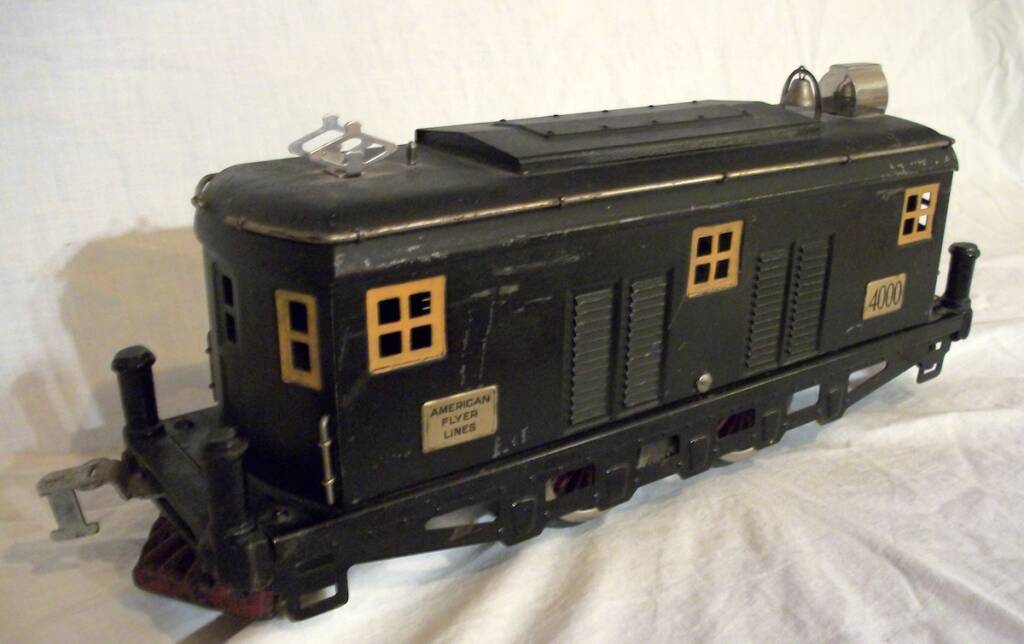
This No. 4000 American Flyer locomotive, from the Sesquicentennial set. is my favorite piece in my possession. It shows a fair amount of wear, but I consider it “well-loved.” Steve Allen photo

I started collecting Standard and Wide Gauge trains in 2004, but the seeds were sown decades earlier. Back in the 1970s, I visited my country cousins each summer. In the attic of their barn were stored toys, including early Ertl farm toys and a boxed Lionel Standard gauge set.

I remember being shown the set twice. It was headed by a No. 10 or No. 10E in Peacock, and included two freight cars — I am pretty sure one was a No. 515 tank car and the other was a No. 517 caboose in green and red. Although I wanted to see it run, and there was some track, operating it wasn’t possible. The wheels had suffered from the dreaded zinc-pest.

While I had Marx and Lionel O gauge trains back then, this set intrigued me. I didn’t really know what it was until many years later when Classic Toy Trains introduced me to the prewar years and the larger gauge.

While I was in grad school in the 1980s and ‘90s, I had no money for toy trains, though I saw examples at train shows. But CTT kept showing me Lionel Standard gauge along with Ives and American Flyer Wide Gauge.

Eventually, I bought a few pieces and more. Most were pretty rough, but I couldn’t afford any better at the time. I even bought some guides and other books, such as Peter Riddles’ America’s Standard Gauge Trains. Reality set in a few years later: too many gauges, too little room. So my few prewar pieces went away along with all the published resources. I regretted that decision almost immediately.

In 2020, I started getting sucked back into Standard and Wide Gauge trains. This time, I spent a little more money to get pieces in better condition. I bought examples of some of what I had sold off and then bought more. And I made sure that they ran.

What’s my favorite piece and why?

Tough question! I have two answers. The first is the favorite piece that I possess. The second is the “holy grail” for me, the piece that I wanted most of all.

The favorite piece that I possess is difficult to pin down. Every piece I have appeals to me, or I wouldn’t have purchased it. If I had to choose, I’d have to select the American Flyer No. 4000 electric-outline locomotive. It’s basic, but it has the distinction of being an example of the first American Flyer locomotive. I bought it with the rest of its original set: No. 1432, The Sesquicentennial, which was first released in 1926, the sesquicentennial of the United States. This plain locomotive lacks the add-on glitz of later versions bedecked with brass and detail pieces, but it is the one that started Flyer on its Wide gauge journey.

vintage dark green train set
An Ives No. 700 Wide Gauge set in great condition: a No. 3241 S1 lettered for the New York Central and Hudson River, a No. 184 Buffet Car, and a No. 186 Observation Car. Steve Allen photo

My holy grail is an American Flyer set called the Flying Colonel, No. 1486. This version was made in 1928-29, and is pulled by an electric-outline locomotive (developed from the No. 4000) with brass plates identifying it as “The ACE.” The set is decorated in a dark “military” blue with red pilots, gray trucks, and gobs of brass trim. It is truly a beauty!

What’s the best thing about collecting Standard and Wide gauge?

three vintage toy train accessories
This is a selection of Lionel accessories: an early No. 93 Water Tower, a No. 437 Switch Tower (restored by me), and an early No. 45 Gateman with the lattice pole. Steve Allen photo

History. I am interested in preserving the past, and these trains combine the history of railroading, the history of toys, and my own family history. My trains are at least 90 years old with some over 100. Each one has a story to tell. The events are recorded in the scratches, chips and dings in the paint, and in the occasional missing trim piece. I don’t mind what many other collectors call “flaws.”

Their story is that the trains have been used, enjoyed, and even loved by previous owners. Imagine the joy in a boy’s face when he came down the stairs on a Christmas morning around 1930, and found one of these trains running under the tree. At the time, they were state-of-the-art, perhaps even the most sophisticated item in the entire household. That boy ran that train at every opportunity; augmented his play with building toys, cargo swiped from Mother’s kitchen cabinets, some dime-store cars and trucks, and possibly even soldiers. These scenes play in my mind every time I look at my collection.

Their age sometimes shows in broken wheels or frames. But their motors run like brand new, and the trim pieces, wheels, and frames are reasonably easy to replace. Their construction is simple and robust. I want my trains to run — they don’t have to be condemned to sitting on the shelves! If their first owners could play with them, I can too! So, I repair and ensure everything works. I don’t repaint, unless the paint on the original is so far gone as to be hard to identify. I don’t need sparkly and shiny. I am satisfied with the patina, which age imparts.

What advice would I give to a newcomer?

  1. Start with the small and the common. Buy what you like, and consider concentrating (at least at first) on a limited range of pieces, such as a particular series of freight cars.

  2. Spend a little more to make sure the locomotives you buy runs (or are, at least, easy to make run).

  3. Corollary to buying running locomotives: set up a basic pike as soon as you can. At the very least, run a loop around the base of the Christmas tree. Do whatever it takes to run those trains!

  4. Corollary to building a pike: good, used track from the prewar period is not hard to find, but it will need cleaning and maintenance. New Standard and Wide Gauge track is made today by USA Track, LLC.

  5. Buy the guides and other books that show, describe, and evaluate the trains and accessories. Don’t get hung up on the prices, however. Read them to learn what trains were made and how common they are. Learn what to look for when you actually consider buying a piece. The listed prices may be a long way off what you come across, but they can give you a sense of value relative to other pieces.

  6. Research in CTT (past issues, too!) and online, by talking to others who are interested in these trains, and by going to shows and actually getting a feel for them (ask permission first!).

  7. Lionel created this gauge, and Lionel made more trains in this size than any other manufacturer, but there were others. Ives and American Flyer were the primary challengers, and they both made excellent and beautiful trains.

  8. The trains are great, but it is the accessories that make a railroad pike. Your trains need stations to stop, signals to protect them, cargo to carry, passengers to serve, and bridges and tunnels to make their travels more interesting.

Like this series? Read more!

Why I collect the General Mills era of Lionel Trains

Why I collect Gilbert American Flyer

Why I collect Kusan

Why I collect Marx

You must login to submit a comment