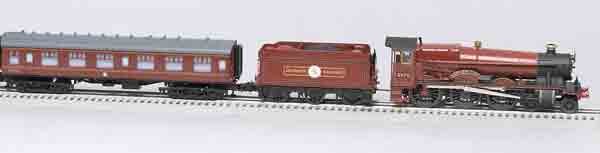
In my book, what really makes this set a potential “train of the year” is that it is the first popularly priced, O gauge British outline set to be produced on either side of the Atlantic in, oh, 60 years (no, Thomas doesn’t count).
My affection for British trains goes back to, well, the movies. I’ll never forget Sherlock Holmes and Dr. Watson on the “Scotch Express” in Terror by Night, highlanders with their rifles and kit bags slung over their shoulders in The Immortal Battalion, or the tense train-borne drama of The 39 Steps.
While American railroad history is full of large trains, long distances, and giant locomotives, British railroading seems at times less intimidating, and slightly mysterious, while presenting a seemingly endless variety of trains, routes, and destinations for such a small country. Every branch line has its own quaint story to tell.
This set commemorates a train that moves a group of wizard cadets from London to the Hogwarts School at the start of each term. Though having little screen time in the movies, the sturdy steam-powered train has established quite a following among fans of OO scale trains, thanks to versions of it made by Hornby, Bachmann, and Märklin. A Lego train version has also been made, and the movie train regularly runs excursions.
In the films, the Hogwarts Express is powered by “Hogwarts Castle.” In reality, the locomotive is a modified Hall-class Great Western Ry. 4-6-0 named Olton Hall. Built for mixed freight and passenger traffic, more than 300 Hall-class Ten-Wheelers were constructed starting in 1928.
Our star, no. 5972, was built in April 1937, retired in 1963, and sold to the Woodham Brothers Scrap Yard in Barry Island, Wales, in 1964.
The Barry Island facility was renowned for being a major disposal point for UK steam locomotives and rolling stock, but it was also the spot where many great locomotives were saved. By 1968, the more than 220 steam locomotives that remained at Barry were prime targets for the fledgling British railway preservation movement. Surprisingly, 213 engines left the yard (88 from the Great Western), and more than 100 were restored to operating condition.
Olton Hall stood on weed-lined tracks for 17 years until removed in 1981.
The locomotive
What’s great about this O gauge locomotive model is that it was built at all. Few things would be more alien to Lionel designers than foreign locomotion. So considering that it is both an entry-level locomotive and a foreign prototype, I’ve got to say that Lionel got more things right with the model than wrong.
Thumbing through my stacks of Backtrack, a British railway history magazine, and a pile of other reference material, I think this is a good representation of a Hall-class Ten-Wheeler.
The pilot, unusually square by American standards, is pretty decent. It’s painted red (compared to the maroon locomotive it looks almost pink) because, for the most part, British steam pilots were painted red. There is a good level of cast-in rivet detail as well, along with a hook for link couplers and an air-brake line located between the buffers.
British trains identify their class by the position of lanterns on the pilot. This model has two that are cast into the pilot. Lionel puzzled me by placing a headlight inside the base of the smokebox, when it should have placed a separate lantern just ahead of the smokebox, on the pilot.
British steamers tend to be more cleanly laid out and less cluttered externally than their American counterparts, and this is reflected on the die-cast metal boiler. Still, you’ll find cast-in pipes and a reverse lever.
Of particular note are the stanchions on the right side of the locomotive that are affixed through an add-on pipe – just like the prototype. Resist the urge to grab the model by the top of the boiler, lest you bend the rails.
Notable add-on details include handrails that wrap around the boiler, arching up and behind the train headboard. Speaking of the headboard, the Hogwarts Express name is perched high on the smokebox face, and the Hogwarts Castle locomotive nameplate is positioned above the center driver.
The model is made for O-36 operation, and the running gear is simple and mirrors the prototype locomotive. I particularly liked the business-like black spoked drive wheels.
The cab is a bit spartan, but there is some nice backhead detail, and four of the six windows have plastic windowpanes. If you want to dress up the cab, O scale British locomotive crew figures are available from Langley Models (langleymodels.co.uk).
I also liked the sturdy cab-side steps and the subtly positioned grab iron that helps lift crewmembers into the cab and support the roof. The smoke unit on/off and directional lock switches are on the deck of the cab.
The tender is a little gem. Though plastic, it has six die-cast metal wheels (the center pair are flangeless). It has diminutive buffers on the front, and standard buffers on the rear.
On the deck, you’ll find two plastic add-on brake handles and add-on grab irons on all four corners. Though the coal load is cast in, it is painted black and slopes downward with some “spilling” onto the deck. The rear of the tender contains steps running up the rear, as well as a hook for UK-style couplers and a thumbtack knuckle coupler.
The locomotive has two power pickup rollers spaced roughly 2½ inches apart, and the tender has two power pickup rollers 3½ inches apart for the traditional air whistle.
On our sample, the rivet holding one of the rollers in place slid out after a few minutes of operation.
Though the set’s maroon seemed a tad duller than I’d expected (it suggests more a dull red), the paint and decoration of the locomotive were absolutely the tops. The boiler is maroon with black accents running over the cab, the smokebox and pilot, and the boiler’s running boards.
The lining of the boiler bands is outstanding, with the maroon/gold/black/gold/maroon all flawlessly applied with no bleed or smearing.
The gold accents of the stack cap, the housing for the pop-off valves, and the around-the-cab number are also neatly executed.
The tender’s lining is nicely done, too. The Hogwarts Railways name and logo are cleanly applied, though the Hogwarts logo tended to lose some sharpness due to the white background.
The passenger cars
The coaches are roughly 13½ inches +long (approximately 54 feet in O scale), and they are made of a lightweight plastic. The cars have no interior decoration, but this is creatively hidden with frosted plastic windows and interior illumination. On a first glance, I couldn’t find any screws to remove the shell from the frame.
In a nod to the bad-old-days of the MPC era of the 1970s, you need to depress six window tabs to lift the roof (and window sections) from the body.
The ends of the cars have rubber diaphragms and plastic buffers. You’ll find add-on grab irons on each corner. There is also a nub on both ends of the frame; these probably represent hooks for the link-coupler system, but they are merely rounded off, square nubs.
There are some nicely accomplished undercarriage details, such as a suspension system and battery compartments.
The trucks are the low-bidder part of the cars. Though the wheels and axles are metal, the truck sideframes are plastic, as are the couplers. While the trucks are nicely detailed, the brake shoes appear to be absurdly far away from the wheels (more than a foot in O scale). I couldn’t find any prototype photos that seemed to confirm this distance.
The coach lining was well done. However, the Hogwarts Railway logos on our samples appear to have been applied – and then moved a fraction – which left a slight glue residue.
Operation
The outfit is equipped with a loop of Lionel FasTrack and a CW-80 transformer. The power supply proved up to the challenge of running a locomotive and three illuminated cars.
The locomotive mounts two traction tires on the rear drive wheels, and responsiveness was great. Our low-speed average was 22.6 scale mph, and our high-speed average was 67 scale mph. Drawbar pull came in at 13 ounces.
The smoke unit produces smoke in gentle rings, rather than a torrent. The rolling stock rolled flicker-free.
My gripes about the set are largely philosophical and need to be framed with the reality-check remark, “Hey, dude, it’s just a starter set.”
First, I think a British train should have British link couplers. Lionel comes close with the hooks on the locomotive.
And second, a proper British train ought to have a shrill British whistle.
If you share my gripes, after-market UK train sounds are available (see my review of the Remtrak sound module in the July 2005 CTT), and I’m sure link couplers can be crafted together from British sources as well.
My only operational concern is that the knuckle couplers are plastic. I suspect, since this set will probably get played with a lot, the couplers will be the first thing to break. Link couplers might have been a good idea after all.
This outfit holds great promise on a number of levels. It may outdo the highly popular Polar Express in mass-market penetration because the Harry Potter fan base runs from grade-schoolers to granddads. Factor in the appeal of British railways, particularly the Great Western Ry., and you have a unique product that crosses genre and generational lines – and even an ocean.
While the passenger cars were less than spectacular, the Hogwarts Express greatly exceeded my expectations. The FasTrack system is first-rate, and Lionel’s CW-80 power supply got the job done. If you like UK-outline trains, this set may be for you.
Price: $299.99 (no. 11020)
Features: O-36 operation, can-style motor, headlight, smoke unit, air whistle; cars feature interior illumination
Pros: Solid rendering of a British steam locomotive, neat smoke unit, will appeal to budding wizards
Cons: Trucks and knuckle couplers made of plastic, and traditional (not British) air whistle
Made in the People’s Republic of China for Lionel LLC