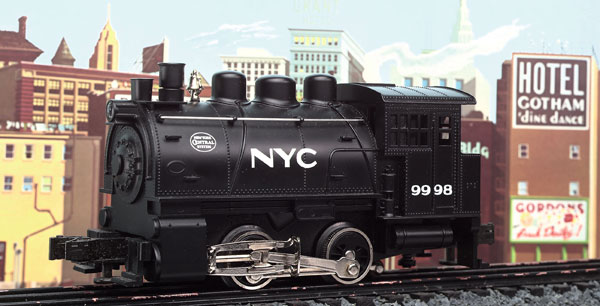
In 1999, MTH began producing an O gauge die-cast model based on the Baltimore & Ohio’s C-16 “Docksider” steam switcher. The biggest surprise was that this is a common locomotive in HO gauge, yet no O gauge company had previously made a die-cast metal Docksider. Right-of-Way Industries sold a brass O gauge Docksider in the early 1990s; Lionel sold a different plastic 0-4-0T in starter sets in the 1980s.
The second biggest surprise was that it would take a few more years (and a CTT magazine cover photo) for avid Docksider fans to realize that MTH’s version was even out there.
Leave it to MTH, whose offices are just west of Baltimore, to introduce the little lost locomotive to O gaugers.
The real Docksiders – four switchers built in 1912 by Baldwin for the B&O – derived their nickname from working the shipping port of Baltimore.
Docksiders were built to navigate tight waterfront curves, where they routinely hauled short strings of cars. They did the job until the early 1950s. If a model ever screams “O-27,” this 0-4-0T steamer does.
But the Docksiders, also called “Little Joes,” earned their fame in scale model railroading instead, particularly in connection with Varney’s original die-cast metal HO model.
MTH released its first Docksider in a Baltimore & Ohio starter set just in time for Christmas 1999. The sets sold quickly, and MTH followed up with similar sets in 2000 (Jersey Central) and 2001 (New York Central).
MTH announced in its 2002 Toy Fair catalog that the locomotive would be offered as a separate-sale RailKing item in New York Central and American Steel schemes.
A three-year-old B&O Docksider, on the cover of CTT’s October 2002 issue, prompted a flurry of calls and emails to our offices asking which company made the 0-4-0T, and where they were sold.
The model
The operative word to describe the Docksider is, indeed, “cute.” The model, like the real thing, captures that undeniable trait and is perhaps the core of its celebrity.
Despite its RailKing heritage, the locomotive is dimensionally a 1:48 scale model. Measured from inside the front step to the rear bunker, it’s a scale 26 feet long (61/2 inches), nearly matching the prototype’s 25-foot, 8-inch frame length.
The proportions hold true for height and width as well. MTH has accurately modeled the cab windows, which are not the same size on each side of the cab. (The engineer’s side is larger for better visibility.)
MTH built the Docksider with a “solid chassis,” a concept used in other RailKing steamers. This space-conscious design, with a can-style motor nestled right above the axles, eliminates the “air gap” between the drivers and the boiler.
Appearance-wise, the only real criticism is that the cylinders, which are cast into the shell, are about a 1/4-inch too far forward. Fortunately, the overall effect isn’t spoiled by the discrepancy. Also, the running gear is clearly built with simplicity (and reliability) in mind.
On the test track
This cute engine performs like a brute and runs surprisingly smoothly. It’s a heavyweight steamer (weighing a hair over 3 pounds) on a compact body, powered by a proportionately large can-style motor aided by a flywheel. These attributes give the model substantial pulling power for its size – nearly 3/4pounds. In the real world, the MTH Docksider can pull about a dozen cars.
There are no traction tires, since on a four-wheel locomotive all wheels are needed for electrical grounding. Instead, the Docksider’s drivers are horizontally grooved to aid traction. On tubular track, these grooves whine like truck tires when under way, but be aware that nothing is wrong if you hear that sound!
The Docksider coasts like a postwar spur-geared locomotive. When powered off quickly from 12 volts, the unit coasts several track sections before coming to a stop. This design makes it a smooth runner on dirty track, which is important because the two pickup rollers are spaced only two inches apart.
Available as a conventional-control locomotive, the Docksider crawls nicely (roughly 8 scale mph at 6 volts) and cruises impressively (about 47 scale mph at 12 volts). At 18 volts, its little wheels are turning so fast you might be afraid it’ll fly apart, even though it is traveling only about 84 scale mph. Obviously, this 0-4-0T can handle the tightest curves O gaugers can throw at it.
As with most MTH steamers, the Docksider’s fan-driven smoke unit pumps out a lot of smoke. It’s visually impressive on such a diminutive model, especially when the locomotive is in neutral.
There’s no room for a sound system and speaker inside the Docksider’s shell, nor does there seem to be room for DCS circuitry in future releases of the locomotive. In starter sets, MTH makes up for the mute 0-4-0 by installing whistles in the work cabooses that came with Docksider sets. This is a good compromise for the price.
I was disappointed that the Docksider lacks directional lighting. Running forward, it has a bright headlight that enhances its appearance.
In reverse, however, the presence of a nice-looking lamp lens behind the cab is wasted.
With MTH’s efforts, the Docksider’s fame has been extended to the world of O gauge. A star is reborn.