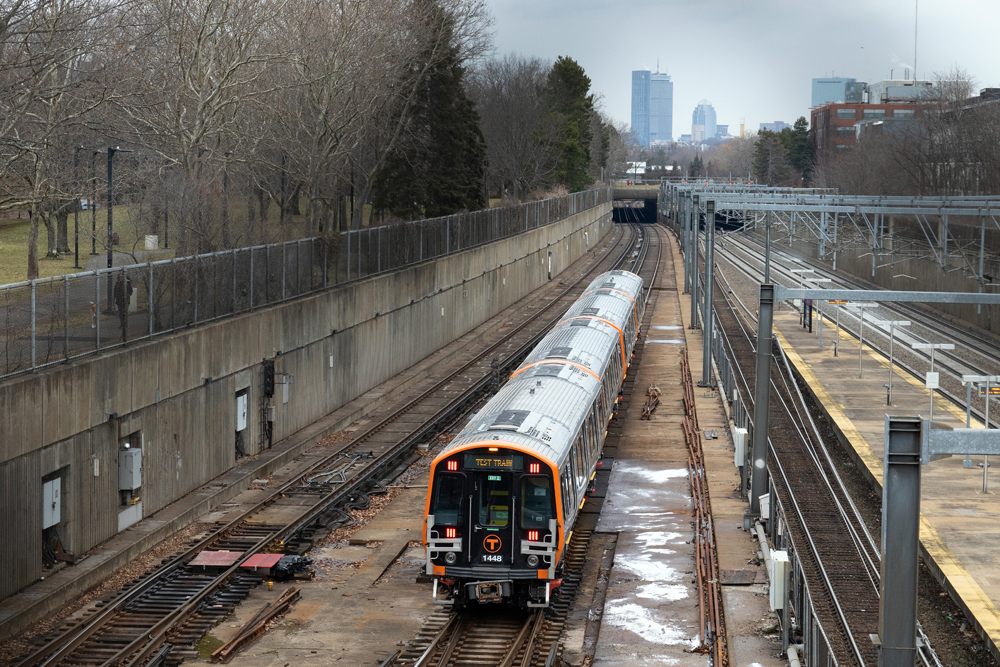
BOSTON — The Massachusetts Bay Transportation Authority will pay an additional $148 million to Chinese railcar manufacturer CRRC as part of an agreement to complete the order for its long-delayed, problem-plagued Red and Orange Line subway cars, the Boston Globe reports. That will push the total cost of the order to more than $1 billion.
The settlement will also forgive at least $90 million in penalties the manufacturer faces; another $37 million could be forgiven if CRRC meets new targets, State House News Service reports.
The additional money to be paid includes $95 million to reimburse CRRC for increased parts costs, $55 million for tariffs since the contract was signed, and $10 million in incentives to meet the new deadline that calls for completion of the order by the end of 2027. The 404 cars, 284 of which were ordered in 2014, with another 120 added in 2016, were all to have been delivered by last year. To date, just 130 cars have been delivered.
MBTA CEO Phillip Eng said Thursday that without the new agreement, the agency would not have received the last car in the order until 2029 at the earliest.
Eng said the MBTA had looked at cancelling the CRRC contract but the new deal would be faster than ordering equipment from another company.
“This is the best way to get reliable cars for the riders we’ve promised to provide a better trip,” Eng told the Globe. “These cars are essential.”
Cars have been completed at a Springfield, Mass., factory built by a CRRC as part of the contract, but the new agreement allows some wiring work to be done in China. Jeffrey Cook, MBTA chief procurement and contract administrations officer, said the agreement protects all jobs at the Springfield plant and gives the T the option to purchase the facility if CRRC sells it.
The CRRC order has been plagued by delays relating to the COVID-19 pandemic, quality control, and reports of a “toxic environment” at the Springfield factory [see “News report describes ‘toxic environment’ …,” Trains News Wire, Jan. 16, 2023]. The cars that have reached service have subsequently been sidelined because of door malfunctions, wheelset issues that contributed to a 2021 derailment, power-cable defects, and a battery explosion [see “MBTA pulls newest cars from service,” News Wire, June 22, 2022]. But Eng said the quality has improved considerably over the last year.
The agreement came in for immediate criticism.
Stacy Thompson, executive director of transit advocacy group LivableStreets Alliance, told the Globe the deal is “indicative of a larger pattern of mismanagement of large procurement contracts. I hope this is a wakeup call that the governor and the T will be taking a closer look at similar contracts, especially the fare transformation project, which is also hundreds of millions of dollars over budget and years delayed.” The nearly $1 automated fare payment program, approved in 2018, was expected to begin its rollout in 2022, but continues to be pushed back.
Erik Olson, executive director of the Rail Security Alliance — an industry group which has opposed contracts with CRRC for national security and other reasons — said in a statement that MBTA officials made it clear during a Thursday meeting that “CRRC has not fulfilled its original contract [and is] also unreliable and unsafe. …. Instead of cutting their losses, they’re doubling down. The sad thing is the worst is still to come.”
Share this article