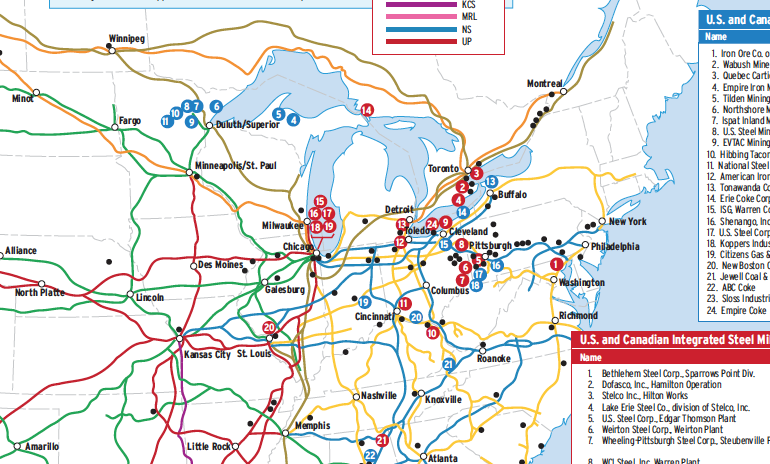

Steel in the U.S. and Canada, 2001
Screen Shot 20140411 at 22253 PM

Mini-mills provided half of U.S. and Canadian steel-making capacity in 2001. Their decentralized geographic distribution mirrored U.S. population density (with the notable exception of California), and did not work to the benefit of railroads. The remaining integrated mills primarily sold high-quality sheet steel to auto and appliance factories. Railroads included in this map: BNSF Railway; […]

Read More…

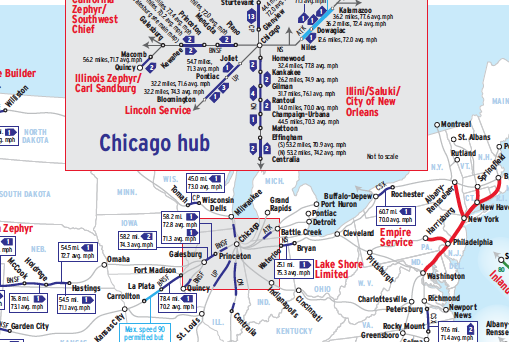
America’s fastest rail lines

Screen Shot 20140311 at 111909 AM

How many places in the United States can a railroad passenger travel more than 70 miles in one hour? This map spotlights those locations, based on the schedules in Amtrak’s Fall/Winter 2007 system timetable and its Spring 2008 Northeast Corridor timetable. (Where precise information was not available, the speeds factor in 1 minute of dwell […]

Read More…

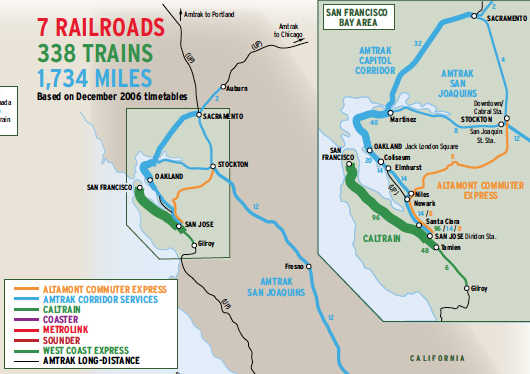
West Coast passenger trains

Screen Shot 20140213 at 95216 AM

What you’re seeing here is a transformation that’s nothing short of remarkable. Twenty years ago, a map of West Coast short-haul passenger trains would’ve been little more than a blank page. Back then, Amtrak provided minimal service between Oakland and Bakersfield, Calif., and between Portland and Seattle, though it did field 14 San Diegans a […]

Read More…

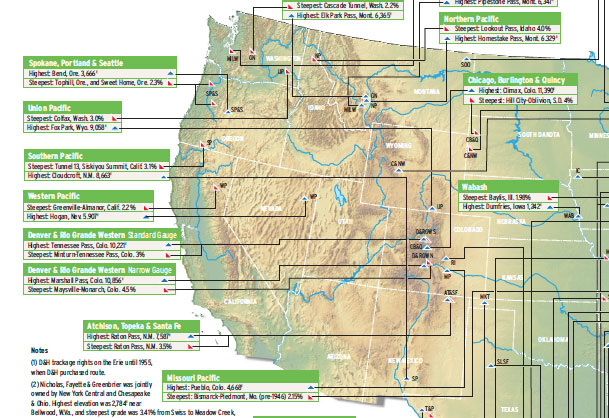
Highest points and steepest grades on America’s classic railroads

1212A

Railroad names: Georgia Railroad, Great Northern, Gulf, Mobile & Ohio, Illinois Central, Kansas City Southern, Lehigh Valley, Louisville & Nashville, Maine Central, Milwaukee Road, Missouri Pacific, Missouri-Kansas-Texas, Monon, Nashville, Chattanooga & St. Louis, New Haven, New York Central, New York, Ontario & Western, Nickel Plate, Norfolk & Western, Northern Pacific, Pennsylvania, Reading, Rock Island, Rutland, […]

Read More…

CSX Transportation’s predecessors

TM0203

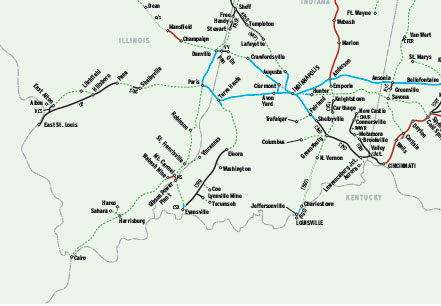
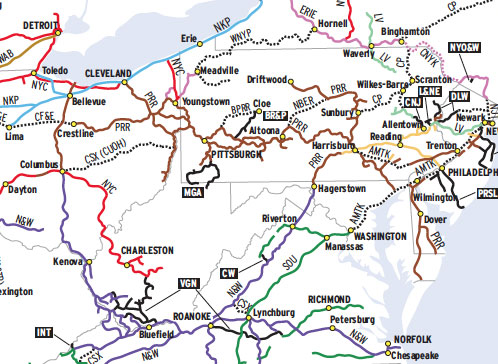
Geographic growth by acquisition or merger, and the elimination of redundant routes by sale or abandonment, are two factors that have been with American railroading from the outset…and are not about to go away. Consider this map of CSX Transportation’s principal ancestors. Shown here are 22 former Class I railroads — in post-World War II […]

Read More…

Top intermodal lanes in North America, 2004

TM0804

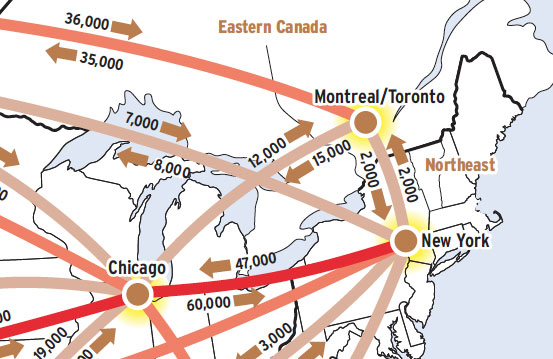
This Map of the Month was featured in the August 2004 issue of  Trains magazine. This map shows a commodity flow, or what everyone treats as a commodity flow: the trailers and containers that move in intermodal lanes in the U.S. and Canada. These boxes might actually contain anything from hay to helicopter parts, but almost […]

Read More…

Southern Pacific’s Lucin Cutoff

TM0502

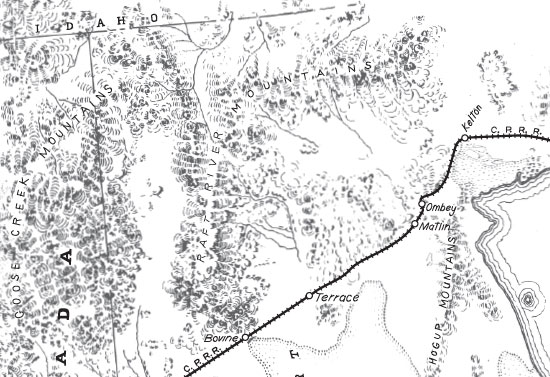
An English import, the American railway diverged sharply from English ideals. Environment proved stronger than genetics — settled and industrializing England constrained railway builders to design the most efficient routes possible, whereas their counterparts in unsettled and impecunious America disregarded gradient and circuity on pain of not completing lines at all. As the American era […]

Read More…

Penn Central versus Conrail tonnage

TM0303

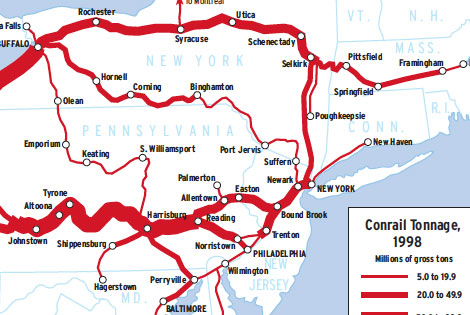
Twenty-four years separate these two density maps — a long time in North American railroading. The 1974 Penn Central map uses the last data available for the failed railroad; the 1998 Conrail map likewise is based on the last data before its system was split between CSX Transportation and Norfolk Southern. While similarities appear, the […]

Read More…

Norfolk Southern’s predecessors

TM0204

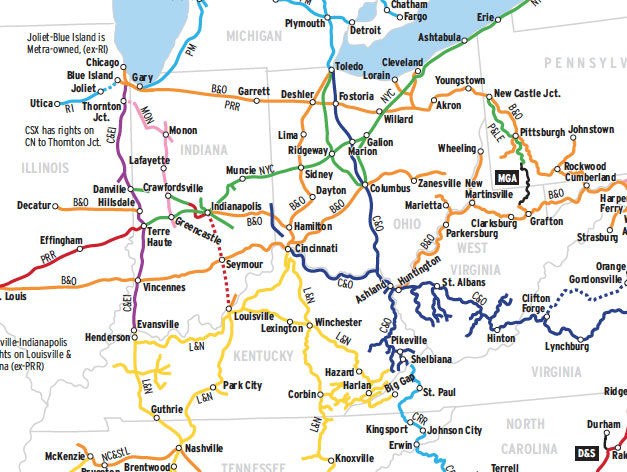
This Map of the Month appeared in the February 2004 issue of Trains magazine. Historians have argued that one key to the success of Norfolk & Western’s 1982 consolidation with Southern Railway was that the railroads shared a similar culture — determined, forward-looking, and committed to success. This served to douse the fires of early rivalries […]

Read More…

Illinois Central Gulf tonnage, 1973

TRN-M0209

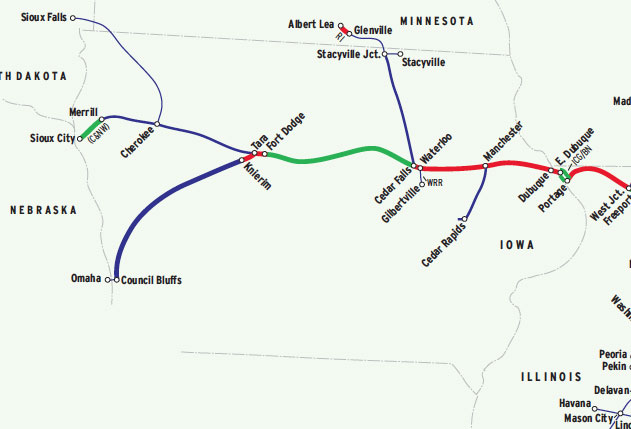
This Map of the Month was featured in the February 2009 issue of Trains magazine. The railroad Abraham Lincoln so ardently championed in the 1800s had changed dramatically in the ensuing century. On a mainly double-track speedway (enhanced with Automatic Train Stop in Illinois), diesel locomotives rushed goods from Gulf Coast ports and farms to […]

Read More…