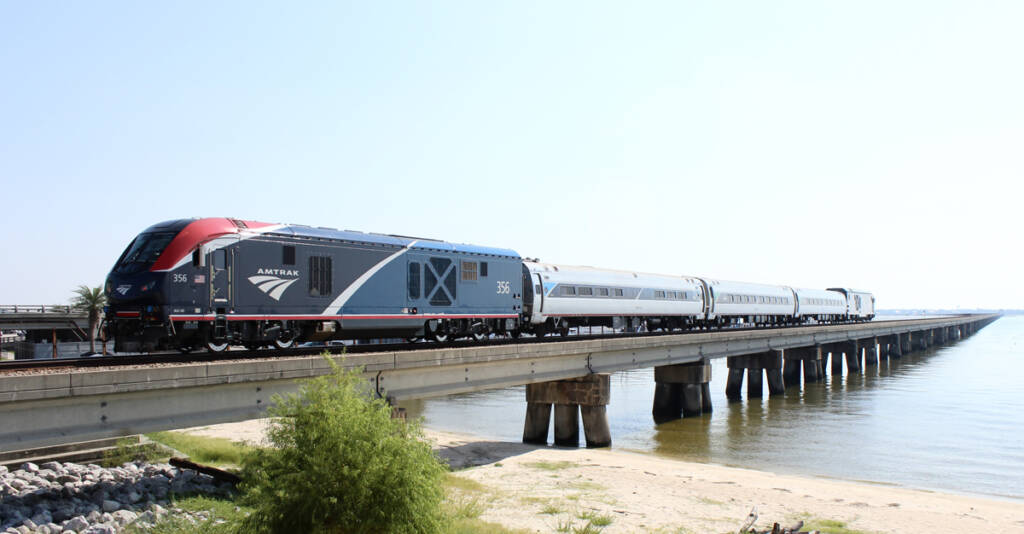
NEW ORLEANS – Ridership on Amtrak’s Mardi Gras service — launched in August to link New Orleans and Mobile, Ala. — has exceeded expectations in its first three-plus months of operation along the Gulf Coast.
Amtrak on Thursday said that more than 46,000 passengers have ridden the twice-daily roundtrips since the long-awaited service launched using a combination of CSX, Norfolk Southern, and New Orleans Public Belt Railroad trackage.
“We are well on-track to double the original estimate,” Amtrak Board Chairman Anthony Coscia said in a statement. “Demand is very high across our network.”
Amtrak Executive Vice President Jennifer Mitchell said the communities along the route have embraced the service faster than predicted. “Amtrak is proud of what we’ve achieved with local partners in Louisiana, Mississippi, and Alabama,” she said in a statement.
Strong support has also come from three regional tourism agencies and the Southern Rail Commission, Amtrak noted.
The trains rank at the top of all Amtrak services in customer satisfaction scores, which Amtrak attributes to work by its train, engine, on-board, and maintenance teams. Some 96% of customers said they were “extremely satisfied” with their trips.
Customer on-time performance to date is 86%, which is one of the best rates in the Amtrak system. When trains are delayed, nearly 90% of passengers said they were still “extremely satisfied” with the Amtrak experience.
In 108 days of service, an average of more than 420 people daily rode the Mardi Gras trains.
— To report news or errors, contact trainsnewswire@firecrown.com.

Too bad Amtrak cannot spare another coach to accommodate the greater demand. And why are they not using cab cars, so that they can operate the trains in push-pull mode and save the wasted expense of having to use a locomotive on both ends? Both changes would reduce the operating loss and subsidy.
For some unexplained reason, Amtrak management chose to use two, 58-seat, long-distance coaches on the MARDI GRAS route, instead of 72-seat, short-distance coaches, for the 3 hour 43 minute trip for these trains. The long-distance coaches are in extremely short supply. In fact, two of the four 58-seat coaches were pulled off their assignment on the CARDINAL route in March, 2025. (It only operates with two 58-seaters and is almost always sold out). Amtrak has many more 72-seat cars, used on the NEC and other Regional routes, but management doesn’t want to reduce seating capacity on the NEC or Regional trains. They prefer to extremely limit capacity on long-distance routes, like the CARDINAL, so they can focus on short-haul service. By the way, the MARDI GRAS trains would likely have carried more passengers, if a third or fourth coach would have been added. Same for all other long-distance trains…..add more cars, offer more seats, carry more passengers, make more revenue.
As of the end of September 2025, according to Amtrak’s numbers, the Mardi Gras Service generated approximately $500,000 of ticket revenue. Operating expenses were approximately $1,600,000, thereby leaving an Adjusted Operating Loss of $1,100,000. Amtrak recorded a loss on its books of $200,000, leaving the state sponsors with a loss of $900,000. The trains carried approximately 14,900 riders, resulting in an average combined federal and state subsidy of $73.83 per rider. Depreciation, as well as the amortization of other capital items, probably add another 15 to 25 percent to the losses per rider.
Give it a rest Paul. Everyone on this site knows you’re a math genius. Especially when it comes to keeping us up to date on the fact that Amtrak doesn’t make money or at least break even. Why don’t you tell us something we DON’T know. Like why airlines or bus or trucking or river barge operators can be SO profitable without our hard earned tax dollars? I’ll tell ya why because ya can’t!
By the way Paul. My wife and I have made two round trips to N.O. to date. We enjoyed our trips and intend to make more next year. I personally can’t care less it cost, as you say $73.83 more in subsidies per ticket. Better we should get the subsidy than some rich bank or corporation whose executives make millions. As smart as you are about Amtrak subsidies surely you’re aware of the BILLIONS corporations get in taxpayer subsidies a year. Since you’re on this site I’m guessing you’re a rail fan. So why don’t ya try riding an Amtrak train instead of always bitching about how much they cost?
CHRIS _ I think it’s legitimate to look at the numbers as Paul Smith has done. Your sarcastic response in the second sentence of your 8:34 PM post doesn’t change his analysis.
What gets me (as in my own frequent posts) is how easy it is for rail proponents to look past the capital amortization. Yes highways and aviation are subsidized but they also carry a whole lot of people. Amtrak does not. We had the discussion in the past week of the cost of rebuilding IH 94 in Milwaukee. Yes it’s a fortune but IH 94 carries a lot more traffic crossing Hawley Road than Amtrak carries in 46 states, DC, Ontario, and BC combined.
Let’s go past the comparatively reasonable capital expenditures for the Mardi Gras or the Boring Alice and look at some of the more outrageous examples of capital cost — Brightline Florida’s Orlando extension made possible by the rebuilding of a freeway, or CalHSR, or Brightline West. If you add capital amortization to the cost of a ticket (which no one does) then you get the real subsidy.
What most folks forget is that the Federal Government created the current, unequal and financially unfair passenger transportation systems we now have in the United States. In the 1940’s, it was the Government that chose to fund/build the Interstate Highway Network and fund/build all of the airports (and the FAA Flight Control System) that perpetuates our current dependance on highway and airline travel modes in this country. The Government’s focus on autos and airplanes, and the termination of U. S. Mail contracts with the railroads (that helped support the cost of operating passenger trains), are the reasons railroads were forced to abandon passenger service. Since the Government funded the infrastructure of competing systems, the railroads could not fairly compete for travelers.
.
Yes, highways and airlines now handle the bulk of travelers, because both are heavily subsidized by billions of dollars of federal funds annually. And there are far more autos and planes operating, by comparison to trains. With 5,000-5,700 passenger planes (FAA Statistic) over the U. S. airspace daily, millions of people are going to fly. If we had 5,000-5,700 passenger TRAINS operating in the U. S. every day, millions more people would ride trains than currently do. To say MORE people fly and drive, is simply NOT comparing apples to apples, because highway, air and rail are not equal in availability throughout the country.
.
The private railroads have to pay for virtually everything related to their tracks, bridges, tunnels, signals, dispatching, terminals, buildings, equipment purchases and all other company operations. Let’s see how many airlines would survive if we make them build and maintain every airport all over the country, and, pay for the operation of the FAA Flight Control System. The result would be the cost of airline tickets in the thousands of dollars per passenger on every flight, just to break even. If every Interstate Highway was a toll-road, to pay for the construction and maintenance of every mile of highway, the cost of owning and operating an automobile would be beyond most people’s affordability.
.
The current U. S. transportation system is broken! We need to either make ALL passenger modes pay for their own, actual costs of operations and financially survive on their own revenue, or, we need to subsidize ALL modes equally and give every mode a level playing-field in which to financially operate.
.
Since airlines and highways are not going away, the only real option is to increase funding for rail passenger services to create equalized competition. Passengers will ride trains, if they are operated with the frequency and on-board amenities to make them attractive. It costs the same amount to pay a locomotive engineer to handle a 5-car passenger train as it does to handle a 20-car passenger train. The difference is you offer more capacity when you add more cars, carry more riders and earn more revenue. Trains are unique in that they are the ONLY mode of passenger transportation that can add more capacity per trip.
.
When Amtrak was created in 1971, it was never intended to survive beyond a couple of years and the creators never really focused on “fixing” the system. Amtrak needs to be re-invented. Corridor and Regional passenger trains need to operate under a separate entity from long-distance trains. Or, other railroads need to be allowed to operate long-distance passenger trains and compete with each other and in the marketplace, like airlines do. There are many possible scenarios that could be implemented to achieve this…..too numerous to outline here. But radical changes need to be made to bring the operation of passenger trains into the mainstream of travel mode options in the U. S. Doing any other cost comparisons is futile, when the current systems are not equal to begin with!
ROFL! Leave it to “railfans” to ALWAYS have something bad to say about Amtrak.
Yes, Mr Shigley, that’s like saying “Yeah, ONLY 105 people rode that plane from New Orleans to Atlanta.” What on earth is wrong with all of you negative Nancys? Why do you always whine and complain and piss and moan about EVERYTHING?
Yes, 105 passengers in two coaches means that it was probably not too crowded on most runs.
Nothing is good enough. In fact, nothing is good because it’s not the same as it was in 1952. Honestly, it gets REALLY OLD. Stop whining.
So we’re not allowed to comment?
If 105 riders per train is twice the estimate, what are we allowed to think?
So daily an average 105 people are riding each one way trip. That should lead to comfortable seating.
I’m puzzled by the definition of “comfortable seating” above. The MARDI GRAS trains operate with two 58-seat Amfleet II coaches, that is 116 seats in Class Class. If 105 passengers are riding, that leaves 11 empty seats per trip. If you add the 18 seats in Business Class at one end of the Amfleet Dinette car, then you have 29 empty seats on average.