FRA proposes Amtrak become holding company, overseeing three divisions, passenger group says

FRA proposes Amtrak become holding company, overseeing three divisions, passenger group says

By Bob Johnston | February 21, 2026

| Last updated on February 22, 2026


Separate entities would handle operations, equipment, infrastructure

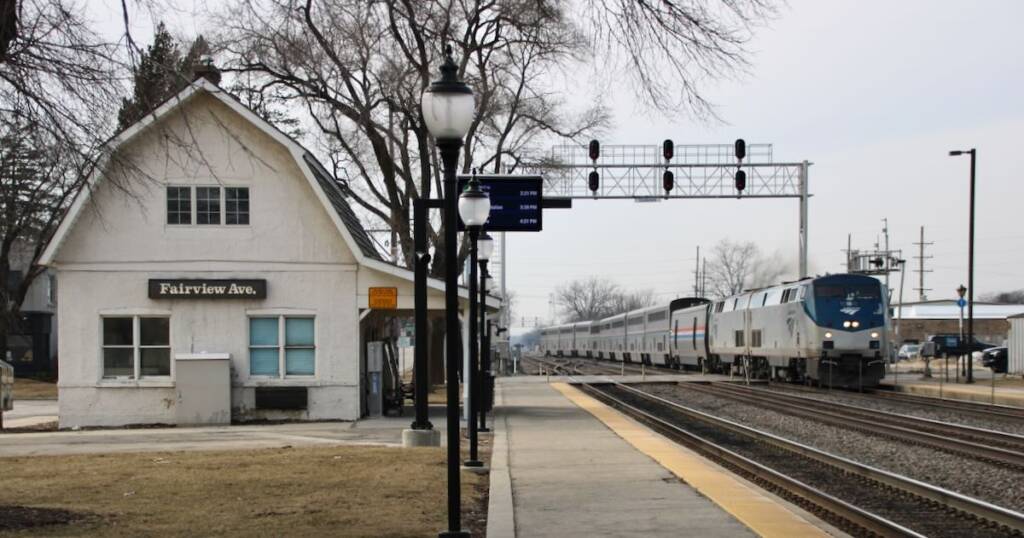
Passenger train passing white, barn-like station
The eastbound California Zephyr passes Metra’s Fairview Avenue station in Downers Grove, Ill., on Feb. 14, 2026. The Federal Railroad Administration is considering restructuring Amtrak into a holding company with separate divisions for operations, equipment, and infrastructure, the Rail Passenger Association reports. David Lassen

WASHINGTON — Federal Railroad Administration officials have briefed the Rail Passengers Association on a plan that would recast Amtrak as a holding company that would oversee separate entities responsible for operations, equipment management and leasing, and infrastructure and construction.

According to a statement on the RPA website, there are only cursory details of how the reorganized company would be structured, and no indication of how federal or state funding would be addressed. The proposal comes in a year when all current federal surface transportation authorizations expire.

A paywalled Bloomberg report quotes a Brotherhood of Locomotive Engineers and Trainmen official who warns restructuring will be a first step toward privatization. Officials at other unions have also speculated to their membership about that possibility.

However, U.S. Department of Transportation spokeswoman Danna Almeida told Bloomberg, “The Trump Administration is considering ways to strengthen and modernize Amtrak for the future, but privatization is not under consideration.”

Based on discussions with the FRA, the Rail Passengers Association document contains an overview of its “understanding of the USDOT restructuring proposal” as well as a list of the association’s proposed “metrics of success for any restructuring.” Among those is a call for an explicit rejection of profitability as a system-wide goal: “Instead, the primary object should be for services, construction projects, and rolling stock to be delivered quickly, on time, and on budget.”

— To report news or errors, contact trainsnewswire@firecrown.com.

Share this article

12 thoughts on “FRA proposes Amtrak become holding company, overseeing three divisions, passenger group says

  1. I don’t see the advantage of three holding companies over three business units and one company. In fact, I do not see how you split the shared assets across three companies. Starting with the 800 number used to make reservations. I think the three holding companies will reduce economies of a single company and will result in reduction of service and higher costs.

  2. Amtrak, in its current form, is badly broken! A total restructuring of the “long-distance passenger train business model” is needed. There are multiple options, but any or all of the following are worth implementing —
    .
    (A) Since the Postal Service loses billions per year, it’s time to restore some of the intercity mail delivery contracts to railroads, with the requirement that the mail be carried on long-distance passenger trains between major cities. Mail cars could be positioned on the rear of train consists to allow for adding/subtracting at major intermediate or end-point cities, without separating passenger-occupied cars from head-end power. The mail contracts would help incentivize freight railroads, or other passenger rail companies, to again operate long-distance passenger trains by defraying operating expenses, while helping the Postal Service reduce higher priced transportation costs of flying and driving the mail.
    .
    (B) Require ALL freight railroads, or passenger rail companies, to create interline operating agreements that give equal access to ALL mainline rail routes that would be needed to run individual long-distance passenger trains.
    .
    (C) Task the USDOT with paying for upgrades to tracks, bridges, tunnels and capacity expansions on rail routes used by long-distance passenger trains, similar to the USDOT infrastructure financing given to airlines and highways.
    .
    (D) Provide a guaranteed funding mechanism for a nationwide equipment pool that would provide standardized, single-level coaches, sleepers, diners, lounges, domes and baggage cars, that would give flexibility of use on ALL long-distance routes. This would again help railroads receive some similarity of financial support given to airlines and highways.
    .
    (E) Create a single reservation & ticketing system, similar to or in conjunction with, Amtrak’s Arrow System, to run a website and mobile app needed to book and sell ALL revenue-generating space on ALL railroads operating long-distance passenger trains. This system would be provided free to ALL railroads, as a comparison to the funding given to airlines for the FAA Flight Control Network and be a single source for rail travel.
    .
    (F) Program the same reservation & ticketing system to automatically add coach cars and sleeping cars to computer inventory as each class of service sells out, up to within 24-hours of train departures from origin terminals. This would maximize sales by selling seats and rooms to meet demand for individual routes and different dates of operation, while preventing empty cars from operating. A larger equipment pool would be needed, but would provide flexibility to adjust train consists as warranted by passenger demand. As example, a train could run with 5 sleepers and 9 coaches one date, but with 3 sleepers and 4 coaches on a different date.
    .
    (G) Establish nationwide, standardized, minimum, on-board services of a dining car, a lounge car, a dome car(s) (as clearances allow), on EVERY long-distance train and allow ALL coach car and sleeping car passengers to access those services/amenities. This would upgrade the on-board experience to a higher-level of “land-cruise” service that is unique to train travel and would provide an attractive alternative to crowded airports and highways, thereby generating more ridership and more revenue.

  3. Amtrak is to big to manage properly. Its past time to break it up and separate the long distance trains from the NEC. Maybe then we can get leadership that cares and is willing to fight for the long distance routes.

  4. This is an interesting one.

    First of all let’s remember that most of Amtrak’s mileage already is on infrastructure that Amtrak does not own, but rather is over private railroads and in some cases local ‘commuter’ railroads where Amtrak is a tenant.

    Before Amtrak there was the NECIP (Northeast Corridor Improvement Project) which was initiated to facilitate operation of the Metroliners which were then under development. After Penn Central failed, one reason why Amtrak was created was to ensure continued operation of the Metroliners, over infrastructure maintained to higher standards through the NECIP.

    The NECIP was subsequently folded into Amtrak, and the significant expense of NEC infrastructure has distorted Amtrak’s balance sheet ever since. The average observer sees a big line item in the federal budget for Amtrak, then looks at the nearest once-daily or tri-weekly Amtrak service and thinks: “Waste of Money!” Having a separate infrastructure entity would address that perception.

    Remember also that Amtrak is just one user of Northeast Corridor infrastructure. A separate infrastructure entity would benefit the local ‘commuter’ operators as well.

    Having a separate equipment management entity would be useful when securing funding. Commercial financing is a possibility with the financing secured by the equipment. But if funding from Congress is desired these would be one-off requests not reflected in the yearly Amtrak line item.

    It should be interesting to see what the people who actually make the decisions come up with.

  5. I agree privatization has become a fantasy with Brightline’s precarious financial situation & potential bankruptcy. It’s time to face the fact that all transportation modes are dependent on taxpayer for “investments” direct/indirectly none pay their way entirely. I would like to see Amtrak divided into three independent units separate funding, separate Boards & CEO’s which would make costs more transparent than they are under the current Amtrak mgmt model.

  6. Don’t worry about Amtrak privation. It’s 54 year history speaks to why that can never work. Any investor worth his salt sees what is happening to Brightline’s business model in Florida and the rising costs of their High speed Las Vegas line and would never consider investing in a private rail passenger system.

  7. You could follow the chaos in Britain, with rails owned by the government and operations farmed out to a freight railroad and a zillion passenger operators. You know, the railroad either works or it doesn’t work. Rearranging the deck chairs on the Titanic (the metaphor’s ubiquitous popularity speaks well of it) results in rearranged deck chairs.

  8. The “holding company with functional components” looks good “on paper” but railroad components are too integrated and interdependent. Senior railfans remember when CSX was born with three semi-independent components – one to operate the railroad, one to provide/maintain equipment, and one to market the products and services. Sounded good; flopped completely. Another concept pitched was to spin off the fixed plant into a separate company and offer route access to the highest bidder(s). Experience has shown tenants don’t fare as well as the owners. If we could do a “do-over”, the best choice would be to let the carriers provide a negotiated level of service on a 100 percent reimbursement-of-losses basis.

  9. Current Amtrak system does not really serve anyone well. Amtrak has lost half its market share by percent since 1971, despite higher passengers counts because airlines and cars have gained passengers more than twice as fast.

    I would also recommend Amtrak be split market wise too. Northeast Corridor, Long Distance, and State Supported trains.

    1. It may be true that Amtrak has lost market share, but they have also been constrained from growth by a negligent government whose focus has been on a “cutting for prosperity” mindset that isn’t applied to either the highways or the airports.

You must login to submit a comment