MEXICO CITY — The train involved in a fatal derailment in Mexico on Dec. 28 was traveling at excessive speed, the federal Attorney General’s Office said Tuesday (Jan. 27) in its initial report on the accident that killed 14 passengers.
The Interoceanic Train was traveling at 65 kilometers per hour (40 mph), 15 kph (9.3 mph) faster than the speed limit in the curving area where the train derailed, according to the locomotive’s event recorder, La Jornada reports.
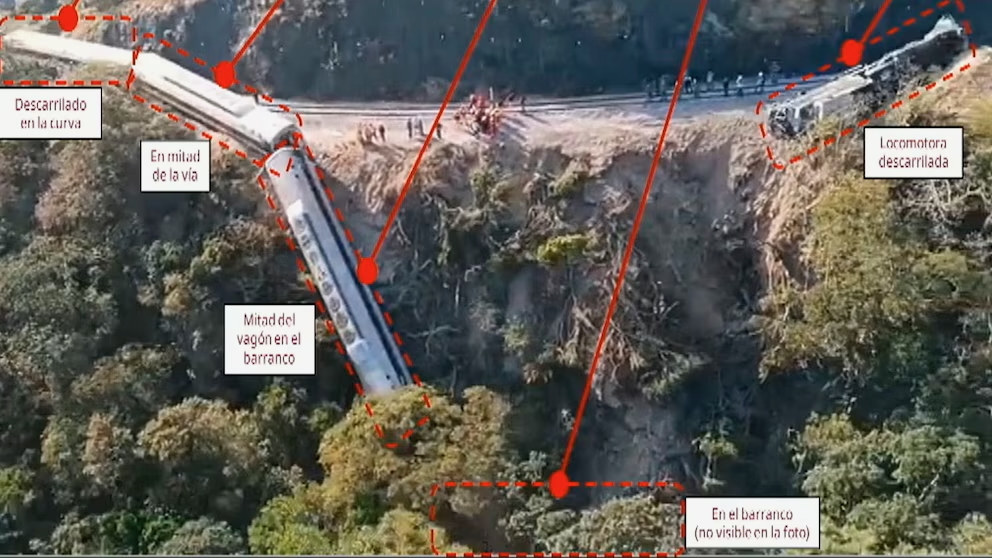
In addition to the 14 killed, 98 were injured in the incident near Nizanda in Oaxaca state when four cars derailed, with one falling down a steep embankment and a second left suspended on the hillside [see “Investigation begins …,” Trains.com, Dec. 30, 2025].
Attorney General Ernestina Godoy Ramos said the federal public prosecutor’s office plans to bring criminal charges for wrongful death and wrongful injury, and is currently working to establish responsibility. El Universal reports the train’s engineer was arrested on Monday.
Prior to the derailment, the train had been traveling at speeds up to 111 kph in an area with a 70 kph limit (69 mph versus a limit of 43 mph), Godoy Ramos said. While there were no indications of faults with the track infrastructure, El Financiero reports work is continuing to rule out other factors as geological issues, track alignment, or wheel-rail interaction.
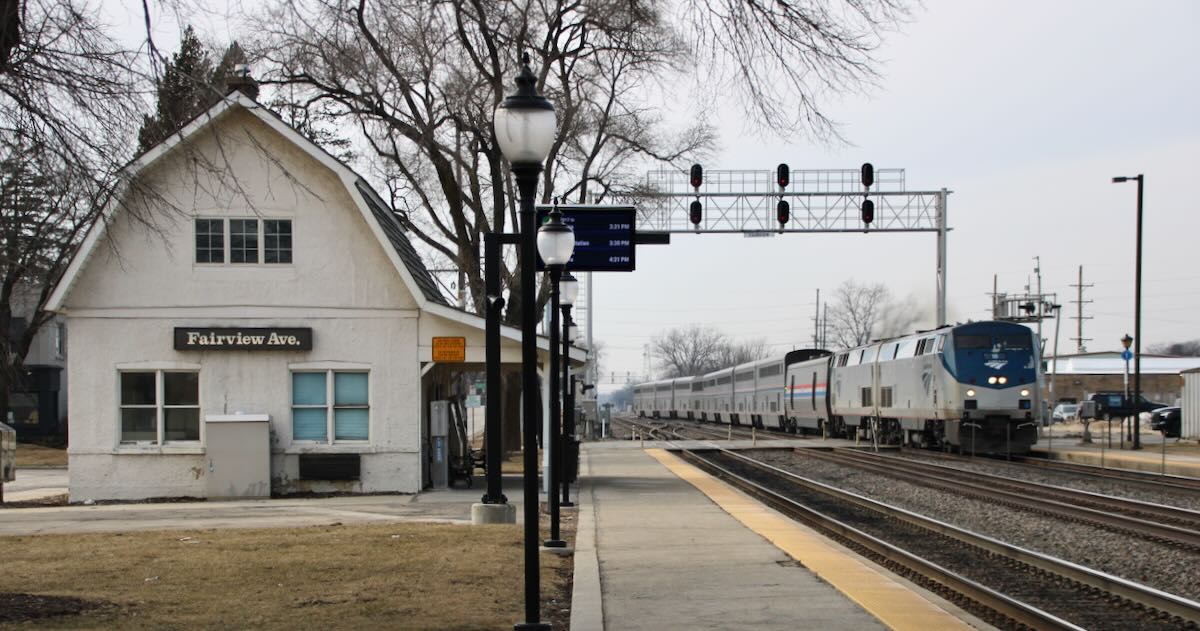
There were also no faults found with the train equipment, made up of secondhand U.S. locomotives and SPV-2000 railcars formerly owned by the state of Connecticut.
Operation of the Interoceanic Train has remained suspended since the accident.
— To report news or errors, contact trainsnewswire@firecrown.com.

Without knowing the degree of curve, and superelevation, it is hard to believe that a 9 MPH overspeed was the sole cause of the derailment. Especially with fairly low center of gravity passenger cars. got to be more to this.
Have to wonder if this is an indication of Mexican engineers just thinking speed limits are just an advisory? Was there management pressure to get train back on schedule? Are the schedules impossible to make?
What part of the design and/or construction led to such a low speed limit for a 21st century built line?