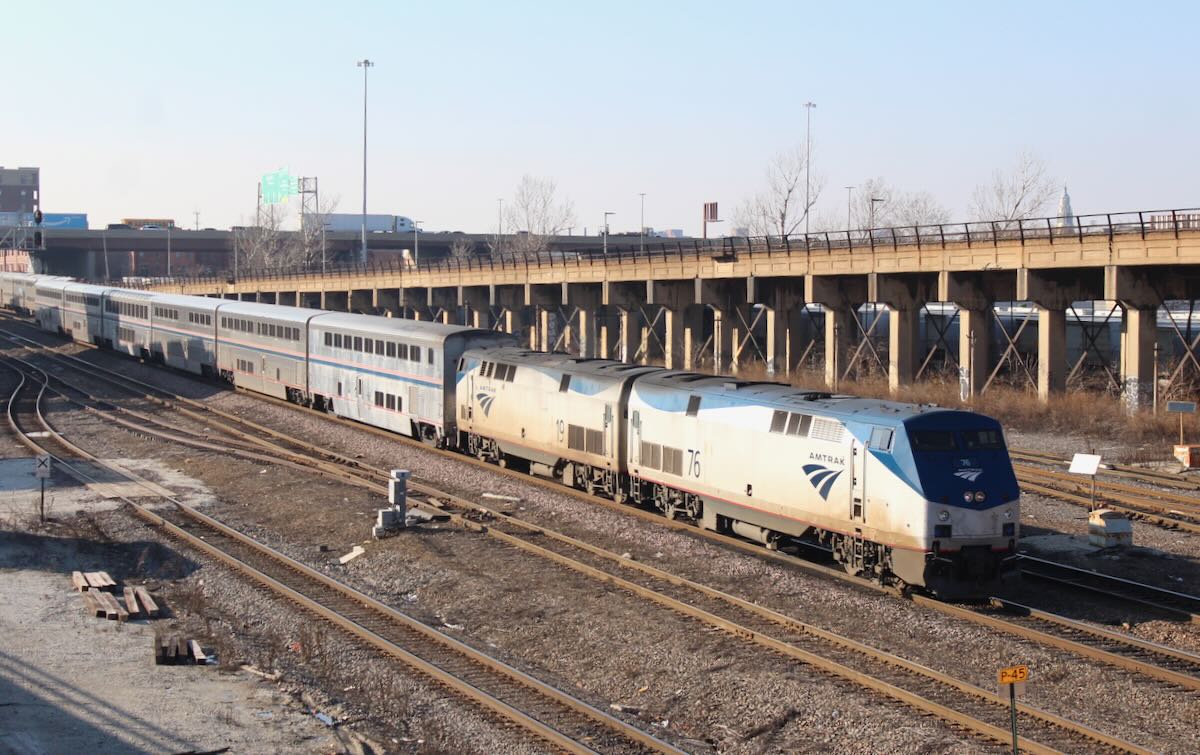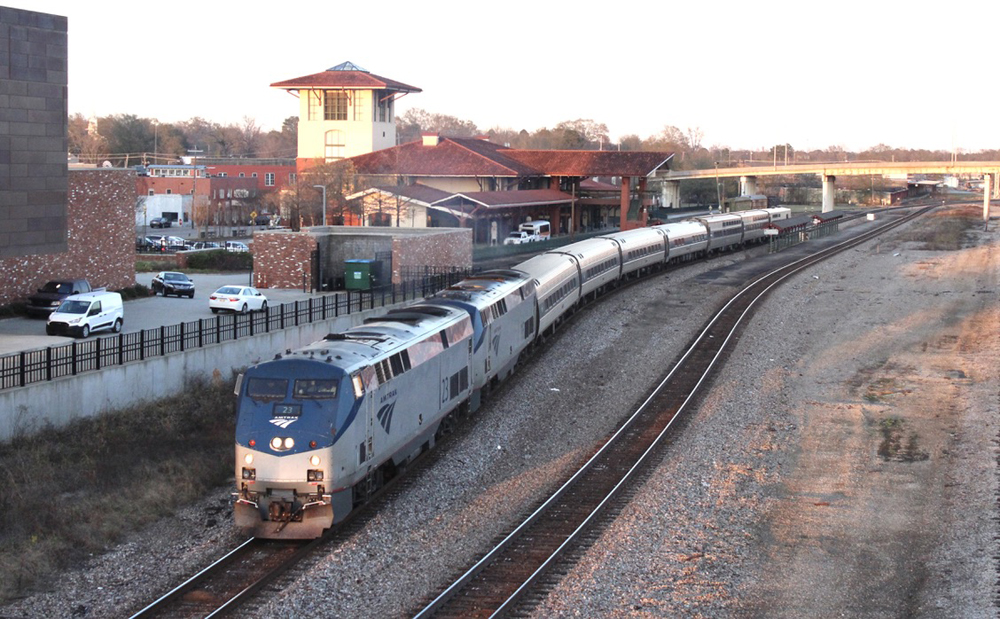
WASHINGTON — Norfolk Southern today asked a federal court to dismiss the Justice Department’s lawsuit over the railroad’s handling of Amtrak’s Crescent, arguing that the government’s “extreme” interpretation of passenger train right of preference doesn’t hold water.
NS says the Justice Department “complaint depends on the idea that freight railroads must totally clear their tracks for approaching Amtrak trains, the same way D.C.-area commuters must clear the road for the President’s motorcade—even if the result is a massive traffic jam.
“But ‘preference’ for passenger trains has never worked that way. Not in the decades before Congress codified it, and not in the half-century since,” NS told the U.S. District Court for the District of Columbia. “And with good reason: If adopted, the Government’s absolutist theory would produce gridlock, with a series of cascading delays grinding the rail network to a halt. Congress thus recognized that dispatchers must have flexibility to ensure the smooth flow of all traffic, not just individual passenger trains.”
The Justice Department hauled NS to federal court in July, contending that NS regularly fails to give the Crescent preference over freight trains, leading to delays that harm and inconvenience passengers, impede passenger rail transportation, and negatively affect Amtrak’s financial performance.
It is only the second right of preference suit Justice has filed. A 1979 case against Southern Pacific for its handling of the Sunset Limited between New Orleans and Los Angeles was resolved without a federal court issuing a final decision.
The New York-New Orleans Crescent operates on NS-owned or managed track between Alexandria, Va., and New Orleans. In all, NS controls 1,140 of the Crescent’s 1,377 route-miles.
In 2023, according to Amtrak data, 57% of Crescent passengers arrived on time, which was well below the 80% threshold required under federal customer on-time performance standards that went into effect in 2020.
The Justice Department says freight train interference is the leading cause of delays to the Crescent – and that the “vast majority” of those delays were the result of violations of the right of preference.
The suit cites five ways NS delayed the Crescent in violation of the right of preference. They include putting the train in a passing siding to meet a freight; requiring the Crescent to follow slower freight trains; running trains longer than most passing sidings, limiting where meets can occur; freights that block Amtrak from station stops; and forcing the Crescent to wait while freights were recrewed on the main line.
“The complaint does not, however, describe the surrounding circumstances or the reasons for any of these specific dispatching decisions. It also alleges nothing about the content or requirements of Norfolk Southern’s dispatching policies, supervisory functions, or training programs. And while the complaint acknowledges that ‘Amtrak has executed operating agreements with Norfolk Southern’ and other host carriers, it says nothing about the terms of the Amtrak-Norfolk Southern contract that governs the Crescent service,” NS says.
Norfolk Southern also argues that the Justice Department complaint hinges on the notion that every host railroad delay to an Amtrak train is a violation of the right of preference.
“This extreme view of ‘preference’ contradicts every interpretive tool, including decades of history. If adopted, it would wreak havoc on the rail network and Amtrak’s finances. The Court should reject it,” NS says.
“If Amtrak were really entitled to presidential-motorcade service, it would have to pay the host railroads’ ‘incremental costs’ of providing that level of service … which it almost certainly cannot do,” NS says. “So the government’s theory would likely result in a massive bill to U.S. taxpayers.”
The lawsuit failed to take into account the circumstances surrounding NS dispatching decisions, NS says. “It is wholly plausible that Norfolk Southern directed each Amtrak train into a siding because putting the freight train into the siding would actually have taken longer, or because this was the most efficient way to clear the line for all nearby traffic, including other passenger trains,” NS told the court.
Over the years, several Amtrak presidents and executives have said that it can be faster and more efficient to put a passenger train into the hole for a meet with a freight train, NS noted.
The Justice Department’s argument regarding the operation of long freight trains, NS says, would amount to a cap on train length. “Since these kinds of delays can be avoided only by running shorter freight trains or building longer sidings, the complaint thus assumes that … [the] ‘preference’ obligation can dictate operational matters beyond the basic dispatching questions of which train moves where and when,” NS says. “Indeed, on the Government’s view, [the law] … silently limits the length of freight trains on Amtrak routes.”
NS also argues that Congress, in giving passenger trains the right of preference in 1973, never meant for passenger trains to cause burdensome delays to freights.
“Far from imposing an inflexible duty to clear the rails for every Amtrak train, consequences be damned, Congress required freight railroads to give Amtrak trains priority while also ensuring that freight shippers receive adequate service and the rail network remains fluid for all traffic. The Government’s contrary view would have disastrous consequences,” NS says.
Congress did not intend the preference obligation to “materially . . . lessen the quality of freight transportation provided to shippers,” NS argues.
Norfolk Southern’s operating agreement with Amtrak notes that NS agrees to operate Amtrak’s trains “to the avoidance of unreasonable interference with the adequacy, safety, and efficiency of [Norfolk Southern’s] other railroad operations.”
The contract also includes penalty payments for late Amtrak trains and performance payments for exceeding an on-time performance threshold.
“Together, the provisions of this contract, which Amtrak voluntarily signed … imposes a flexible obligation that accounts for network constraints and freight-service obligations rather than the absolute obligation the Government asserts,” NS argues. “Otherwise, Amtrak would have no incentive to negotiate these contracts in the first place—and freight railroads would have no reason to sign them. By ignoring the contract’s terms, the Government’s legal theory conflicts with the statutory structure.”
NS also sought to have the case transferred to a federal court in Georgia, where the railroad is headquartered.
Passenger on-time performance and the right of preference also are key topics in the complaint Amtrak filed with the Surface Transportation Board regarding Union Pacific’s handling of the Sunset Limited. That case – the first of its kind – continues to wind its way through the board’s investigation process.
Note: Updated at 9 a.m. Central to remove reference to North Carolina Railroad.
Share this article