





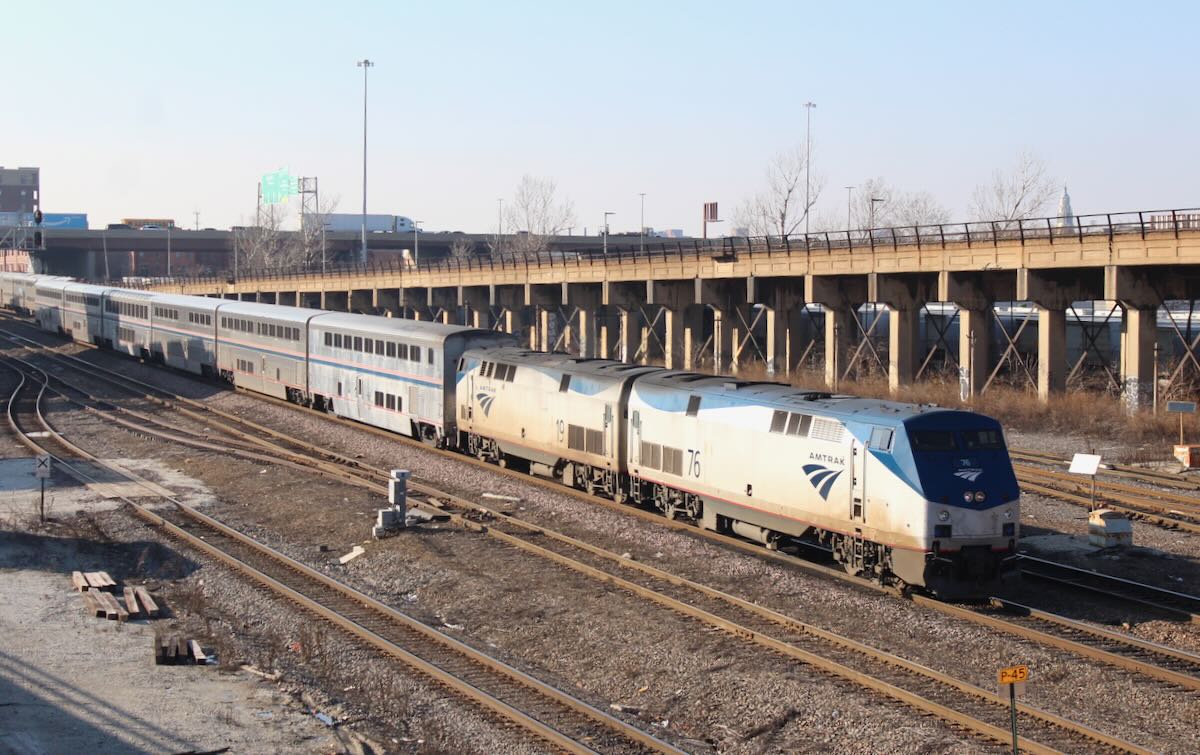
CHICAGO — Amtrak is addressing the coach capacity shortfall on the Coast Starlight and Sunset Limited while shuffling equipment to beef up summer consists on other Superliner-equipped trains.
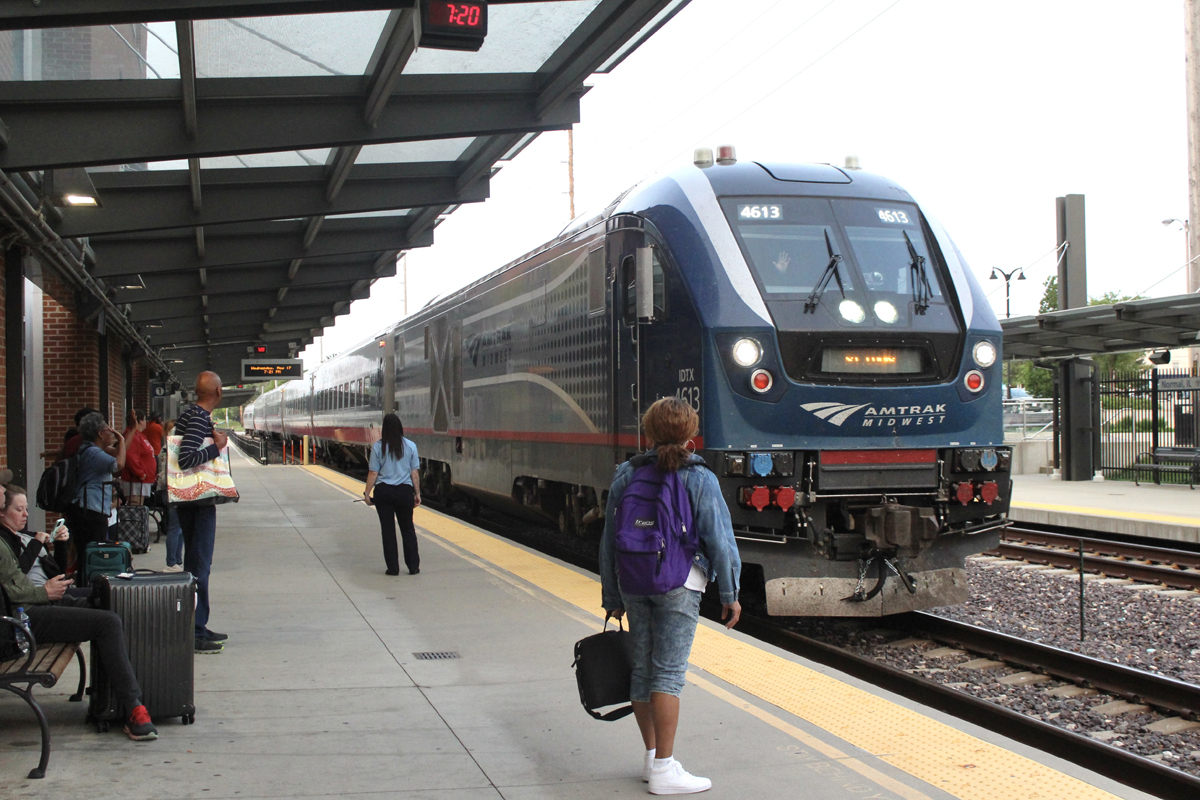
However, the railroad still contends it can’t come up with two Viewliner sleeping cars and two Viewliner diners to augment the triweekly Cardinal, its perpetually sold-out New York-Washington-Chicago train.
Ramping up
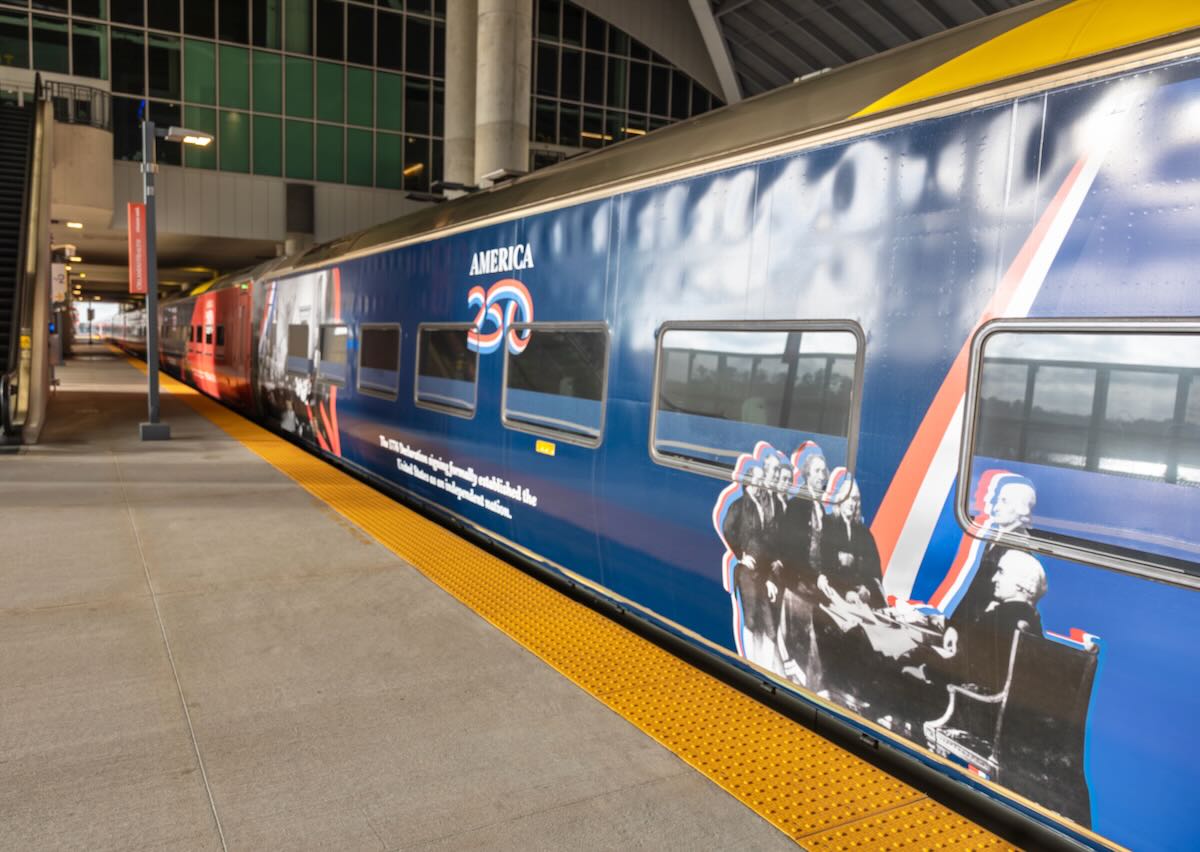
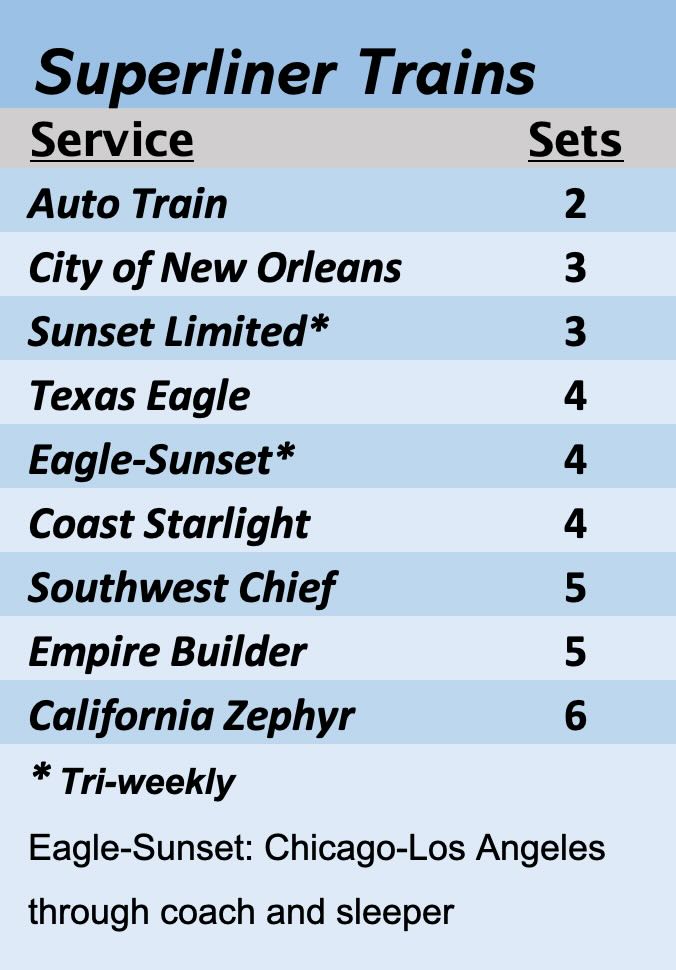 Assigning an additional coach or sleeping car to the available inventory of long-distance trains means that Amtrak must find enough cars for every consist. The table at right shows the number of trainsets required to the operate Superliner-equipped trains.
Adding one car to every Southwest Chief, for instance, requires five cars of that type. The 30- to 45-year-old equipment typically gets cycled through periodic maintenance when demand is lighter. The Chief, which has been running since the New Year holiday with a single sleeping car plus roomettes in the train’s transition sleeper, has been a tough ticket. Chicago-Los Angeles roomette fares through March 15 range from $806 to $1,438 (four rooms were left at this price for March 14 as of Thursday). There is also one date where roomettes are sold out.
But later this month, another full sleeping car is being added to every Southwest Chief through the summer, along with a full baggage car. A third coach will be added in April, once Colorado’s Winter Park Express finishes its season. This will help accommodate campers destined to and from the Philmont Scout Ranch, a bus ride away from the train’s stop in Raton, N.M.
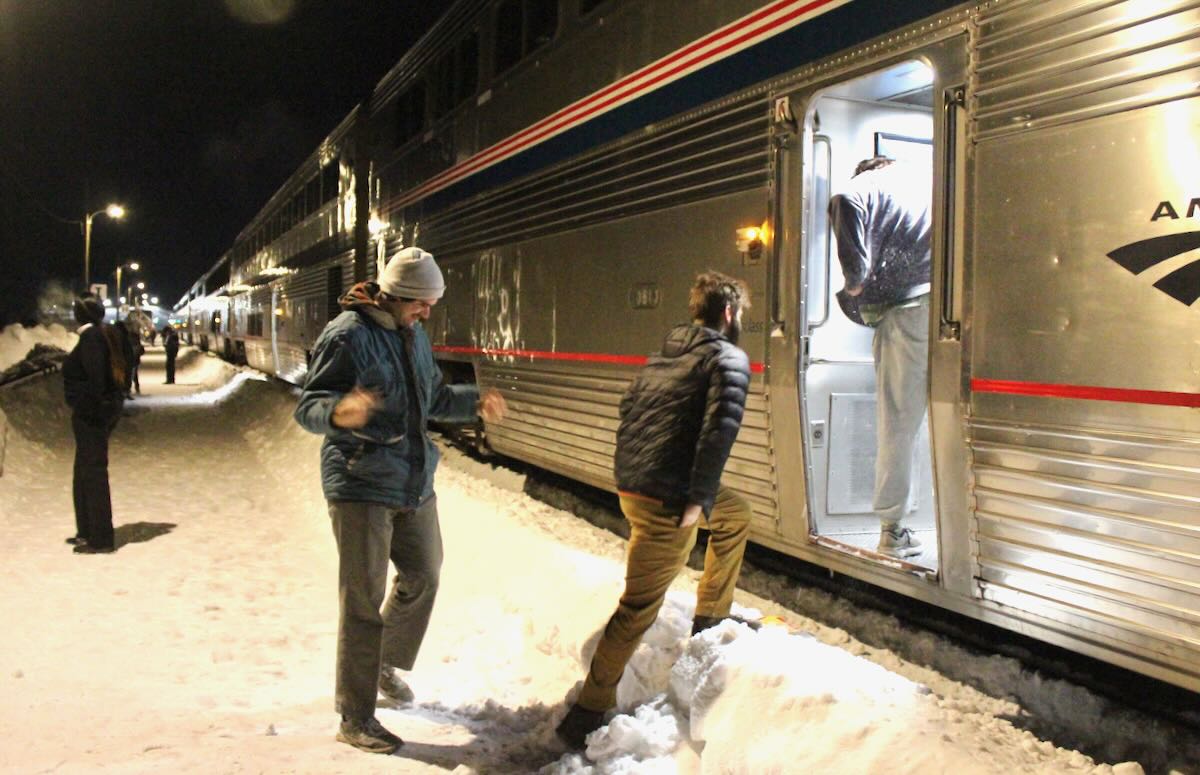
Elsewhere in the long-distance network:
- The Chicago-Seattle/Portland, Ore., Empire Builder is also getting a second Seattle sleeping car from March through the summer, but not a second Seattle coach. The train continues to operate with a full coach, coach-baggage, and one sleeping car (plus the Sightseer Lounge) on the Portland section. The train operated with two Seattle coaches and two Portland sleeping cars in summer 2020 during the COVID-19 pandemic, but subsequent Chief and Builder accidents depleted the Superliner fleet.
- The California Zephyr adds a third sleeping car in early June, made available from Auto Train reductions, but not a third coach. The extra coach “performed well in 2025,” Amtrak said, responding to a Trains inquiry, “but the equipment will operate on the Coast Starlight (as a third car) and Sunset Limited (a second Los Angeles-New Orleans coach) to maintain their consists.” Both of those trains have had numerous coach sellouts over portions of their routes during the past year. Before the Starlight lost its first-class Pacific Parlour Car in early 2018 in response to an edict from then-president Richard Anderson, the train usually operated April through December with four coaches and three full sleeping cars.
In other moves, the Superliner-equipped Fort Worth-Oklahoma City Heartland Flyer adds a third coach in March, but a shortage of single-level Amfleet II coaches means that the Lake Shore Limited’s Boston section won’t get a second coach until summer. A debut date has not been announced for the first Airo Cascades trainsets, but they likely won’t be available until after World Cup soccer matches are staged in Seattle and Vancouver, B.C., in June and July. Except for two higher-capacity Talgo Series 8 trainsets, the Cascades have been selling out with two Amfleet I coaches and an Amfleet café-business class car.
— To report news or errors, contact trainsnewswire@firecrown.com.

What does frequently sold out mean?
In FY25 the average load factor on the Sunset Limited was 41.2%. And it had an Adjusted Operating loss of $46.2 million. On a fully allocated cost basis the loss probably was $60.1 million. The Cardinal had an average load factor of 57.1%; it had an Adjusted Operating loss of $20.9 million and a fully allocated loss of $27.2 million.
Unless one has access to Amtrak’s reservation system, determining the load factor, as well as sold out conditions by segments, the argument that trains are frequently sold out is problematic appears to be an educated guess at best.
The long-distance trains have never come close to covering their operating costs, let alone their fully allocated costs, and it is unlikely that they ever will. The best outcome would be to scrap them and deploy Amtrak’s limited resources to short, high density corridors where passenger trains make economic sense.
PAUL — LD’s especially those with longer routes, tend to load heavier leaving or approaching the end points but thin out in the middle — in other words, many patrons might ride Chicago to KCMO but the train empties out in Kansas and SE Colorado until it picks up again Albuquerque to Arizona to LA. Thus it’s possible to sell out a train even if along part of the route it’s not all that heavily loaded.
This problem is a subset to the reality that one train on a route can’t be everything for everybody. The recent second train CHI-MSP, the Borealis, addresses that issue. But most LD routes don’t have that second train.
This post is in response to your remark on trains selling out. It’s not meant as an argument for or against your other points. You suggest that the LDs be discontinued. That’s your opinion. I’m not expressing my opinion on that point one way or the other.
How many of the 479 Superliners are still in service? How many scrapped? How many OOS but repairable? Inquiring minds want to know.
They could save another Superliner trainset by making the Sunset Limited Tri-Weekly again. In my view that would be of net benefit to the bottom line, to shift those cars to more heavily patronized routes.
My best information is that Sunset is still tri-weekly. Erich, did you mean another train?
Good to see that the Coast Starlight won’t be losing a coach this summer like what happened last year. But I hope Amtrak will take serious steps to address capacity shortfalls with the limited addition of Superliners it should get in the coming months. With the Airo trains on schedule to debut on the Cascades this summer, Amtrak can use those Amfleets in addition to the limited number of Horizons that will be coming back to augment the Borealis which has take six additional Superliner coaches. Nevertheless it’s still not enough even when Amtrak is able to get Superliners withdrawn from the Illini and Saluki pending shunt enhancer device installation! You’re very likely not gonna see a Southwest Chief operating with four coaches in summer like was seen pre-pandemic.
Here we go again, the poor Cardinal stuck at the bottom of the barrel with a regularly sold out consist and gets no additional cars YET AGAIN. How much would it really hurt Amtrak if they took only two coaches out of the Northeast equipment pool which includes some Amfleet IIs( multiple trips a day; five coaches minimum per train which rarely sells out) to give a critical capacity boost on the Cardinal only three times a week almost always sold out and what was Amtrak thinking not ordering enough Viewliner Diners to give the Cardinal one and enough sleeping cars to add a second during peak travel. Amtrak expressed the capacity and amenity shortfall on the Texas Eagle in the last year and it’s showing results! The Cardinal has that potential too! Easily had demand for a consist of three coaches minimum, a cafe a diner, and two sleeping cars during peak travel. To add on to that Amtrak’s desire to increase the Cardinal to daily service is only gonna drive up demand for more cars even further!
From the early 80’s til the Cardinal got Superliners in the early 90’s, the Cardinal was a healthy vibrant train. Slumbercoach, 10 6 Sleeping Car, FULL DINER, lounge and numerous coaches. I still can’t fathom the fact that Amtrak claims they can’t come with 2 extra Viewliner diners and sleepers for the Cardinal.
Also, why are Amfleet 2 cars running on NEC trains. Those cars belong to long distance trains.
Let Roger and his fly boys have the NEC and have the long distance trains be run by people that look to increase revenue vs cost cutting and no bonuses.
Mike Lustig
My mistake on Amfleet 2 cars on NEC trains
MR JOHNSON — If my memory is correct, Amtrak originally purchased 25 Viewliner Diners. Based on current consists of the SILVER METEOR, FLORIDIAN, CRESCENT and LAKE SHORE LIMITED, my calculations would indicate approximately 17-18 Diners are regularly in use. That leaves roughly 7-8 spare Diners on Amtrak’s property, although a couple are set aside for “protect” service, when a car is pulled out for repair or servicing. As a result, various, recent drone videos, available on YouTube, verify that spare Viewliner Diners are sitting idle and empty at Beech Grove Shops.
Amtrak has also completed the refurbishing of a number of Viewliner I Sleepers to supplement the active Viewliner II Sleepers in use on the above trains. Current equipment assignments, show three (3) sleepers regularly operating on the SILVER METEOR, FLORIDIAN and LAKE SHORE LIMITED (2 on the New York Section – Trains 48/49 and 1 on the Boston Section – Trains 448/449) for a total of three (3) on the Albany-Chicago portion of that route. The CRESCENT currently operates with two (2) sleepers on each consist. Again, this leaves spare sleepers on Amtrak’s property at various locations.
Therefore, Amtrak actually has two Diners and two Sleepers that it could easily assign to the two consists that make up the CARDINAL operation. AND, yes, Amtrak could easily pull two Amfleet I Coaches off the NEC, remove a few rows of seats from those cars, reducing seating from 72 seats (corridor configuration) to 58 seats (long-distance configuration) and create a couple of “Amfleet II” coaches. So the problem is not a shortage of a few single-level cars,
The real irony is that Amtrak management acknowledges the CARDINAL is frequently –sold out– of coach seats and sleeping car rooms — caused by a severely restricted consist (2 Amfleet II Coaches, 1 Cafe, 1 Sleeper and 1 Bag/Dorm) and by the concentration of travel demand restricted to tri-weekly operation. The only conclusion is that Amtrak management doesn’t want to add the employee cost of an extra coach attendant, an extra sleeping car attendant and the extra dining car crew, as their reason for not adding the additional revenue-generating cars that would allow more passengers to travel, while making more money for the company. Slightly higher operating costs appear to be connected to management not getting their bonuses, even though the extra revenue generated by carrying more passengers would substantially offset the addition of a few employees.