





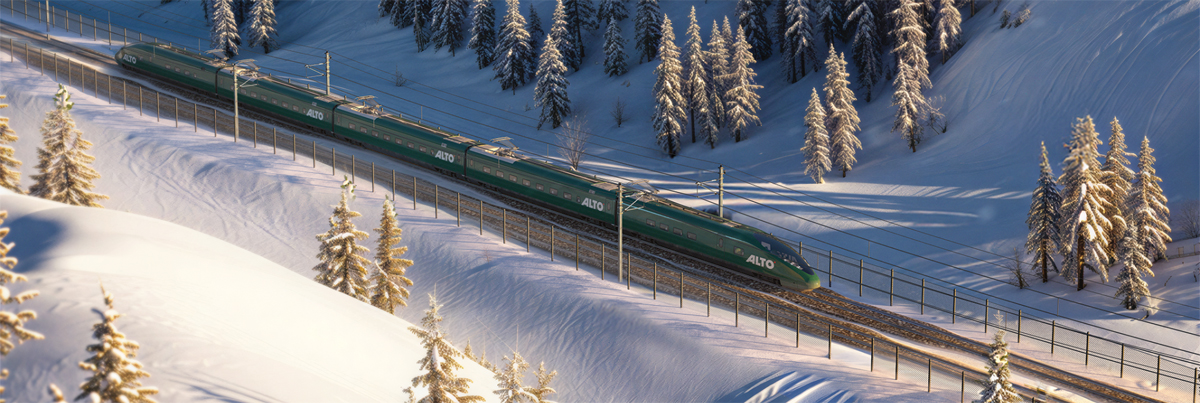
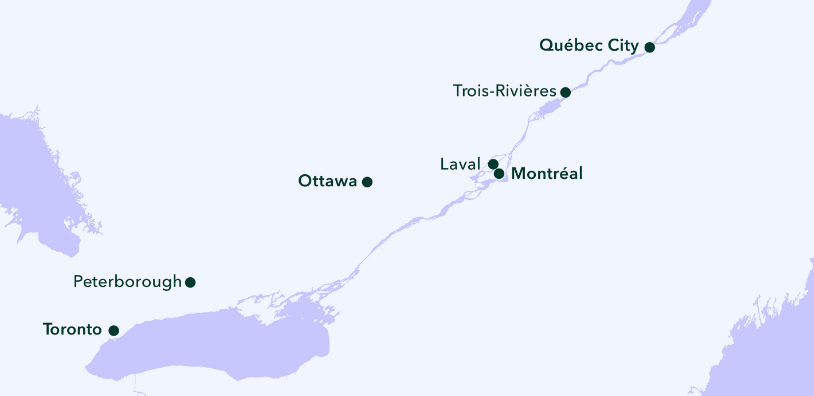
GATINEAU, Quebec — The first segment of Canada’s planned high-speed rail line will be built between Montreal and Ottawa, Transport Minister Steven MacKinnon announced today (Dec. 12).
Construction will begin within four years — half the time that had originally been projected, MacKinnon said during a morning news conference in Gatineau.
“This segment represents a unique opportunity to connect two provinces and quickly generate benefits for travelers, communities, and the economy,” MacKinnon said. He called the Montreal-Ottawa route “the most logical option” for beginning the project.
“It is a relatively short and straight portion of the overall route,” he said. “And you know, these high speed trains, they don’t like curves. … This provides an excellent opportunity for teams in both provinces to begin to develop together the expertise needed to deliver the other segments in both Ontario and in Quebec. And since this section is at the center of the future network, the other segments can be added.”
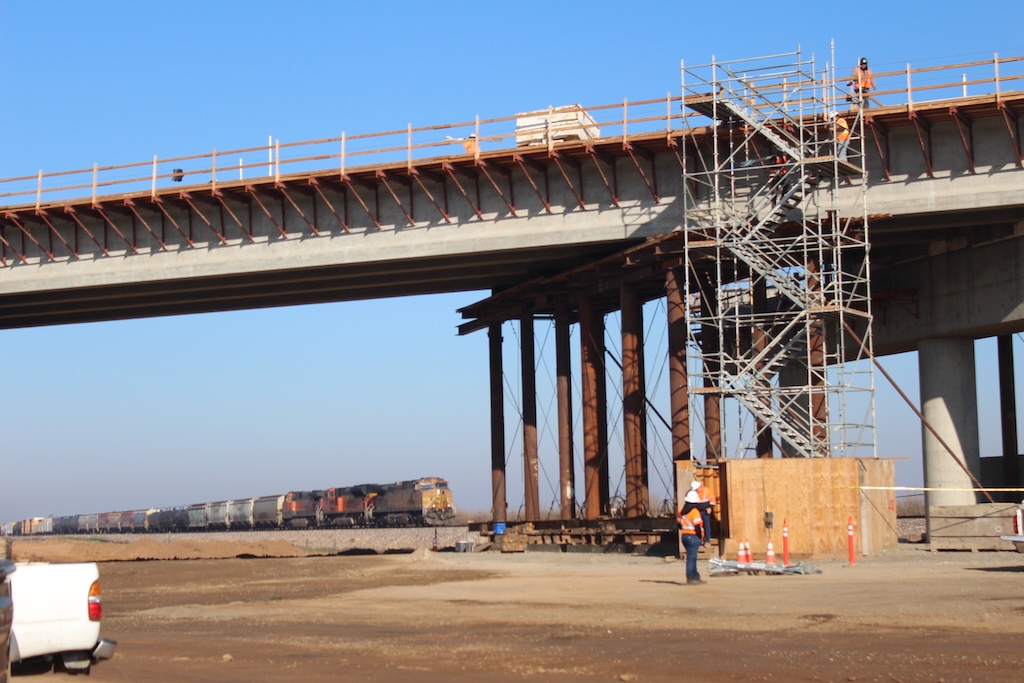
Beginning with the 200-kilometer (124-mile) center segment mirrors the approach of California’s high-speed project, which is building its first section in the state’s Central Valley, the flat midsection of the overall route, avoiding the tunnel-building and other construction challenges with mountain and urban sections.
Martin Imbleau, CEO of Alto, the crown corporation charged with developing the high speed route, said the Ottawa-Montreal segment “gives us a manageable distance to deliver it in a controlled, disciplined way. … start with a defined scope, sequence the work properly, validate assumptions early through structured analysis, and then apply the same rigor as the network expands with greater agility.”
While MacKinnon said the overall project would cost in “in the (Ca) $80 billion range,” he said no estimate had been made for what the first segment would cost. And Imbleau said it would be difficult to have a separate estimate “because we will use the first segment as a test case, and some of the components we buy, some of the contracts that we will give, and some of the items, including rolling stock, will be used for other [segments]. So it would be difficult and kind of absurd to have an independent budget.” The Ottawa-Montreal portion will represent about 25% of the overall project, he said, “but don’t do the rule of thumb” to draw a dollar figure from that.
Imbleau characterized the high-speed line as a “nation-building” project.
“And nation building means building with our own people, our own expertise, and our own supply chain,” he said. “… The project represents a generational investment in Canada’s future economy, one that we expect will contribute to an uplift of 1.1% in GDP.”
The Ottawa-Montreal segment will have to confront the lack of a clear route to downtown Montreal and the city’s Central Station, although the solution may simply be to go elsewhere. Imbleau said earlier this week that the high-speed route is not likely to serve Toronto Union Station, but would seek a station “in the vicinity of Union Station” that would be “economical” and “reliable.” And MacKinnon said today that it was “too early to tell” if trains would enter downtowns, or, as a questioner suggested, might serve suburban stations and rely on local or regional transit for the final portion of the trip.
The exact route for the project will be determined through a process including a three-month consultation beginning in January 2026, Transport Canada said in a press release. Consultation will include open houses, virtual sessions, and an online platform to give residents a chance to comment. Details on the consultation process are available at the Alto website.
Former Prime Minister Justin Trudeau announced plans for the high speed project, as well as Ca$3.9 billion in funding, earlier this year [see “Canadian government announces plans …,” Trains.com, Feb. 19, 2025]. The Cadence consortium signed a contract for development of the project in March [see “Cadence consortium signs …,” March 21, 2025]. The government has said the high-speed line will be among the projects addressed by a new Major Projects Office intended to fast-track major infrastructure work [see “Montreal’s container port ….,” Sept. 13, 2025].
— Updated at 10:58 a.m. CT, replacing earlier version with information from press conference. To report news or errors, contact trainsnewswire@firecrown.com.



Well at least Canada is trying. What are we doing but trying to squeeze a few extra minutes out of our Northeast corridor?
No, Canada is NOT trying. Canada is issuing press releases.
Such negativity. Give them a chance before criticizing.
MARC — The basis for my negativity is the government’s intent to start with the shortest and the “easy” part, with the least obstacles. Proven to be a fraud in California.
Another reason for my negativity is that Canada won’t lift a finger to fix its existing passenger railroad, which is the worst in the world with the exception of Tanzania. Fix VIA RAIL first.
Our politicians, like yours, love flashy announcements that grab headlines but at the moment their dream is a long way from even the start of location, let alone any construction. Finding a location for the route through mostly well populated farms, towns and cities will be a hot potato politically. Yes, there is a tongue of the Canadian Shield in the future segment west of Ottawa but most of the overall route will be in relatively easy terrain.
“…because we will use the first segment as a test case…”
Any bets that IF it is built, it becomes the ONLY CASE. Until you get past the Canadian Shield, an area that runs through the remains of what the great Canadian glacier’s terraformed of southern Canada and the extreme northern midwest of the US, which are gigantic granite/dolomite rock masses, there is no straight areas to build HSR quality rail lines unless you do the “Gotthard Method” and “Drill, baby drill” a straight tunnel or series of tunnels to get to the high plains of Canada. The 27 mile long Gotthard Base Tunnel cost 13 billion dollars to drill from 1996 to 2016. This line’s Tunnel or sets of Tunnels would be three times that cost now at a minimum and probably more. You can’t build around the Canadian Shield because as Minister MacKinnon pointed out, HSR doesn’t like lines that are curvy, unless the curves are long and gradual. EVen now Canadian freight trains through the Shield are slow speed affairs (compared to HSR goals) that weave and wag around the rock formations , usually following river courses through the mass, That only leave going over, under or through with through being the most direct and without curves of any kind as Gotthard Base Tunnel has proven.
Is Canada really “rich” enough to do what the Montreal’ers French cousins only have to do in a very short and restricted area compared to the vase openness of the bulk of Canada? I don’t think so. And I don’t think they want to be another California HSR albatross to hang around the Canadian taxpayers necks for all time. SO, if it get built will it be the only segment that ever gets built by the Canadian government? I say yes and for one reason only: “Talk is cheap, but it takes money to buy Whiskey…” A relatively straight line from Ottawa/Toronto to Vancouver would consume a lot of Whiskey!
Lots of Canadian Club Vince but the proposed line is in the eastern corridor, not transcon. Maple Leaf Forever, eh?
Speaking of Canadian Club, no HSR line to Windsor Walkerville?
Note that the official estimated/planned travel time by Alto for the Ottawa-Montreal segment is 58 minutes (Currently the best travel time with direct VIA Rail service is 1 hour 54 minutes)… As is known, global high-speed rail systems compete directly with air travel under 1000 km.
Fine and good Dr. Ustun. Problem is this: the HSR line doesn’t exist, may never exist, and if it does someday get built, we actually don’t know the travel time.
Considering a three-seat ride (local car or local transit at each end, and the headway between trains) saving 56 minutes, if that even happens, will make no difference.
Oh, and Dr. Ustun, I could give an example. My trip home from Colorado last Saturday took about eight hours, by air in the middle segment but automobile on each end, to DEN and home from MKE. Include the usual time spent at the airports on each end. The time on the airplane, gate to gate taxying or flying, was less than three hours
Suppose instead of a United Airlines A319, the plane would have been an SST (which like HSR is nonexistent.) Would’ve shaved a certain amount of time off the flight. So what? At the cost of billions of dollars I wouldn’t have noticed a difference.
Alto is go! So is Alstom?!
If you’re referring to Madison WI I was just there in June the city is surrounded by freeways, both freeways & the surface streets in town are both constantly congested & overcrowded. If there is any city needs alternatives this city would be the one!
I have to agree with you Galen. Madison has issues. I’m fortunate that I have no need to go there. My answer, Galen, to your point is my answer to all advocates of new transit systems: This is my answer:
“Tell me what you have in mind, Galen. Find a map of Dane County, take out a sharpie, and start drawing the ‘alternatives’ that you say are needed.”
One train from Milwaukee to Madison won’t make any measurable difference in Dane County’s overloaded freeways and surface streets. It wouldn’t take 1% of that traffic away.
Dane County has local buses. There are also intercity buses along IH 94. (One of the major bus stops is the Waukesha Park-Ride, near the former office of Kalmbach in the Town of Brookfield.) If those buses don’t abate traffic congestion, neither will billions of dollars’ worth of rail transit.
Not citing the end stations downtown reminds me of how the railroads (other than the New York Central) served New York City prior to the construction of Penn Station — ferry rides across the river.
Well, at least this route is between two major cities and not in a rural valley. First job is to lay out a straight route and estimate the acquisition cost, including legal costs for recalcitrant landowners. What are the Canadian laws on eminent-domain seizures?
Only if these steps are achieved on time and on budget should the project continue. This includes the location of each terminus in a logical and accessible location.
Not that the formula would work in the US or Canada, but the discussion of trying to reach Union Station reminds me of the Shinkansen station siting in many Japanese cities. You will run across stations like “Shin-Osaka” and “Shin-Aomori” (“shin” being Japanese for “new”) where the Shinkansen station was built outside of the city center and has an indirect connection to the city’s central station. The JR companies have then developed the real estate at and around these new station sites to bring in income for the railroad. This “train in the basement” approach is a little like what Brightline is trying in Florida. I have my doubts on how well this will work in North America where land is more plentiful. Even in Japan, Shin-Osaka is a bustling city in itself, whereas the more rural Shin-Aomori is still not much more a station in a residential neighborhood.
If you want to know how much rail transportation matters in North America, I could point to two of the fastest growing and prosperous cities, Madsion and Columbus. Madison had a few trains until 1971, none of them worth riding, and nothing since. Columbus had one truly pathetic train until around 1979, and nothing since. I was in Columbus some time in the 1980’s. I asked to see Union Station. It was gone and the entire site was built over with other uses.
One of the reasons I have zero confidence in Brightline West is that the proposed terminus station in Rancho Cucamonga is insufficient for a metro area the size and population of a state, nor is it well located for most travelers.
The key to public transportation is a network of routes and services and connectivity. One high-speed railroad, no matter how much you spend on it, means nothing.
True Charles and connectivity is key in the Japanese case as well. Both built-up big city Shin-Osaka and quiet, almost rural, Shin-Aomori have easy connections to the local rail network.
I would disagree with Mr. Landey’s opinion of the AMTRAK train serving Columbus. I rode it frequently between 1973 and 1975, and it was on time, ran with over a dozen cars, served all passengers good meals in the diner, was comfortable, and even offered free pillows for sleeping in coach. Now, it is true that it only served Columbus westbound well before dawn, and the cars seemed as if they would almost tip over when the train stopped in Columbus and Dayton — but those were track and scheduling issues (the latter left over from the schedule of the PRR’s “Spirit of St. Louis,” which the National Limited ostensibly replaced with the arrival of AMTRAK.
Bonjour matin, mes chers amis canadiens. Bienvenue au California de nord-est. Here we go again! Start with the easy segment. When that segment comes in a decade late and three times over budget, start thinking about the segments that are more difficult, more time-consuming, more expensive, but are of much greater consequence.
In the meanwhile, in the interim, perhaps think about making VIA, which you already have, something better than the world’s laughingstock.