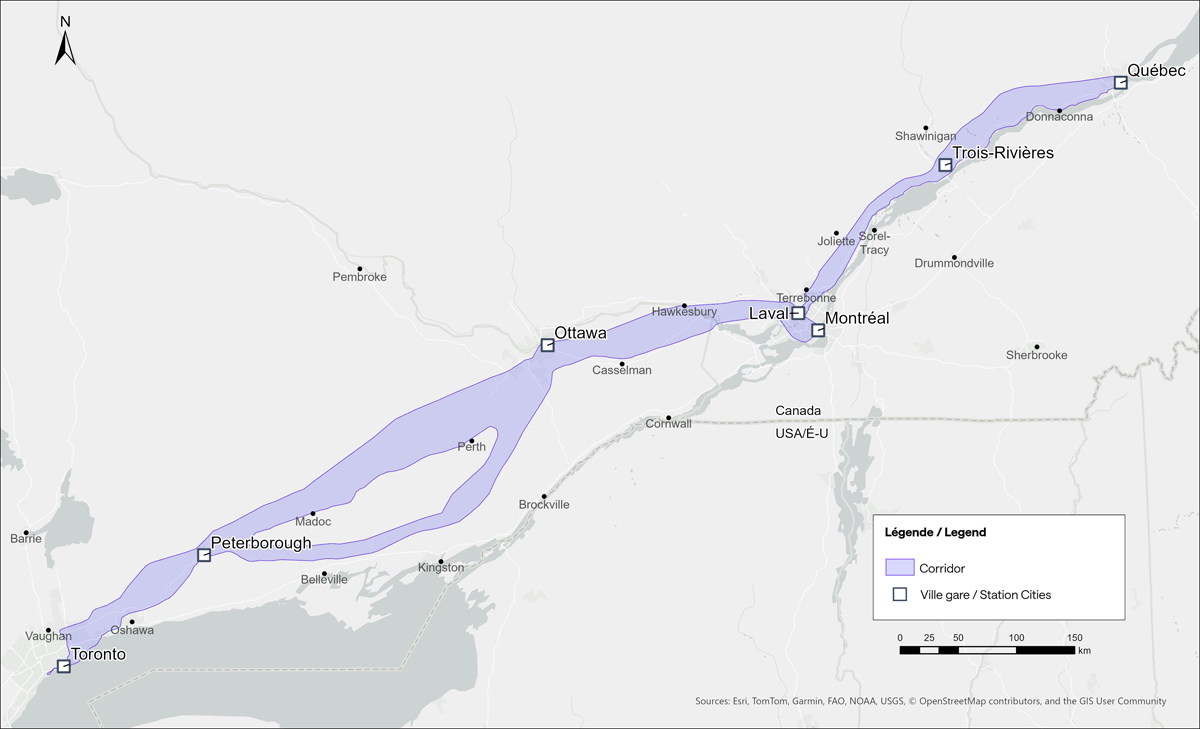
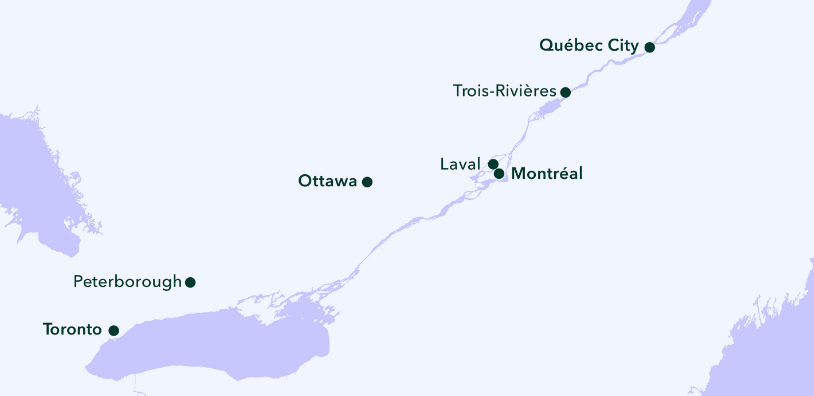
GATINEAU, Quebec — The first segment of Canada’s planned high-speed rail line will be built between Montreal and Ottawa, Transport Minister Steven MacKinnon announced today (Dec. 12).
Construction will begin within four years — half the time that had originally been projected, MacKinnon said during a morning news conference in Gatineau.
“This segment represents a unique opportunity to connect two provinces and quickly generate benefits for travelers, communities, and the economy,” MacKinnon said. He called the Montreal-Ottawa route “the most logical option” for beginning the project.
“It is a relatively short and straight portion of the overall route,” he said. “And you know, these high speed trains, they don’t like curves. … This provides an excellent opportunity for teams in both provinces to begin to develop together the expertise needed to deliver the other segments in both Ontario and in Quebec. And since this section is at the center of the future network, the other segments can be added.”
Beginning with the 200-kilometer (124-mile) center segment mirrors the approach of California’s high-speed project, which is building its first section in the state’s Central Valley, the flat midsection of the overall route, avoiding the tunnel-building and other construction challenges with mountain and urban sections.
Martin Imbleau, CEO of Alto, the crown corporation charged with developing the high speed route, said the Ottawa-Montreal segment “gives us a manageable distance to deliver it in a controlled, disciplined way. … start with a defined scope, sequence the work properly, validate assumptions early through structured analysis, and then apply the same rigor as the network expands with greater agility.”
While MacKinnon said the overall project would cost in “in the (Ca) $80 billion range,” he said no estimate had been made for what the first segment would cost. And Imbleau said it would be difficult to have a separate estimate “because we will use the first segment as a test case, and some of the components we buy, some of the contracts that we will give, and some of the items, including rolling stock, will be used for other [segments]. So it would be difficult and kind of absurd to have an independent budget.” The Ottawa-Montreal portion will represent about 25% of the overall project, he said, “but don’t do the rule of thumb” to draw a dollar figure from that.
Imbleau characterized the high-speed line as a “nation-building” project.
“And nation building means building with our own people, our own expertise, and our own supply chain,” he said. “… The project represents a generational investment in Canada’s future economy, one that we expect will contribute to an uplift of 1.1% in GDP.”
The Ottawa-Montreal segment will have to confront the lack of a clear route to downtown Montreal and the city’s Central Station, although the solution may simply be to go elsewhere. Imbleau said earlier this week that the high-speed route is not likely to serve Toronto Union Station, but would seek a station “in the vicinity of Union Station” that would be “economical” and “reliable.” And MacKinnon said today that it was “too early to tell” if trains would enter downtowns, or, as a questioner suggested, might serve suburban stations and rely on local or regional transit for the final portion of the trip.
The exact route for the project will be determined through a process including a three-month consultation beginning in January 2026, Transport Canada said in a press release. Consultation will include open houses, virtual sessions, and an online platform to give residents a chance to comment. Details on the consultation process are available at the Alto website.
Former Prime Minister Justin Trudeau announced plans for the high speed project, as well as Ca$3.9 billion in funding, earlier this year [see “Canadian government announces plans …,” Trains.com, Feb. 19, 2025]. The Cadence consortium signed a contract for development of the project in March [see “Cadence consortium signs …,” March 21, 2025]. The government has said the high-speed line will be among the projects addressed by a new Major Projects Office intended to fast-track major infrastructure work [see “Montreal’s container port ….,” Sept. 13, 2025].
— Updated at 10:58 a.m. CT, replacing earlier version with information from press conference. To report news or errors, contact trainsnewswire@firecrown.com.
Share this article