





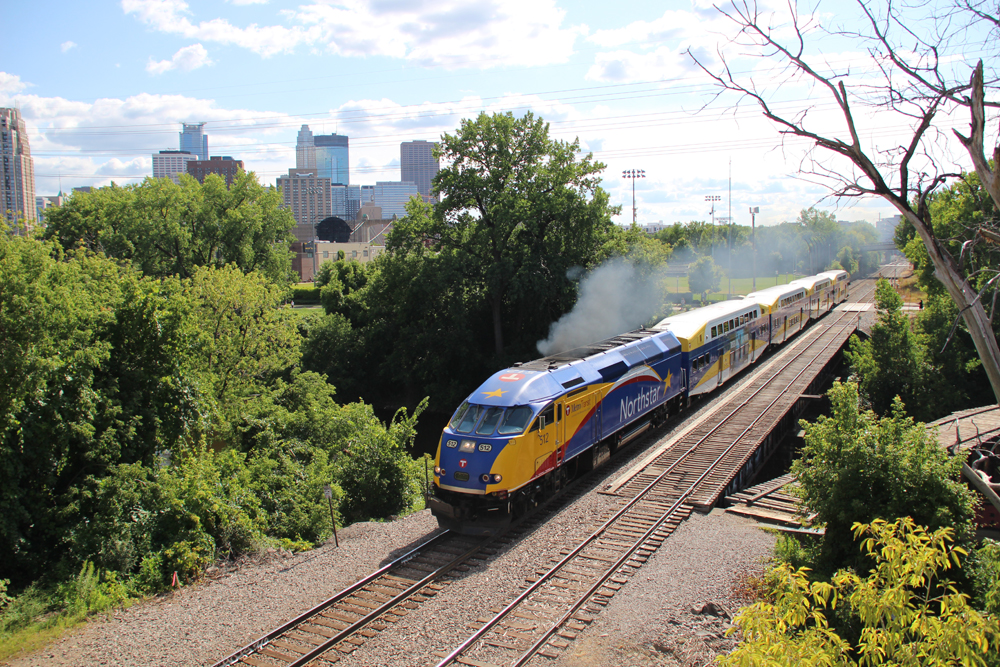
MINNEAPOLIS — Minnesota’s Northstar commuter rail line, launched in 2009 with service between Minneapolis and Big Lake, Minn., made its final run Sunday (Jan. 4), with a special-event round trip to the Minnesota Vikings’ season-ending home game against Green Bay.
The Metro Transit service was ultimately done in by low ridership along a shorter route than was originally envisioned. Once planned as a more than 80-mile line between Minneapolis and St. Cloud, Minn., it was cut back to 40.1 miles after the Federal Transit Administration declined to provide requested construction funding, determining the route would have insufficient ridership to qualify. The federal government did ultimately help fund the abbreviated route. Ridership never matched projections, peaking at just under 794,000 in 2017, plummeted during the COVID-19 pandemic, and never recovered. Through the third quarter of 2025, it was averaging about 400 riders a day, compared to pre-pandemic projections of 5,590 daily.
In announcing the decision to end service, Metro Transit officials said the subsidy for each rider was about $233; in 2023, it was $116.60, compared to $16.07 for bus service [see “Minneapolis to end Northstar …,” Trains.com, Aug. 7, 2025].
Beginning today (Monday, Jan. 5), the train will be replaced by two bus lines, one providing half-hourly service on weekdays during morning and evening rush hours, and another — a two-year pilot program — offering three weekend round trips between Big Lake, Elk River, and Minneapolis. Metro Transit says the switch will allow it to “better meet the needs of more riders, more often, at a lower cost” by replacing roughly 40 train trips per week with almost 400 weekly bus trips. More information is available here.
— To report news or errors, contact trainsnewswire@firecrown.com.

So true Mr. Spindler! This Fed policy is only an enabler to the caraholics due to the fact that it benefits Corp. & wealthy individuals despite the fact that it adds $10’s of billions to the deficit every year. The highways carry more people & freight due to the fact that the Govt has continued to build & expand them even though the HTF became insolvent in 2008 so they are now doing this with money they don’t have. The RR’s were handling freight & passengers efficiently even following WWII then the Govt was influenced to turn to highways & those industries that could profit both of them & the decline began. This also effected interurban lines & the then private transit industry. As a result transit needed to be publicly absorbed to preserve even basic service. I remember when LRT was first introduced in my area the R’s called it “social engineering” , HAH! like the the freeways weren’t the ultimate form of social engineering. People use to work, shop, dine & socialize in their own communities everything was within walking distance or a short streetcar ride. Now even more remote subdivisions continue to be built bringing their retail circus side show with them. Drivers now cover less than 50% of their drive the rest is siphoned from the Treasury from non user sources there is so much road mileage in this country today a user supported system as the hwys were suppose to be would be nearly impossible. So hwys will continue suckling the tit of the public taxpayer, drivers will cover less & less financial responsibility for their rides. Yet transit must toe the line cut costs, raise fares, cut salaries because they cost too much. Oh! Also you don’t use them! As for the Northstar service the MET Council didn’t have the knowledge or commitment to handle a heavy rail commuter system for the region their concern is only for communities west of Hennepin Co. They try to blame BNSF but I doubt they put much effort into restoring svc as one council member said ” now that the parallel Hwy 10 had been expanded they didn’t see the need for the train” that pretty well sums it up now millions of dollar of platforms & stations need to be demolished & an additional transit option to the connect the seven county area will become a footnote. Thanks a lot!!!
I believe one of the biggest issues with public transit in many cities is safety. It seems like light rail and buses have the biggest issues, less so for commuter rail.
We need to make transit and stations safe so that riders can use them without worrying about their safety. Criminals, especially repeat criminals, that have dozens of convictions and diversions need to be removed until they demonstrate that they are turning their lives around.
Looking at the math, the subsidy per rider is $233, does that mean $466 per daily round trip? Is it only daily O+M or does it include capital amortization?
Let this be a lessen to people who advocate for half-thought-through proposals like Charlotte’s possible commuter line, or Brightline West. The dollars just aren’t there.
Before the predictable comment’ what about freeway costs – freeways carry more people plus a whole lot of cargo. This train carried about a twelfth the number of people as a low-stress county highway out in farm country.
Eliminate free parking (including employer ptovided) and that changes the equation for all transit.
The FIRE Sector relies on automobiles, free highways and parking to build McMansion subdivisions, big box retail and office parks. Without that huge subsidy of 100 years of highway building and tax advantages these wasteful things wouldn’t exist.
GREGG – You’re living in a different world than I am.
How do you explain that transit ridership in this country has dropped like a stone? Was there more free parking in 2025 than there was decades earlier?
I’m this forum’s biggest transit advocate, not a transit opponent. For transit to survive, the following must happen.
(1) No more half-baked proposals.
(2) Costs must come down including pension costs.
(3) Make transit safe. We need to eliminate criminals from our streets and our buses and our trains. When a 125-pound woman or girl can walk any street in America at any hour without fear, we have enough criminals in jail Until then, we don’t.