Passenger Agency pursuing Milwaukee-Kenosha rail service holds first meeting

Agency pursuing Milwaukee-Kenosha rail service holds first meeting

By Trains Staff | December 8, 2025

MARK Commission to seek FRA Corridor ID program funds

Email Newsletter

Get the newest photos, videos, stories, and more from Trains.com brands. Sign-up for email today!

Map of rail route between Milwaukee, Kenosha, and Chicago
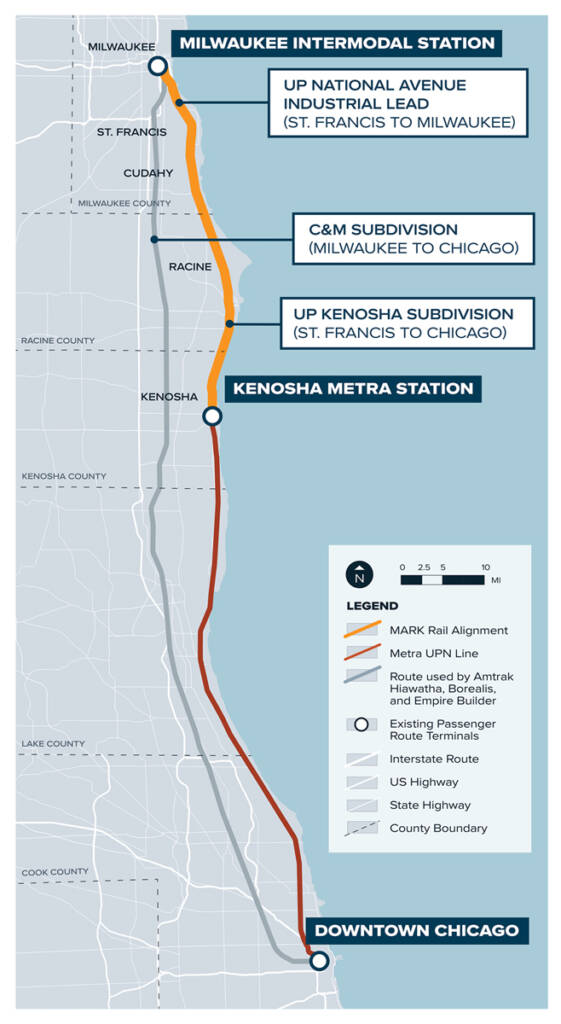
The route of the proposed Milwaukee Area-Racine-Kenosha rail corridor. MARK Rail

RACINE, Wis. — A new agency leading a revived and revised effort to develop passenger rail service between Kenosha, Wis., and Milwaukee has been launched. The Milwaukee Area-Racine-Kenosha (MARK) Passenger Rail Commission held its first meeting last week in Racine.

The commission met Dec. 5 at Racine City Hall, the Racine County Eye reports, adopting bylaws, selecting officers, and approving steps in the pursuit of federal funds.

The new agency aims to shift the effort to launch service from a commuter rail approach to an intercity rail model, with fewer stops and faster service, commission members said during their first meeting. The service would use Union Pacific’s Kenosha Subdivision for most of its 33-mile route.

Other items on the agenda for the first meeting included approval of a Memorandum of Understanding with Metra, which would provide a connection between Chicago and MARK’s southern terminus in Kenosha via Metra’s UP North line, and approving an application to the Federal Railroad Administration’s Corridor Identification and Development Program.

Efforts to develop the Kenosha-Milwaukee route date to 1998; the state legislature created the Southeastern Regional Transportation Authority to pursue the project in 2009, but that legislation was repealed in 2011. Various efforts to revive the project have surfaced since,  most recently a 2022 proposal for a nine-station commuter line along the same route [see “Long-stalled Kenosha-Milwaukee commuter rail proposal …,” Trains.com, Aug. 23, 2022].

More information is available at the MARK website.

9 thoughts on “Agency pursuing Milwaukee-Kenosha rail service holds first meeting

  1. I do not remember the route of the connecting track allowing CNW movement to the “Union” Sta. built by the Milw. Rd.
    Also, the map omits Racine, which may still have its old CNW depot.

    1. The former C&NW station in Racine is still standing and being used as a transit center for city buses.

      I am not aware of any connecting track to take trains from the north end of Union Station up to the C&NW tracks. The opportunity to build such a track has disappeared with the redevelopment of the Cassidy Tire building which stands on the west side of Canal just north of former MILW tracks as they curve sharply to the west. The former C&NW trackage this could have connected to was the tracks that served the former coach yard and Tribune printing plant. I believe this trackage was reached by switch runs from the North Avenue yard.

  2. I sat in the meeting with the KRM group in the early 2000s. Between Kenosha & St. Francis the only freight issue then was the coal trains headed for Oak Creek (expected to be multiple trains daily at the time) but otherwise UP was willingly. Now, I’d bet they won’t care UNLESS the UP-NS merger somehow adds additional traffic north St. Francis to Butler. Like new stack trains to Minneapolis/St. Paul or even Superior.

    It again boils down to who pays.

    1. I heard a UPRR rep say that the obstacles to double-stack trains on the Chicago-Milwaukee-Twin Cities line consist of a highway bridge in Dodge County that needs to be raised and low bridges from Forest Home Ave. eastward in Milwaukee toward Clement Ave. (just west of St. Francis interlocking.)

      The Dodge County bridge seems relatively straightforward and not too hard to solve. The Milwaukee problem is proposed to be solved by lowering the tracks under the bridges. Raising the bridges would highly problematic due to having raise surrounding roads to match the new level. (as I best recall, the tracks need to be lowered by several feet). Last I heard the DNR is involved now due to nearby waterways and as far as I know no work has been done yet.

      Perhaps TRAINS could look into this whole thing and give us some up-to-date information from the best sources they can find.

  3. Waiting to see Charles show up at the commission meetings shaking his stick yelling it won’t work and they know nothing.

    1. I’ll see you at the meeting, Mark. Perhaps you can ask if rebranding “KRM” to “MARK” improved the line’s prospects.

      INCOMING TRAINS EDITOR —– If we have press releases from advocates, couldn’t we follow up with some background. Such as why KRM over the any years got nowhere and had no measurable support from any conceivable funding source.

      Mark, you ask if I think these people know anything. I read the article without finding a single name of the commission members. Who are they and who do they speak for? Who are they connected to that might get this project rolling?

      For example if Milwaukee Mayor Cavalier “Chevy” Johnson were a commission member, wouldn’t his name have appeared in the article? If I had to guess, it’s a bunch of relatively speaking nobodies talking to each other.

  4. Four words:

    (1) Cost
    (2) Ridership
    (3) Union
    (4) Pacific

    Assuming (which is four huge humungous assumptions) the rail proponents can make sense out of the first four words, something else comes to mind. How to get the trains from St. Francis into Milwaukee. Today’s UPRR in southern Milwaukee County isn’t the same railroad as CNW was in 1971 when the passenger trains last ran.

    Moral of the story: find three cities on a map, pick up a sharpie, draw a line connecting, and VOILA!!!, passenger trains. Haven’t we found out yet that middle schoolers can pick up a sharpie, but no one could make this work.

You must login to submit a comment